On this page
Electrostatics opens Class 12 physics and sets up current, circuits and magnetism. The whole chapter rests on five ideas.
Is Electrostatics in the JEE Main 2027 syllabus?
Yes. In the official Syllabus for JEE (Main) 2027 published on jeemain.nta.nic.in, Electrostatics is Physics Unit 11. It covers Coulomb's law and superposition, field and dipoles, Gauss's law for a long wire, an infinite sheet and a thin shell, potential and equipotentials, potential energy, and capacitors with and without dielectrics, including stored energy.
That unit maps onto two NCERT chapters in Class 12 Physics Part I: Chapter 1, Electric Charges and Fields, and Chapter 2, Electrostatic Potential and Capacitance. Read both before opening a question bank.
Neither the syllabus nor the JEE (Main) 2027 Information Bulletin gives a question count per chapter. What the bulletin does fix is the paper: physics has 20 multiple-choice questions and 5 numerical-value questions, each worth +4, with −1 for a wrong answer in both sections. Numerical answers are rounded to the nearest integer, so units matter.
Which ideas carry the chapter?
Coulomb's law and superposition. Forces and fields from several charges add as vectors.
Field. Force per unit charge; lines leave positive charge and end on negative charge or run off to infinity.
Potential. Work per unit charge, a scalar you add without angles. Field points towards falling potential.
Gauss's law. Flux through a closed surface equals enclosed charge divided by ε₀. It always holds, but gives E only when symmetry fixes the field's size wherever flux crosses the surface.
Capacitors. C = Q/V, the series and parallel rules, and energy U = ½CV².
If one feels shaky, the Fermi Concept Library has every concept in physics with its own lesson, so you can fix the gap before practising.
How do you solve the core problems?
Use k = 9 × 10⁹ N m² C⁻² and ε₀ = 8.85 × 10⁻¹² C² N⁻¹ m⁻².
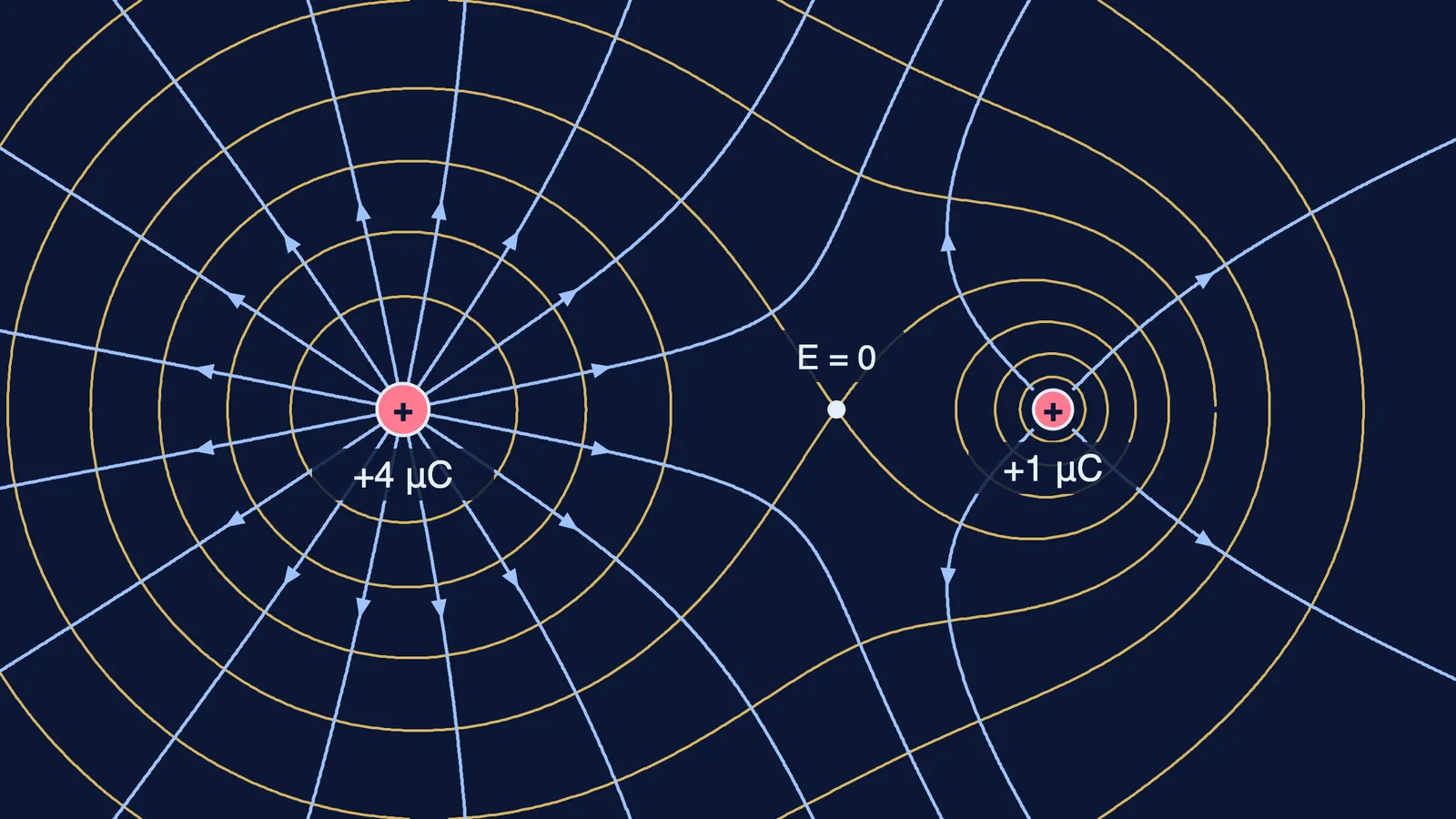
Problem 1: force, field and potential. Charges of +4 μC and +1 μC sit 0.30 m apart.
Force: F = kq₁q₂/r² = (9 × 10⁹)(4 × 10⁻⁶)(1 × 10⁻⁶)/(0.09) = 0.40 N, repulsive.
Where is the field zero? Between them, at distance x from the larger charge: 4/x² = 1/(0.30 − x)², so 2(0.30 − x) = x, giving x = 0.20 m.
Potential at that point: V = (9 × 10⁹)(4 × 10⁻⁶/0.20 + 1 × 10⁻⁶/0.10) = 2.7 × 10⁵ V.
The field is zero there; the potential is not. The diagram above shows this pair.
Problem 2: Gauss's law. A thin spherical shell of radius 0.10 m carries 5 nC.
Flux through any closed surface around it: Φ = Q/ε₀ = (5 × 10⁻⁹)/(8.85 × 10⁻¹²) ≈ 565 N m² C⁻¹.
Field at 0.05 m (inside): zero, because no charge is enclosed.
Field at 0.30 m: E = kQ/r² = (9 × 10⁹)(5 × 10⁻⁹)/(0.09) = 500 N C⁻¹.
Potential inside: constant, equal to kQ/R = 450 V.
For more Gauss practice, see the field of an infinite line charge using Gauss's law and the field between two infinite charged sheets.
Problem 3: a capacitor network. A 6 μF and a 3 μF capacitor in series are connected in parallel with a 4 μF capacitor across 12 V.
Series pair: 1/C = 1/6 + 1/3, so C = 2 μF. Total: 2 + 4 = 6 μF.
Series branch charge: 2 μF × 12 V = 24 μC. That gives 4 V across the 6 μF capacitor and 8 V across the 3 μF capacitor.
The 4 μF capacitor holds 48 μC at 12 V.
Energy: ½ × 6 μF × (12 V)² = 432 μJ. Check: 48 + 96 + 288 = 432 μJ.
If your method goes wrong in a step like this, the Fermi Problem Library has worked problems with a step-by-step solver that explains the reasoning rather than printing an answer.
What traps cost marks in Electrostatics?
Treating E = 0 as V = 0, or the reverse.
Adding potentials as vectors, or fields as scalars.
Using Gauss's law to find E where symmetry fails, such as a finite rod or a cube with an off-centre charge.
Dropping μ, n or p prefixes.
Mixing up the two dielectric cases. If the battery stays connected, V is fixed and Q and U rise by K. If it is disconnected, Q is fixed, so V and U fall by K.
How should you plan practice for this chapter?
Days 1–3: NCERT Chapter 1, then five superposition and null-point problems with your own numbers.
Days 4–5: Gauss's law for the wire, the sheet and the shell. Sketch E against r for each case.
Days 6–8: NCERT Chapter 2 on potential, equipotentials, and the energy of two charges and of a dipole in an external field.
Days 9–11: capacitor networks and dielectrics; check every total energy capacitor by capacitor.
Days 12–14: timed mixed sets. File each error under one of the five ideas, then redo them.
Keep the syllabus PDF open beside NCERT and tick off each line of Unit 11 as you finish it.