On this page
Two parallel charged sheets are the simplest model of a parallel-plate capacitor, a core part of Class 12 electrostatics. It is easy to remember σ/ε₀ between the plates without knowing why. Once you know why, you can handle unequal charges and like charges too.
What field does one infinite charged sheet make?
The NCERT Class 12 Physics chapter Electric Charges and Fields gives the field of an infinite thin plane sheet of uniform surface charge density σ as E = σ/2ε₀, along the normal, pointing outward on either side. Surface charge density σ is charge per unit area, measured in C m⁻², as the same chapter's table of quantities lists.
The field does not depend on how far you are from the sheet. OpenStax's University Physics, section 6.3 notes that this is an effect of assuming the plane is infinite, and that the result is still a useful approximation near the centre of a finite plane.
That gives you two rules for each sheet:
Magnitude σ/2ε₀, the same at every point on both sides.
Direction away from the sheet if σ is positive, towards it if σ is negative.
How do you add the fields from two sheets?
Two parallel sheets split space into three regions: left of both, between them, and right of both. Every point gets a contribution from both sheets, so you add the two contributions in each region separately.
Take the +x direction as pointing right. Call the left sheet's charge density σ₁ and the right sheet's σ₂, each with its sign. Then:
Left of both sheets: E = −(σ₁ + σ₂)/2ε₀
Between the sheets: E = (σ₁ − σ₂)/2ε₀
Right of both sheets: E = (σ₁ + σ₂)/2ε₀
A negative answer means the field points left. Put the signs in once and the table handles every case, so you never have to guess a direction.
What changes for like and unlike charges?
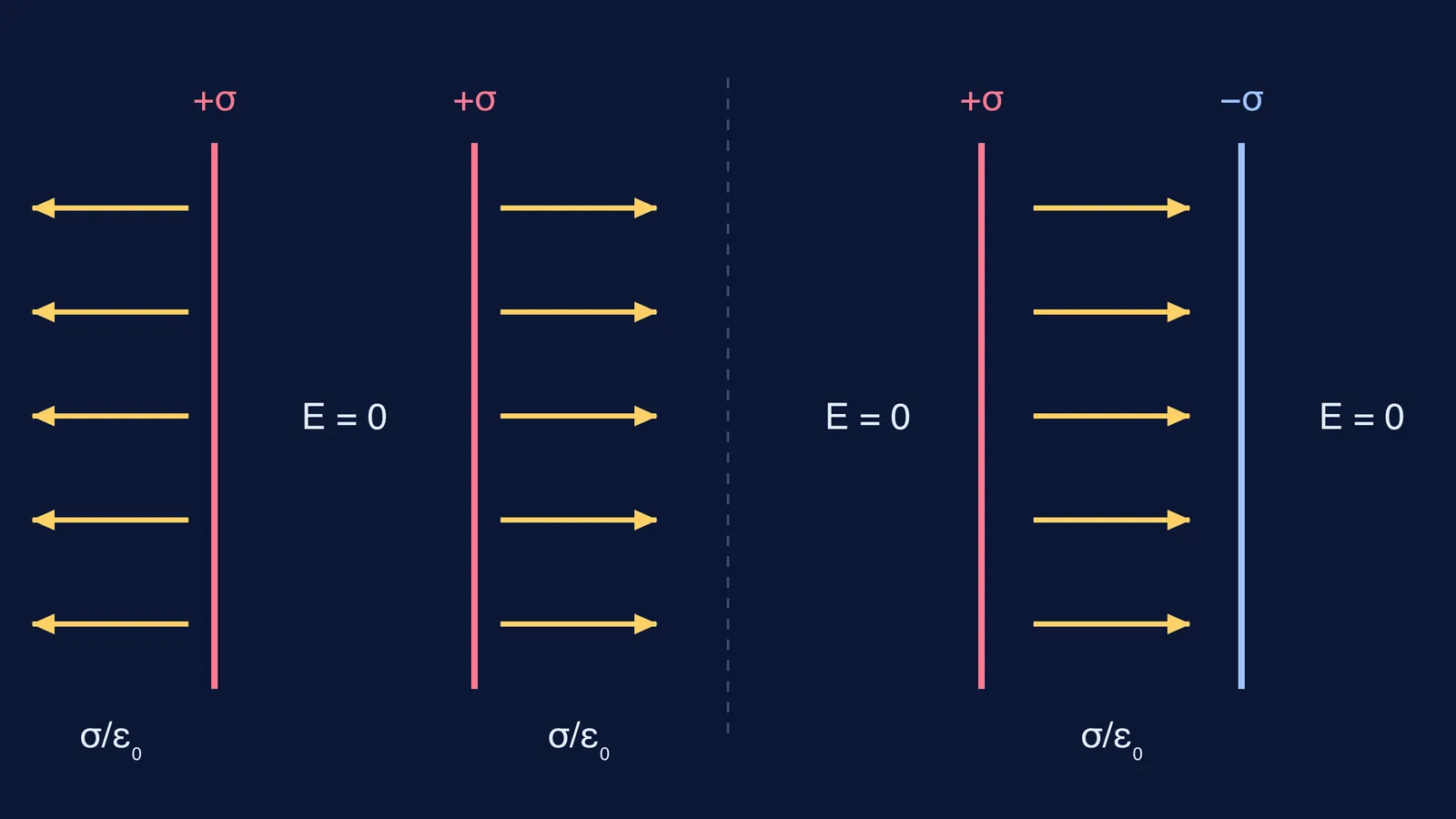
Put σ₁ = +σ and σ₂ = −σ in the table. Outside, the two fields cancel: −(σ − σ)/2ε₀ = 0. Between the sheets they add: (σ + σ)/2ε₀ = σ/ε₀, pointing from the positive sheet to the negative one. This is the parallel-plate capacitor field.
Now put σ₁ = σ₂ = +σ. Between the sheets, the fields cancel to zero. Outside, they add to σ/ε₀, pointing away from the pair on both sides. The hero diagram above shows both cases, with arrow length proportional to the field.
For charge spread through a thickness, see the field inside a charged thick slab.
Worked example: NCERT Exercise 1.23
Exercise 1.23 in the NCERT chapter describes two large, thin metal plates that are parallel and close to each other. Their inner faces carry surface charge densities of opposite sign and magnitude 17.0 × 10⁻²² C/m². It asks for E in the outer region of each plate and between the plates.
Model each charged face as an infinite sheet: σ₁ = +σ and σ₂ = −σ, with σ = 17.0 × 10⁻²² C/m².
Outer region of either plate: the table gives ±(σ − σ)/2ε₀ = 0.
Between the plates: (σ + σ)/2ε₀ = σ/ε₀.
Use ε₀ = 8.854 × 10⁻¹² C² N⁻¹ m⁻², the value given in the same chapter: E = (17.0 × 10⁻²²)/(8.854 × 10⁻¹²) ≈ 1.92 × 10⁻¹⁰ N/C, pointing from the positive plate to the negative one.
So the answers are zero, zero and about 1.92 × 10⁻¹⁰ N/C.
A harder check: unequal sheets
Now try σ₁ = +4.0 μC/m² on the left and σ₂ = −2.0 μC/m² on the right. One μC/m² divided by 2ε₀ is about 5.65 × 10⁴ N/C, using the value of ε₀ from the NCERT chapter, so:
Left of both: −(4.0 − 2.0) × 5.65 × 10⁴ ≈ −1.13 × 10⁵ N/C, pointing left.
Between: (4.0 + 2.0) × 5.65 × 10⁴ ≈ 3.39 × 10⁵ N/C, pointing right.
Right of both: (4.0 − 2.0) × 5.65 × 10⁴ ≈ 1.13 × 10⁵ N/C, pointing right.
The outside fields point away from the pair on both sides, as you would expect for a total charge of +2.0 μC/m². The quick check passes.
Where do students lose marks?
Using σ/ε₀ for a single sheet. That is the two-sheet answer between the plates, not the field of one sheet.
Dropping the sign of σ₂ before substituting. Keep it inside the brackets.
Assuming the field gets weaker further from the sheets. For infinite sheets it does not.
Forgetting the outside regions. Many questions ask for all three.
For more Gauss's law practice, see the field of an infinite line charge or the capacitor plate on a spring.
When a sheet question goes wrong and you cannot see which sign slipped, the Fermi Problem Library has worked problems with a step-by-step solver that explains the reasoning rather than printing an answer. If Gauss's law itself feels shaky, the Fermi Concept Library gives each concept its own lesson.