

On this page
A thick slab of charge is a classic JEE electrostatics setup because it tests whether you can choose a Gaussian surface yourself. Here is the result, the graph to sketch from memory, and one numerical where a common wrong answer is off by exactly 2.
What is the setup for a charged thick slab?
Take a non-conducting slab of thickness d that is very large in the other two directions, with charge spread evenly through its volume at density ρ (in C/m³). Put the x-axis perpendicular to the faces, with x = 0 on the central plane, so the faces sit at x = −d/2 and x = +d/2.
The slab behaves like a stack of thin parallel sheets, so the field can only point along x and can depend only on x. This symmetry argument and the results below match a Washington State University worked solution for an infinite slab of charge, which uses half-thickness a, so a = d/2.
By the same symmetry the field at x = 0 is zero: there is equal charge on both sides of the central plane.
How do you apply Gauss's law to the slab?
Use a box or cylinder (a "pillbox") with its two flat faces, each of area A, parallel to the slab and placed symmetrically at −x and +x. The OpenStax treatment of planar symmetry uses the same kind of box for a charged plane: only the two faces parallel to the charge carry flux, so the total flux is 2EA.
Point inside (|x| ≤ d/2). The box encloses a slice of thickness 2x, so the charge inside is ρ(2x)A. Gauss's law gives 2EA = ρ(2x)A/ε₀, so:
E inside = ρx/ε₀, pointing away from the central plane for positive ρ.
Point outside (|x| ≥ d/2). Now the box swallows the whole thickness, so the charge inside is ρdA. Then 2EA = ρdA/ε₀, so:
E outside = ρd/(2ε₀), the same at every distance from the slab.
The two answers agree at x = d/2: as the WSU solution notes, a volume charge puts no surface charge on the faces, so the field does not jump. As a check, squash the slab into a sheet with σ = ρd, and the standard sheet result E = σ/(2ε₀) gives exactly ρd/(2ε₀).
What does the E versus x graph look like?
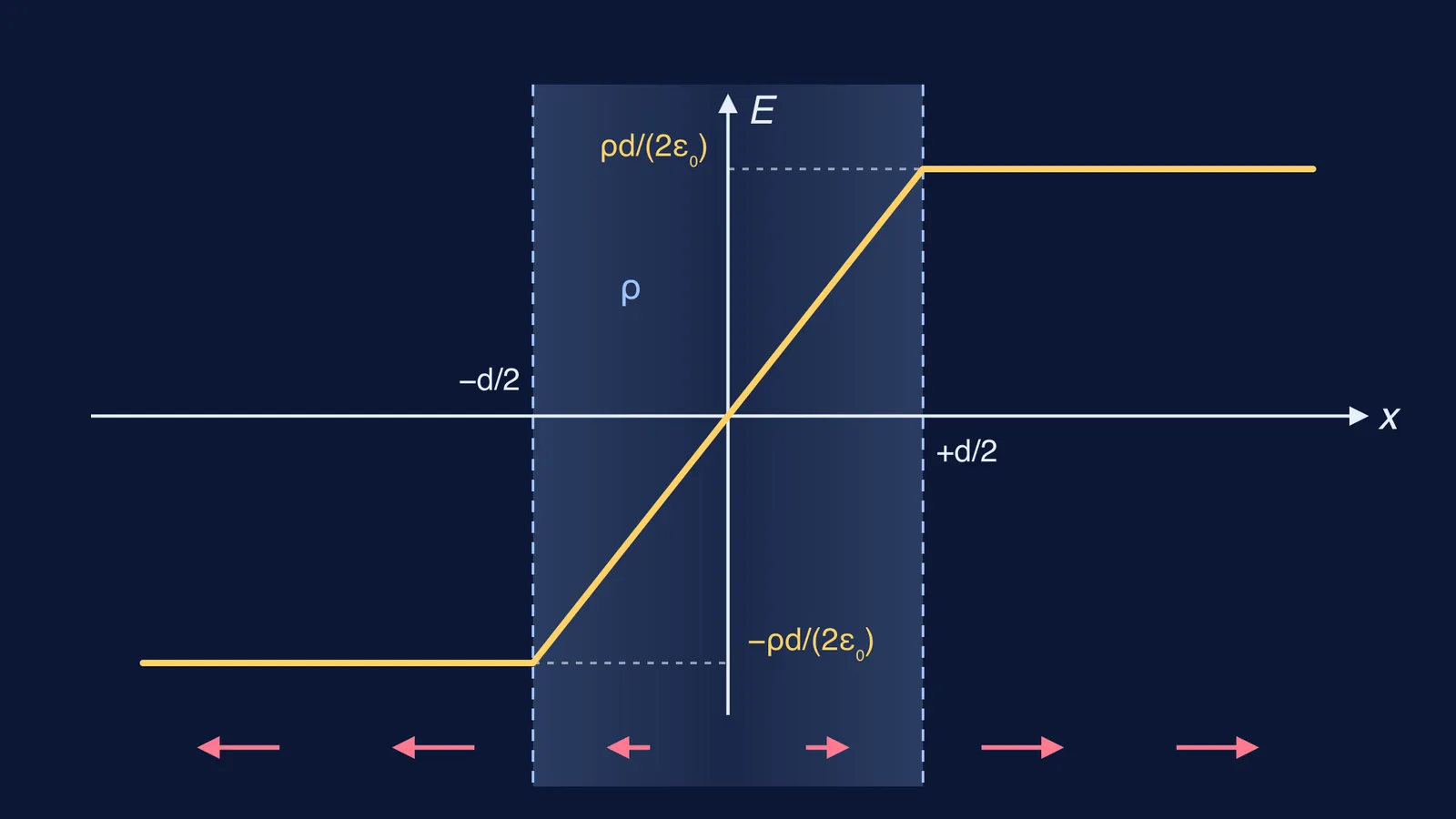
The graph of E against x has three straight pieces:
A flat line at −ρd/(2ε₀) for x < −d/2, where the field points left.
A straight line through the origin with slope ρ/ε₀ inside the slab.
A flat line at +ρd/(2ε₀) for x > d/2, where the field points right.
If you plot only the magnitude, the inside part becomes a V with its point at the centre. Unlike a sphere's field, the slab's field never falls off outside, because the slab is treated as infinite.
Where does the factor of 2 go wrong in slab numericals?
Try this. A non-conducting slab 4.0 cm thick carries a uniform charge density of 3.0 × 10⁻⁶ C/m³. Find E at a point 1.0 cm inside one face, and at a point 5.0 cm outside the slab.
Use ε₀ = 8.854 × 10⁻¹² F/m, the CODATA value published by NIST.
Fix the origin at the central plane. The faces are at ±2.0 cm.
A point 1.0 cm inside a face is 1.0 cm from the centre, so x = 0.010 m.
Inside: E = ρx/ε₀ = (3.0 × 10⁻⁶ × 0.010)/(8.854 × 10⁻¹²) ≈ 3.4 × 10³ N/C.
Outside: E = ρd/(2ε₀) = (3.0 × 10⁻⁶ × 0.040)/(2 × 8.854 × 10⁻¹²) ≈ 6.8 × 10³ N/C. The 5.0 cm is a distractor, because the outside field does not depend on distance.
Watch for three slips; the last two give exactly twice the right answer:
Measuring x from the face. Here the two happen to match, but at 0.5 cm inside a face, x is 1.5 cm. Convert to distance from the middle first.
Using d where d/2 belongs. Writing E outside = ρd/ε₀, or putting the full thickness into ρx/ε₀ at the face, gives about 1.4 × 10⁴ N/C.
Borrowing the conductor formula. E = σ/ε₀ is the field just outside a charged conductor, not a sheet or slab. Our post on conductor surface field versus sheet field explains why the two differ by 2.
How should you practise this?
Solve the slab, then change one thing at a time: a slab next to a charged sheet, or a charge density that varies with x, where the enclosed charge becomes an integral but the box and the 2EA stay the same. Our set of Gauss's law problems gives you more of these to try.
If you keep landing on the wrong factor and cannot see where, the Fermi Problem Library has worked problems with a step-by-step solver that explains the reasoning rather than printing an answer, so you can check each line against yours.


