On this page
Adding up Coulomb's law contributions from every piece of a long charged wire gives a messy integral. Gauss's law does it in a few lines, if you choose the right closed surface. Here is how to choose it, why each step is allowed, and a worked example with λ = 2 μC/m.
What does Gauss's law actually say?
Gauss's law states that the electric flux through any closed surface equals the charge enclosed divided by ε0, written Φ = q_enc/ε0 (OpenStax University Physics Volume 2, section 6.2). The same textbook points out that the Gaussian surface is a mathematical construct, not a real object: it can be any closed shape, but we pick highly symmetric ones because we have to integrate the flux over them.
The permittivity of free space is ε0 = 8.8541878188 × 10⁻¹² F/m, the CODATA 2022 value published by NIST.
How do you choose the Gaussian surface for a line charge?
Work through it in this order.
Use symmetry to find the direction of E. An infinite, uniform line looks the same if you rotate around it or slide along it. So the field can only point straight away from the axis (for positive λ), and its size can depend only on the distance r. OpenStax section 6.3 states that in every cylindrically symmetric case the field points perpendicularly away from the axis.
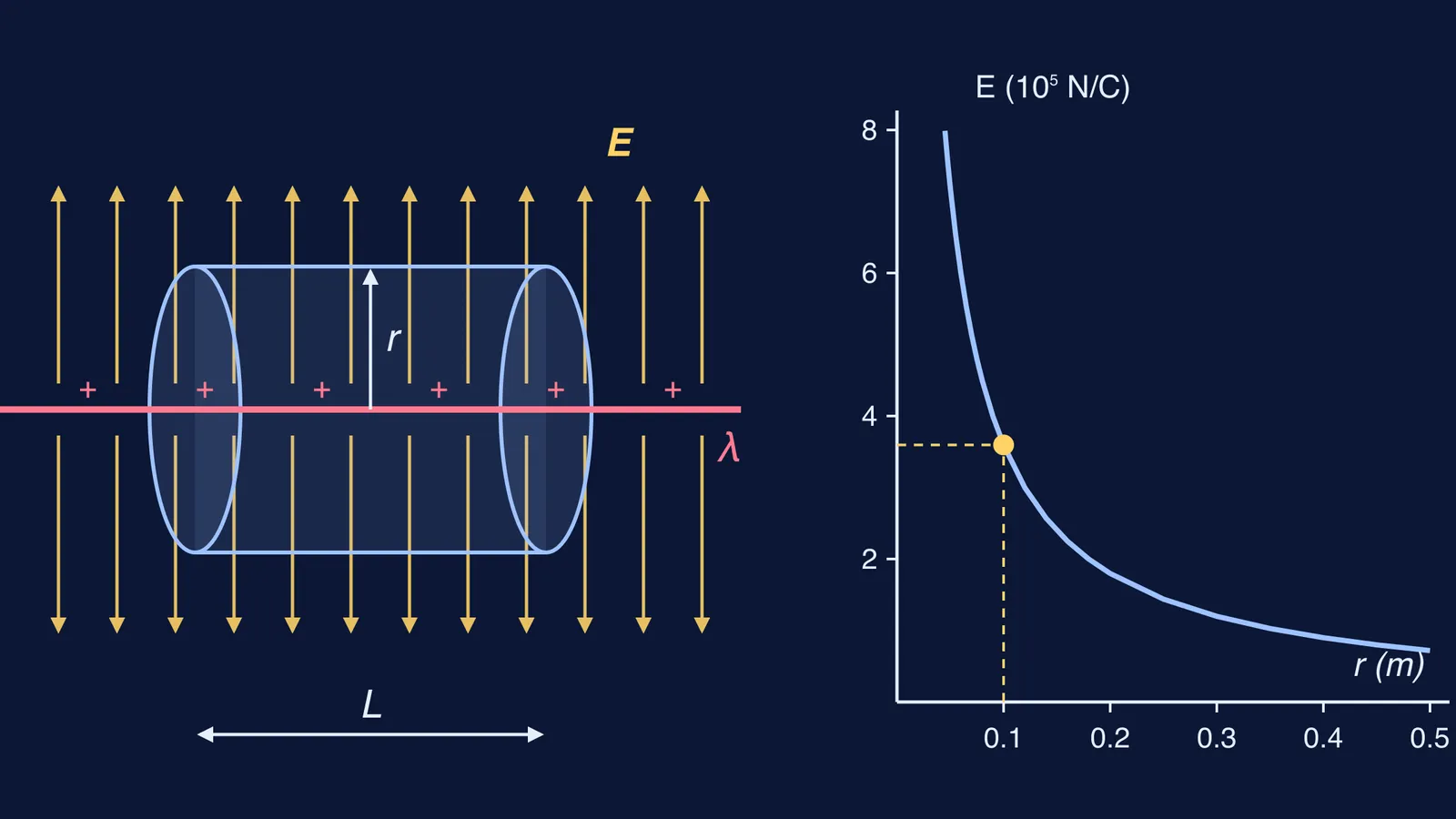
Pick a surface that matches that field. Draw a closed cylinder of radius r and length L with the line charge along its axis. On the curved side, E points straight out through the surface and has the same size everywhere, as HyperPhysics notes.
Handle the end caps. On the two flat ends, E lies along the surface, so E · n̂ = 0 and the flux through them is zero, as OpenStax shows.
Write the flux. Only the curved side counts: Φ = E × (2πrL).
Write the enclosed charge. The cylinder holds a length L of the line, so q_enc = λL.
Set them equal. E(2πrL) = λL/ε0, which gives E = λ/(2πε0r).
Notice that L cancels. That is your sign the choice was right: the field cannot depend on a length you invented.
What is the field 10 cm from a 2 μC/m line charge?
Take λ = 2 μC/m = 2 × 10⁻⁶ C/m and r = 10 cm = 0.10 m, with ε0 from NIST.
First, 2πε0 = 2π × 8.854 × 10⁻¹² ≈ 5.563 × 10⁻¹¹ C²/(N·m²).
Then E = λ/(2πε0r) = (2 × 10⁻⁶)/(5.563 × 10⁻¹¹ × 0.10) ≈ 3.6 × 10⁵ N/C.
Direction: radially outward from the line, because λ is positive.
Now check it from Gauss's law with L = 0.5 m:
Enclosed charge: q_enc = λL = 2 × 10⁻⁶ × 0.5 = 1.0 × 10⁻⁶ C.
Total flux: Φ = q_enc/ε0 ≈ 1.13 × 10⁵ N·m²/C.
Curved area: 2πrL = 2π × 0.10 × 0.5 ≈ 0.314 m².
Field: E = Φ/area ≈ 3.6 × 10⁵ N/C. Same answer, and it would be the same for any L.
The field falls as 1/r, not 1/r² as it does for a point charge. Double the distance to 20 cm and E halves to about 1.8 × 10⁵ N/C; halve it to 5 cm and E doubles to about 7.2 × 10⁵ N/C. A handy shortcut: since 1/(2πε0) = 2k ≈ 1.8 × 10¹⁰ N·m²/C², you can write E = 2kλ/r.
Where do students lose marks on this derivation?
Check these before you write the final line:
Adding flux through the end caps instead of showing that it is zero.
Using the charge of the whole wire instead of λL, the charge inside the cylinder.
Writing the area as πr² or 4πr² instead of 2πrL.
Confusing r, the distance from the axis, with a distance measured along the wire.
Forgetting that μC means 10⁻⁶ C.
Missing the direction: for negative λ, the field points in towards the line.
Using the formula near the end of a short wire. It rests on the symmetry of an infinite line, so it is a good approximation only close to a long wire, away from its ends.
How can you practise this until it sticks?
Redo the derivation tomorrow from a blank page, in the six steps above. Then change one thing at a time: a negative line charge, a long charged cylinder, a coaxial cable. The same cylinder works each time; only q_enc changes. If you go wrong, find which step broke.
For more Gauss's law questions, the Fermi Problem Library has worked problems with a step-by-step solver that explains the reasoning rather than printing an answer. If the symmetry argument is the shaky part, the Fermi Concept Library gives each concept its own lesson and shows its place in the map, so you can go back to electric flux before trying again.
Once you can explain why L cancels, you understand the method, not just the formula.