

On this page
Here is a classic JEE-style setup. One plate of a parallel-plate capacitor is fixed. The other hangs on a spring of constant k, and the gap is d₀ when the plates are uncharged. You put charge on the plates, the plates attract, and the gap shrinks. By how much?
First ask: is the charge fixed (an isolated capacitor), or is a battery holding the voltage fixed? The two cases behave very differently.
Why is the force on the plate Q²/2ε₀A?
OpenStax University Physics gives the capacitance of a parallel-plate capacitor as C = ε₀A/d and the stored energy as U = Q²/2C (capacitance, energy). Put them together and U = Q²d/(2ε₀A).
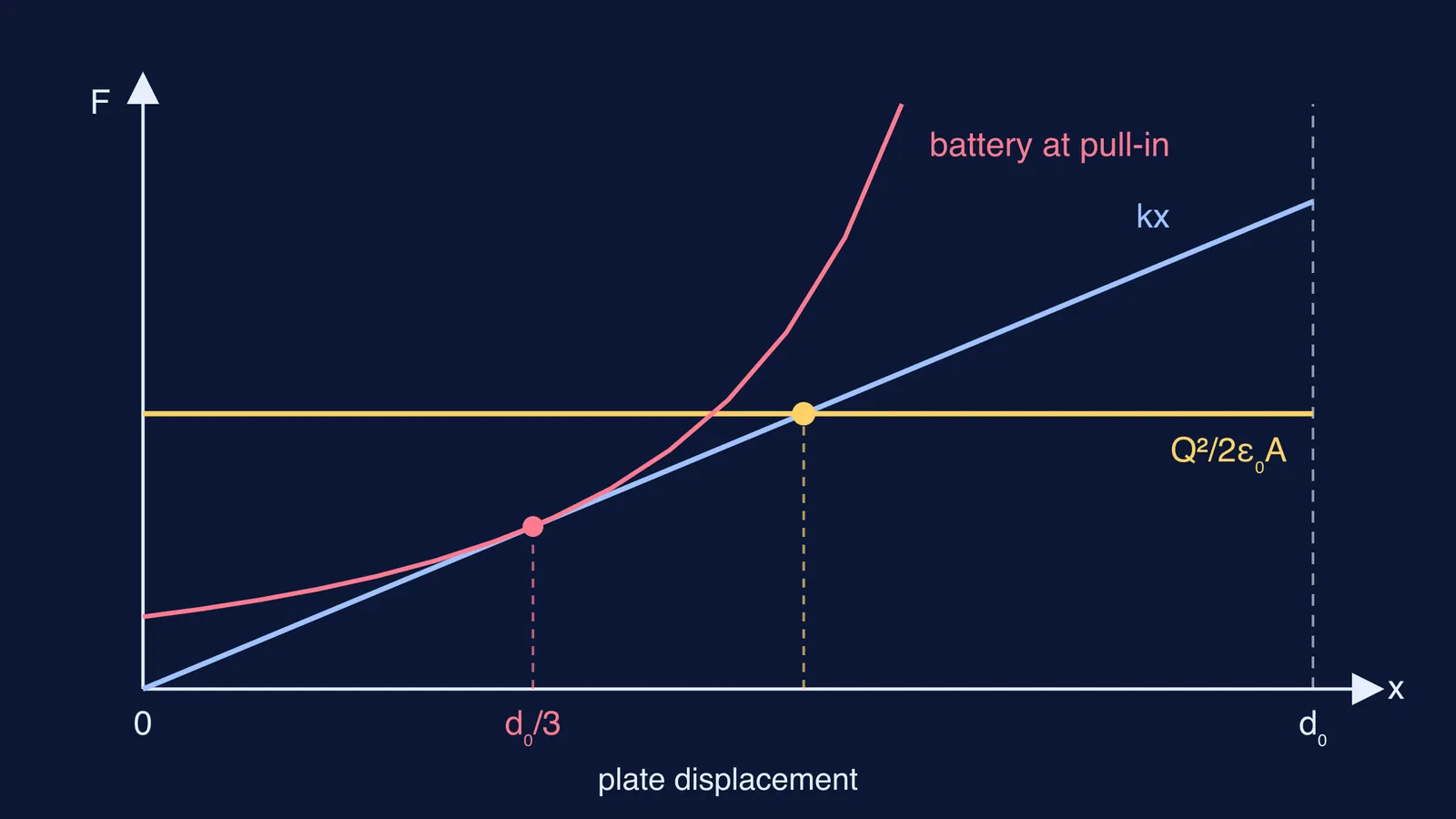
With Q fixed, widening the gap by a small Δd raises the energy by Q²Δd/(2ε₀A). That work must be done against the attraction, so the force between the plates is F = Q²/(2ε₀A). Notice what is missing: d. For a fixed charge, the pull is the same at every gap.
It is half of QE because each plate feels only the field of the other plate, not the total field between them. Our explainer on why the force between capacitor plates is Q²/2ε₀A, not QE walks through that factor of 2.
How do you find the new gap when a capacitor plate is on a spring?
Assume the spring is at its natural length when the gap is d₀, the plate moves along the line joining the plates, gravity is already balanced or acts sideways, and the plates are large enough to ignore edge effects.
Draw the forces on the movable plate: the electric pull towards the fixed plate and the spring pull back.
Let x be how far the plate moves in. The spring force is kx.
At equilibrium the two balance: kx = Q²/(2ε₀A).
So x = Q²/(2ε₀Ak), and the new gap is d = d₀ − Q²/(2ε₀Ak).
Check that x is less than d₀. If not, there is no equilibrium (more below).
Worked example: how far does the plate move?
Take plates of area A = 100 cm² = 0.01 m², an initial gap d₀ = 2.0 mm, a spring with k = 50 N/m and a charge Q = 0.10 µC = 1.0 × 10⁻⁷ C. The vacuum permittivity is ε₀ = 8.854 × 10⁻¹² F/m, the CODATA 2022 value published by NIST.
2ε₀A = 2 × 8.854 × 10⁻¹² × 0.01 = 1.771 × 10⁻¹³ F·m
F = (1.0 × 10⁻⁷)² ÷ 1.771 × 10⁻¹³ = 0.0565 N
x = 0.0565 ÷ 50 = 1.13 × 10⁻³ m = 1.13 mm
New gap = 2.00 − 1.13 = 0.87 mm
Sanity check: V = Qd/(ε₀A) falls from about 2260 V to about 983 V. Fixed charge, larger capacitance, lower voltage: the right direction.
When is there no stable equilibrium?
Fixed charge. If you nudge the plate closer, the spring pulls back harder while the electric pull stays the same, so the plate returns. The equilibrium is always stable. It fails to exist only when the required stretch reaches the gap: x ≥ d₀, which means Q ≥ √(2ε₀Akd₀). With the numbers above that limit is about 1.33 × 10⁻⁷ C, or 0.133 µC. Add more charge than that and the plates close.
Fixed voltage (battery connected). Now the pull is F = ε₀AV²/2(d₀ − x)², which grows as the gap closes. An equilibrium is stable only if the spring stiffens faster than the pull, that is k > dF/dx = ε₀AV²/(d₀ − x)³. Combine this with the balance condition and it reduces to x < d₀/3. Past that point the plate snaps shut. The largest voltage with any equilibrium is V = √(8kd₀³/27ε₀A), about 1160 V for the example spring and plates.
Engineers who build micro-actuators call this collapse pull-in. Legrand and colleagues describe one-third of the initial gap as the typical limit of stability for parallel-plate actuators operated in air, in Applied Physics Letters (2006). For the general idea of reading stability off how a restoring force changes, see our post on stable and unstable equilibrium from an energy curve.
What should you check before writing the final answer?
Fixed Q or fixed V? Re-read the question for words like isolated, disconnected or connected to a battery.
Did you use Q²/2ε₀A and not QE, which is twice as big?
Is x smaller than d₀?
If a battery is connected, is x smaller than d₀/3?
Is the plate released suddenly? Then check 2x against d₀ as well.
For practice with V held fixed, try the current that flows when capacitor plates are pulled apart with a battery connected. For more variations, the Fermi Problem Library has worked problems with a step-by-step solver that explains the reasoning rather than printing an answer. If the energy method itself is the gap, the Fermi Concept Library gives each physics concept its own lesson and its place in the map.


