

On this page
Most students first write F = QE, with E = σ/ε₀ = Q/(ε₀A), and get Q²/(ε₀A). The answer key says Q²/(2ε₀A). The factor of 2 comes from one idea about which field acts on a charge, and an energy argument confirms it.
Why is the force between capacitor plates not QE?
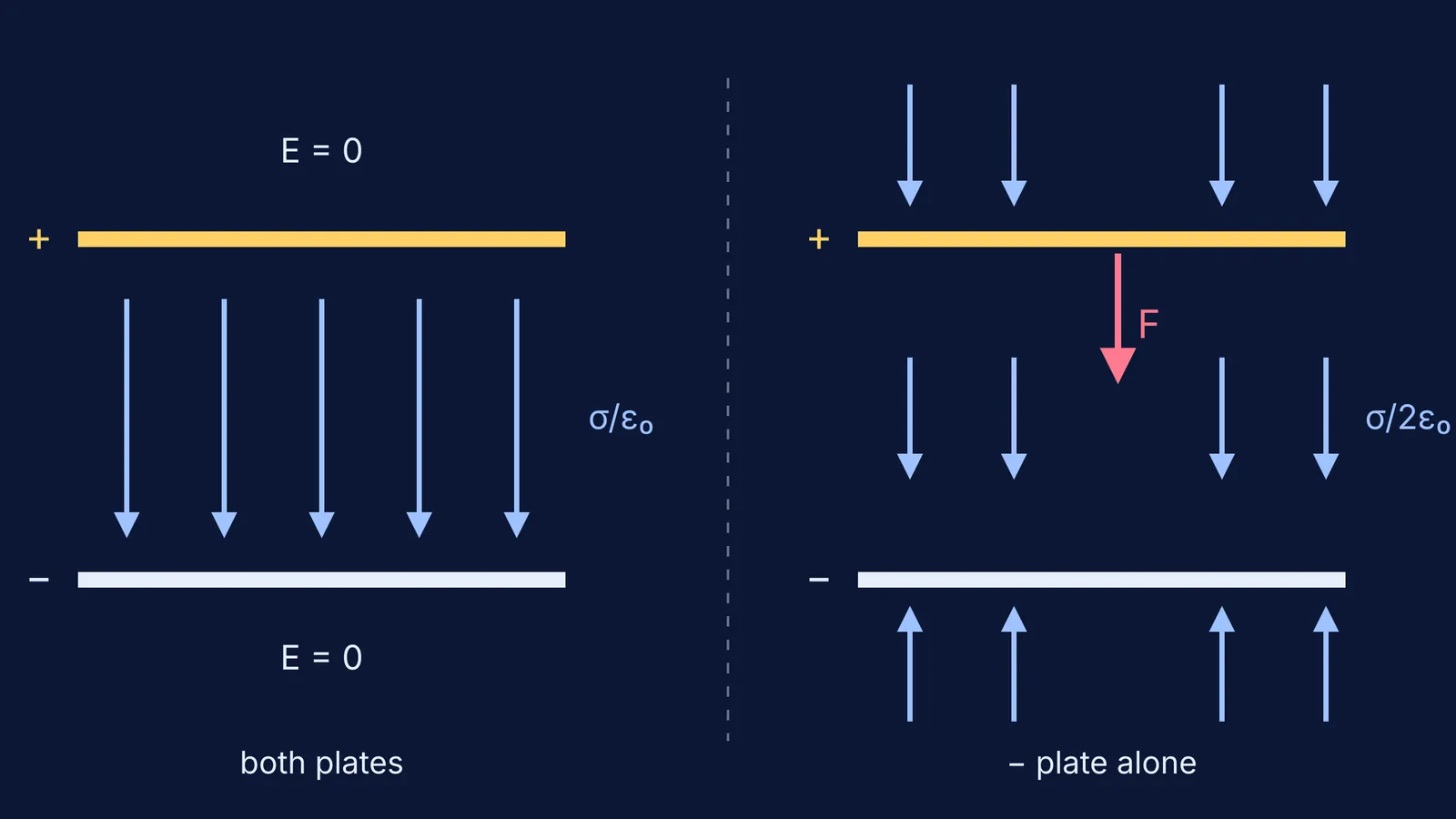
Start from how the field in a parallel-plate capacitor is built. In section 2.12 of the NCERT Class 12 Physics Part 1 chapter on capacitance, each plate is treated as a large sheet of charge with surface density σ = Q/A, and each sheet makes a field of magnitude σ/2ε₀ on both sides of itself. OpenStax University Physics derives the same σ/2ε₀ for an infinite plane using Gauss's law.
Between the plates the two contributions point the same way and add to σ/ε₀. Outside, they point opposite ways and cancel to zero. That is NCERT's equations 2.39 to 2.41.
Now ask what pushes the positive plate. A charge cannot push itself, so the positive plate's own σ/2ε₀ exerts no net force on it. Only the negative plate's field acts on it:
Field of the negative plate at the positive plate: E₋ = σ/2ε₀ = Q/(2ε₀A).
Force on the positive plate: F = Q × E₋ = Q²/(2ε₀A), directed towards the negative plate.
By Newton's third law the negative plate feels the same force, pulling the other way.
The σ/ε₀ in the gap is right for a test charge between the plates, but wrong for the plates themselves, because half of it is their own.
How does the energy method give the same force?
NCERT's equation 2.69 gives the energy stored in a capacitor as U = Q²/2C, and equation 2.43 gives C = ε₀A/d for parallel plates (NCERT chapter 2). Put them together:
U = Q²d/(2ε₀A)
Take an isolated capacitor, so Q cannot change. Pull the plates apart slowly by a small distance Δd. The work you do, FΔd, must equal the rise in stored energy, Q²Δd/(2ε₀A). Cancel Δd and you get F = Q²/(2ε₀A), the same as the one-plate argument, with no field reasoning at all.
A third view ties the two together. OpenStax gives the energy density of an electric field as u = ½ε₀E². Separating the plates creates a new slab of field of volume AΔd holding ½ε₀(σ/ε₀)² × AΔd, which again gives F = Q²/(2ε₀A). Force per unit area is σ²/2ε₀, the same electrostatic pressure that acts on any charged conductor, and it matches our worked guide to electric field energy density, u = ε₀E²/2.
Worked example: how strong is the pull?
NCERT's own example (equation 2.44) takes plates of area A = 1 m² a distance d = 1 mm apart, which gives C = 8.85 × 10⁻⁹ F (NCERT chapter 2). Charge it to 100 V, then disconnect the battery.
Charge: Q = CV = 8.85 × 10⁻⁹ × 100 = 8.85 × 10⁻⁷ C.
Force: F = Q²/(2ε₀A) = (8.85 × 10⁻⁷)² / (2 × 8.85 × 10⁻¹² × 1) ≈ 0.044 N.
Cross-check in terms of voltage: F = ε₀AV²/(2d²) = (8.85 × 10⁻¹² × 1 × 100²)/(2 × 10⁻⁶) ≈ 0.044 N.
The tempting wrong answer: E = V/d = 10⁵ V/m, so QE ≈ 0.089 N, exactly double.
That 0.044 N is about the weight of a 4.5 g coin, spread over a whole square metre. Pulling the plates further apart does not change it while Q stays fixed and the gap stays small compared with the plate size, because d has dropped out of Q²/(2ε₀A).
What changes if the battery stays connected?
Now V is fixed instead of Q. The formula F = Q²/(2ε₀A) still holds at every moment, but Q = CV = ε₀AV/d changes as you move the plates, so F = ε₀AV²/(2d²) and the force grows as the gap shrinks.
Differentiating U = ½CV² at constant V gives the right size but the wrong sign, because the battery also does work, V²ΔC, twice the change in stored energy. Include the battery, or just use F = Q²/(2ε₀A) with the current Q. More set-ups like this are in our capacitors and dielectrics problem guide.
A checklist for capacitor force problems
Whose field? Use only the other plate's field, σ/2ε₀, never the total σ/ε₀.
Isolated or connected? Isolated means Q is fixed; connected means V is fixed.
Energy method: at fixed Q, the size of the pull is F = dU/dd with U = Q²d/(2ε₀A); at fixed V, include the battery's work.
Sanity check: at fixed Q, your answer must not depend on d. If it does, you used the wrong field.
To practise spotting which field acts on which charge, the Fermi Problem Library has worked problems with a step-by-step solver that explains the reasoning rather than printing an answer.


