On this page
This JEE favourite tests three ideas at once: what stays constant, which way charge moves, and where energy goes. Here is the derivation, a worked example and an exam-hall check.
What stays constant when the battery is connected?
The battery holds the potential difference at V, so V is the constant, not the charge.
Capacitance is the ratio of stored charge to the voltage across the plates, C = Q/V, and for a parallel-plate capacitor C = ε₀A/d (OpenStax University Physics Vol. 2, section 8.1).
The permittivity of free space is ε₀ = 8.8541878188 × 10⁻¹² F/m (NIST CODATA value).
So the charge on the plates is Q = CV = ε₀AV/d. When d grows, Q must shrink.
How do you derive the current I = −ε₀AV(dd/dt)/d²?
Differentiate Q with respect to time, keeping ε₀, A and V fixed:
Start from Q = ε₀AV/d.
Write it as Q = ε₀AV · d⁻¹.
Differentiate: dQ/dt = ε₀AV · (−1/d²) · dd/dt.
So I = dQ/dt = −ε₀AV(dd/dt)/d².
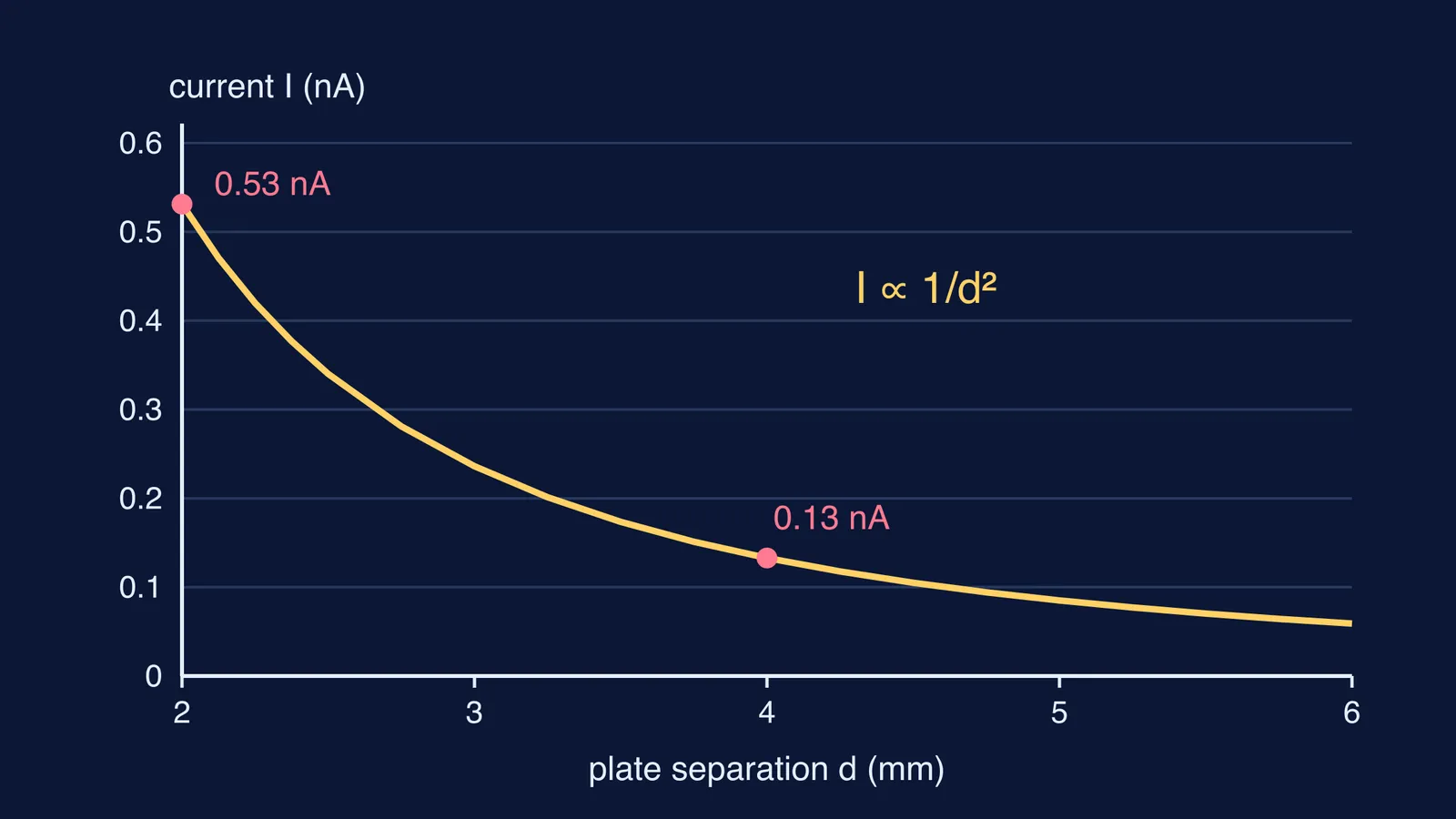
The minus sign is the physics. If you pull the plates apart, dd/dt is positive, so dQ/dt is negative: the charge on each plate is falling. The size of the current is ε₀AV(dd/dt)/d², so at a steady pulling speed it falls as 1/d². The current is largest at the start and fades as the gap widens.
Which way does the current flow?
Charge leaves the positive plate, travels through the wire and enters the battery at its positive terminal. That is the reverse of the charging current: the plates now hold more charge than the smaller C allows, so the extra goes back the way it came. Inside the battery, charge is pushed from + to −, against the EMF, so the battery is being charged.
Where does the energy go when you pull the plates apart?
Three things change, and they must balance. The energy stored in a capacitor is U = ½CV² (OpenStax, section 8.3), so with V fixed U = ε₀AV²/(2d), which falls as d grows.
Jeremy Tatum's treatment of this exact case on Physics LibreTexts/05:_Capacitors/5.15:__Changing_the_Distance_Between_the_Plates_of_a_Capacitor) gives the bookkeeping for a move from d₁ to d₂:
Charge returned to the battery: ε₀AV(1/d₁ − 1/d₂).
Energy needed to push that charge into the battery against its EMF: ε₀AV²(1/d₁ − 1/d₂).
Energy lost by the capacitor's field: ½ε₀AV²(1/d₁ − 1/d₂), exactly half of the above.
Work you do pulling: also ½ε₀AV²(1/d₁ − 1/d₂), the other half.
The same source gives the attractive force between the plates as ½QE = ε₀AV²/(2x²) at separation x. Note the ½: each plate feels the field of the other plate only, not the full field between them.
You can check the balance as power at any instant. The battery absorbs V|I| = ε₀AV²(dd/dt)/d². Your pulling supplies F(dd/dt) = ε₀AV²(dd/dt)/(2d²). The field gives up ε₀AV²(dd/dt)/(2d²). The last two add to the first.
Worked example: how big is the current?
Take plates of area A = 0.02 m² (10 cm × 20 cm), a 12 V battery, a starting gap of 2 mm, and pull at a steady 1 mm/s until the gap is 4 mm. Use ε₀ = 8.854 × 10⁻¹² F/m from the NIST value.
Current at d = 2 mm: I = ε₀AV(dd/dt)/d² = (8.854 × 10⁻¹² × 0.02 × 12 × 10⁻³) / (2 × 10⁻³)² ≈ 5.3 × 10⁻¹⁰ A, about 0.53 nA.
Current at d = 4 mm: the gap has doubled, so the current is a quarter, about 0.13 nA.
Charge returned to the battery: ε₀AV(1/d₁ − 1/d₂) = 2.125 × 10⁻¹² × 250 ≈ 5.3 × 10⁻¹⁰ C.
Energy into the battery: that charge times 12 V ≈ 6.4 × 10⁻⁹ J.
Field energy lost and work you did: about 3.2 × 10⁻⁹ J each, half and half.
The current is tiny, but the idea is not: moving a plate turns mechanical work into electrical energy.
Common mistakes to avoid
Using Q constant when the battery is still connected.
Dropping the minus sign and then getting the current direction wrong.
Using F = QE instead of ½QE for the force between plates.
Assuming the work you do goes into the capacitor. With a battery attached it goes into the battery.
Related reading: what the capacitance of a parallel plate capacitor depends on, capacitance with a metal slab inserted, and where the lost energy goes when two capacitors are connected.
To practise battery-on and battery-off versions side by side, the Fermi Problem Library has worked problems with a step-by-step solver that explains the reasoning rather than printing an answer. If the sign of the current still feels slippery, the Fermi Concept Library gives each idea in electrostatics its own lesson.