On this page
Slide a metal sheet between the plates of a capacitor and the capacitance goes up, as if the plates had moved closer together. The same reasoning also covers dielectric slabs and the battery questions, so it is worth learning once, properly.
What happens to capacitance when a metal slab is inserted?
For an empty parallel-plate capacitor, OpenStax University Physics, Volume 2 gives C = ε0A/d, where A is the plate area, d the separation and ε0 = 8.85 × 10^-12 F/m. The same text gives the field between the plates as E = σ/ε0 and the potential difference as V = Ed.
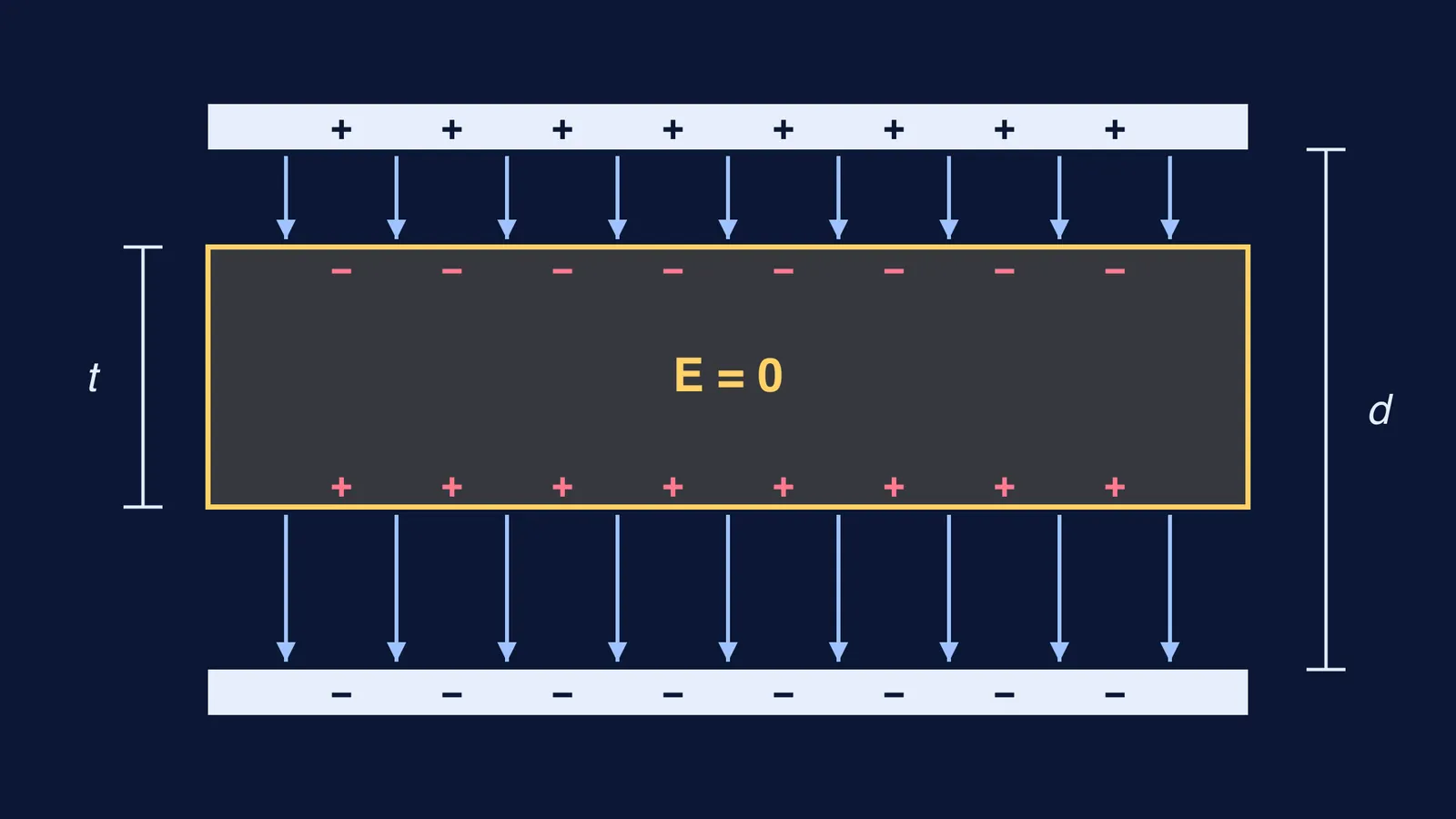
Put an uncharged conducting slab of thickness t (the same area as the plates) into the gap, parallel to the plates. The capacitance becomes C' = ε0A/(d − t). Since d − t is smaller than d, C' is larger than C: the metal acts as if it had removed thickness t from the gap.
Why does a conducting slab give C = ε0A/(d − t)?
The key fact: inside a conductor in electrostatic equilibrium, the electric field vanishes, because its free electrons move until it does. The derivation takes four lines.
Give the plates charges +Q and −Q, so the surface charge density is σ = Q/A.
Charge is induced on the slab: −Q on the face nearer the positive plate and +Q on the far face. The field in each air gap is still σ/ε0.
Inside the metal the field is zero, so the metal adds nothing to the voltage. The air gaps add up to d − t, so V = (σ/ε0)(d − t).
C' = Q/V = ε0A/(d − t).
You can also see it as two capacitors in series. If the top gap is x and the bottom gap is d − t − x, the series rule 1/C = 1/C1 + 1/C2 gives 1/C' = x/(ε0A) + (d − t − x)/(ε0A) = (d − t)/(ε0A). The x drops out.
Worked example: a metal slab filling half the gap
Take plates of area A = 0.02 m² (10 cm by 20 cm) and separation d = 2 mm, using ε0 = 8.85 × 10^-12 F/m from OpenStax.
Empty capacitor: ε0A = 1.77 × 10^-13 F·m, so C = 1.77 × 10^-13 / 0.002 = 8.85 × 10^-11 F, or 88.5 pF.
Insert a metal slab with t = 1 mm, half the gap. The air left is d − t = 1 mm.
C' = 1.77 × 10^-13 / 0.001 = 1.77 × 10^-10 F, or 177 pF.
The capacitance doubles. In general a metal slab multiplies C by d/(d − t), so a slab of thickness d/2 always gives a factor of 2.
How is a metal slab different from a dielectric slab?
A dielectric does not cancel the field; it weakens it. OpenStax defines the dielectric constant as κ = E0/E, so the field inside is E0/κ, and a dielectric filling the whole gap gives C = κC0.
For a slab of thickness t (writing K for κ), the voltage is E0(d − t) + E0t/K, which gives the formula used in this IIT Kanpur SATHEE problem: C' = ε0A/(d − t + t/K). A metal is the limit K → ∞: t/K shrinks to zero and you get back ε0A/(d − t).
Run the same half-gap capacitor through both:
Metal slab, t = 1 mm: effective gap 1 mm, C' = 177 pF (2 times C).
Dielectric with K = 2, t = 1 mm: effective gap 1 + 0.5 = 1.5 mm, C' = 118 pF (4/3 of C). A SATHEE question uses this case in reverse: a slab of thickness d/2 that makes C 4/3 times larger has K = 2.
Pyrex glass, t = 1 mm: OpenStax lists κ = 5.6 for Pyrex, so the effective gap is 1 + 1/5.6 ≈ 1.18 mm and C' ≈ 150 pF.
No dielectric slab of the same thickness can match the metal slab, because t/K is never zero for a real dielectric.
Does it matter if the battery stays connected?
The capacitance is the same either way; what changes is Q or V, linked by C = Q/V.
Battery connected: V is fixed, so Q = C'V rises. In the example the charge doubles.
Battery removed first: Q is fixed, so V = Q/C' falls. In the example the voltage halves, but the field in each gap stays σ/ε0, because σ has not changed. Only the length over which it acts gets shorter.
That last point is a common trap. Before any slab question, ask three things: is the slab a conductor or a dielectric, how thick is it, and is Q or V held fixed?
To practise this family of problems, the Fermi Problem Library has worked problems with a step-by-step solver that explains the reasoning rather than printing an answer. If a zero field inside a conductor still feels shaky, the Fermi Concept Library gives each concept its own lesson.