

On this page
The field of a charged thin spherical shell is a standard Gauss's law derivation in CBSE Class 12, and it turns up inside harder JEE problems. It rests on one idea: choose a Gaussian surface that matches the symmetry, and the integral becomes multiplication. Below is the version in the NCERT Class 12 Physics textbook, Chapter 1, Section 1.14.3, followed by a worked example and a checklist.
What is the electric field of a charged spherical shell?
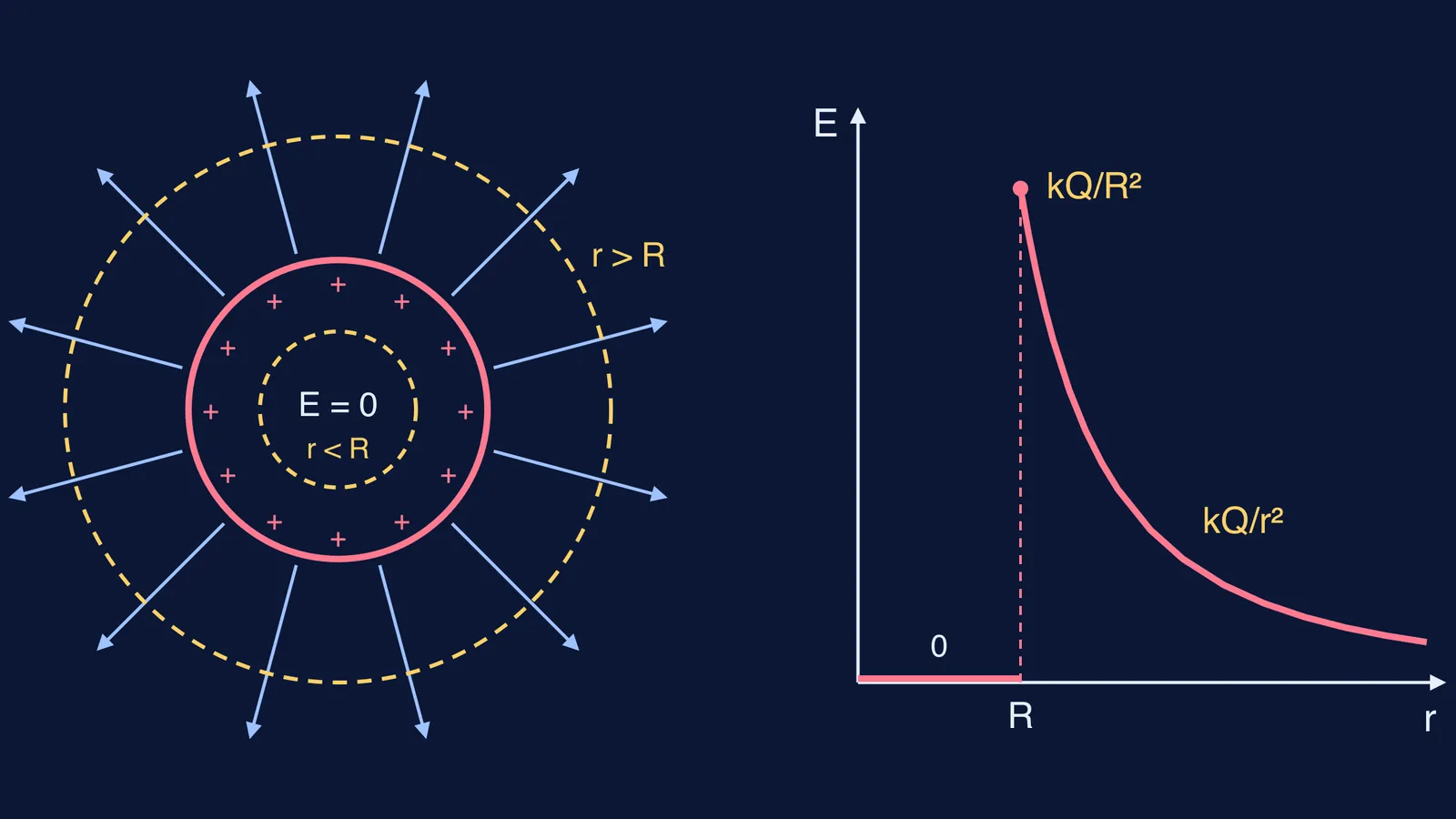
Take a thin shell of radius R carrying total charge Q, spread uniformly with surface charge density σ, so Q = 4πR²σ. The answer has two parts:
Outside the shell (r > R): E = Q/(4πε₀r²) = kQ/r², pointing radially outward if Q is positive and inward if Q is negative.
Inside the shell (r < R): E = 0 at every point.
NCERT states that for points outside, the field due to a uniformly charged shell is as if the entire charge of the shell were concentrated at its centre (NCERT, Section 1.14.3). The same textbook uses 1/4πε₀ = 8.987 × 10⁹ N m²/C², which rounds to k ≈ 9 × 10⁹ N m²/C² (NCERT, Example 1.3).
How do you derive the field outside the shell?
Write these steps in order.
State the symmetry. The charge looks the same from every direction about the centre O, so at any point P the field can depend only on r = OP and must point along the radius.
Choose the Gaussian surface. Draw a sphere of radius r > R, centred at O and passing through P.
Find the flux. On this sphere E has the same magnitude everywhere and is parallel to each area element, so the flux is E × 4πr².
Find the enclosed charge. The sphere encloses the whole shell: q = σ × 4πR² = Q.
Apply Gauss's law. E × 4πr² = Q/ε₀, so E = Q/(4πε₀r²) along r̂.
OpenStax University Physics Volume 2 makes the same symmetry argument for any spherically symmetric charge. In terms of σ, E = σR²/(ε₀r²), which becomes σ/ε₀ just outside the surface.
Why is the field inside the shell zero?
Now put P inside the shell and draw the Gaussian sphere through P, so r < R. The symmetry argument is unchanged, so the flux is still E × 4πr². But this sphere encloses no charge, because all the charge sits on the shell outside it. Gauss's law gives E × 4πr² = 0, so E = 0.
NCERT adds that experimental verification of this result confirms the 1/r² dependence in Coulomb's law (NCERT, Section 1.14.3). Note that "no charge inside" alone only gives zero total flux. It is the symmetry, with the same E at every point of the sphere, that turns zero flux into zero field.
The same closed-surface reasoning drives other problems, such as the flux through each face of a cube with a charge at its centre.
A worked example with numbers
A thin shell of radius 10 cm carries 2 nC. Find E at 5 cm, just outside 10 cm, 20 cm and 30 cm from the centre, using k = 9 × 10⁹ N m²/C².
kQ = 9 × 10⁹ × 2 × 10⁻⁹ = 18 N m²/C.
At 5 cm: the point is inside, so E = 0.
Just outside, at 10 cm: E = 18 / (0.10)² = 1800 N/C.
At 20 cm: E = 18 / (0.20)² = 450 N/C.
At 30 cm: E = 18 / (0.30)² = 200 N/C.
Check the inverse-square rule: doubling the distance from 10 cm to 20 cm cut the field to a quarter, from 1800 to 450 N/C. The field jumps from 0 to its largest value as you cross the shell. The outward push of a charged shell on itself is also why a charged soap bubble expands.
For more shell numericals, the Fermi Problem Library has worked problems with a step-by-step solver that explains the reasoning rather than printing an answer.
What should a complete derivation include?
Use this checklist:
A labelled diagram of the shell (R), point P and the dashed Gaussian sphere (r), for r > R and r < R.
One sentence on spherical symmetry: E depends only on r and is radial.
Flux written as E × 4πr², with the reason (E is constant and parallel to dS).
Enclosed charge for each case: Q outside, 0 inside.
The final results as vectors, with the direction for positive and negative Q.
Ampère's law uses a matching loop in the same way to find the magnetic field inside a toroid. If flux itself feels shaky, the Fermi Concept Library gives each physics concept its own lesson, so you can fill the gap first.


