

On this page
In competitive exams such as JEE Main, JEE Advanced, and NEET-UG, examiners often pose a classic conceptual puzzle: if a soap bubble is given an electric charge, does its radius increase, decrease, or remain unchanged? Many students wonder whether the charge polarity matters or if electric forces contract the film. The answer is straightforward: giving a soap bubble an electric charge always increases its radius. Whether you deposit positive charge or negative charge, mutual Coulomb repulsion between like charges drives an outward expansion across the conducting surface.
Why does a charged soap bubble expand regardless of charge sign?
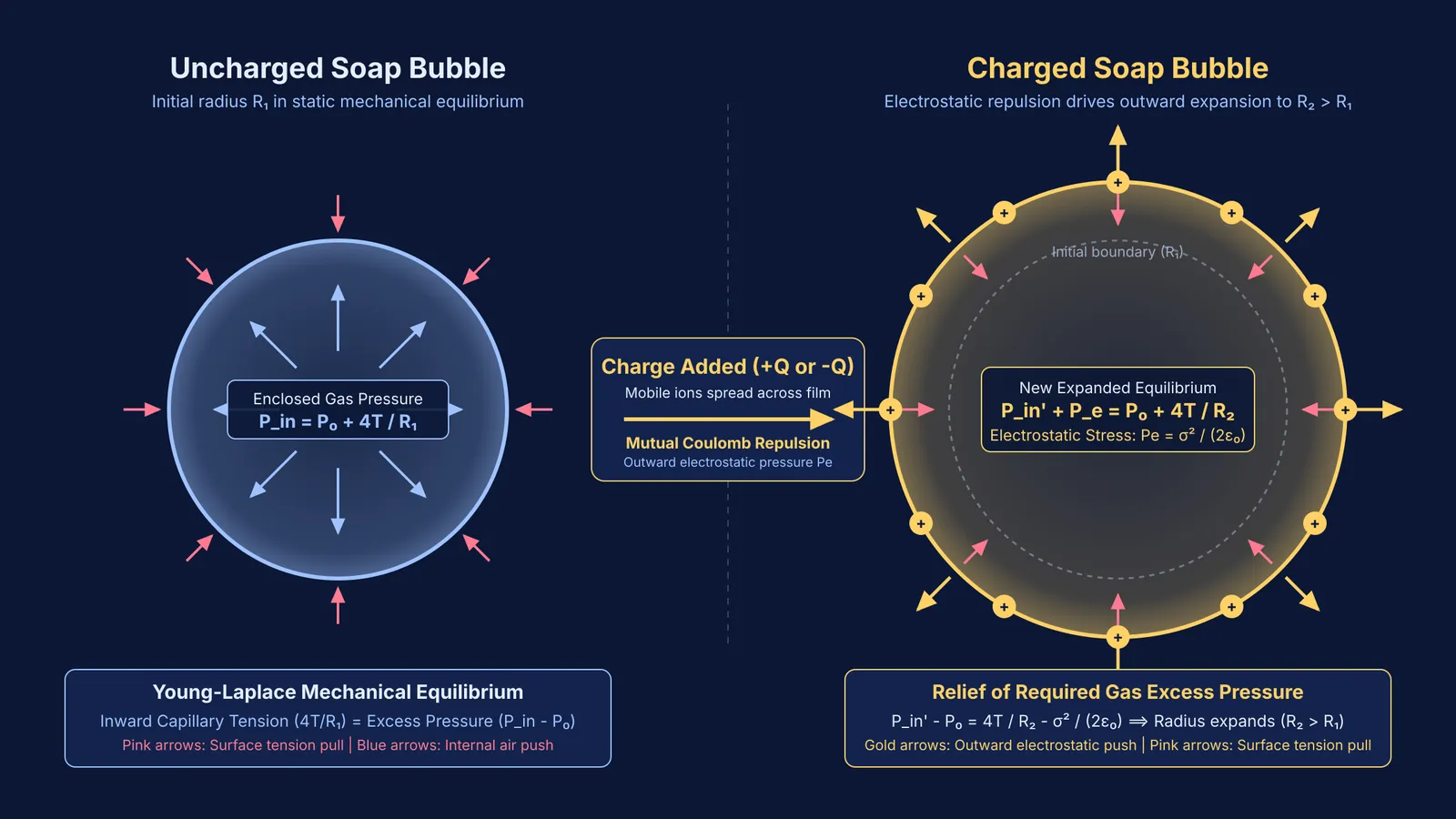
A soap bubble consists of a thin water film stabilized by surfactant molecules. Because dissolved ions move freely within the liquid layer, the soap film acts as an electrical conductor. When charge Q is placed on the bubble, mobile charges distribute across its outer and inner boundaries.
Like charges repel each other according to Coulomb's law. Every microscopic charge element dq on the surface repels every other charge element across the sphere. Due to spherical symmetry, tangential forces cancel, leaving an outward radial force normal to the surface everywhere.
In Introduction to Electrodynamics, David J. Griffiths derives the electrostatic pressure on a charged conductor:
P_e = σ² / (2ε₀) = (1/2) ε₀ E²
Here, σ is surface charge density, ε₀ is the permittivity of free space, and E is the surface electric field. Because charge density appears as a squared term (σ²), electrostatic pressure P_e is strictly positive whether the bubble carries positive charge (σ > 0) or negative charge (σ < 0). Adding electrons or removing them produces identical outward normal stress, sharing the microscopic origin analyzed in electric field at a conductor surface versus a charge sheet.
How does electrostatic pressure alter the soap bubble pressure balance?
To see why the radius grows, consider the mechanical forces acting on the film. An uncharged bubble has two liquid-air interfaces. As Gabriel Grant and Ananda Shastri verified in The Physics Teacher, inward capillary pressure from surface tension T at radius R equals ΔP = 4T / R.
Before charging, outward gas pressure (P_in) balances atmospheric pressure (P₀) plus surface tension:
P_in = P₀ + 4T / R
When charge is added, outward electrostatic pressure P_e assists the enclosed gas. Total outward force per unit area becomes P_in + P_e, while inward pressure remains P₀ + 4T / R. At that instant, outward pressure exceeds inward forces by P_e, driving the liquid film outward, as explored in connected soap bubbles and Laplace excess pressure.
At the new equilibrium:
P_in + P_e = P₀ + 4T / R
Rearranging gives the modified excess gas pressure:
P_in - P₀ = 4T / R - σ² / (2ε₀)
Electrostatic repulsion relieves the excess gas pressure needed to prevent the bubble from collapsing.
What is the formula for the radius expansion of a charged bubble?
For an isolated bubble with enclosed air expanding at constant temperature, Boyle's law gives P_in ∝ 1/R³. If the initial radius is R₁ and the new equilibrium radius is R₂ = R₁ + ΔR, expanding by ΔR << R₁ lowers internal pressure:
P_in(R₂) ≈ P_in(R₁) × (1 - 3 ΔR / R₁)
Because atmospheric pressure P₀ (1.013 × 10⁵ Pa) far exceeds surface tension pressure 4T / R₁ (roughly 6 Pa, as measured by Gabriel Grant and Ananda Shastri in The Physics Teacher), P_in(R₁) ≈ P₀. Substituting into the equilibrium condition yields the fractional expansion:
ΔR / R₁ ≈ P_e / (3 P₀) = σ² / (6 ε₀ P₀)
Since σ² > 0, ΔR is positive, confirming the bubble must expand.
Consider a bubble with initial radius R₁ = 2.0 cm (0.02 m) and surface tension T = 0.030 N/m. Charged to a potential of 3000 V, its surface electric field is E = V / R₁ = 1.5 × 10⁵ V/m. Using the electrostatic pressure formula verified in Introduction to Electrodynamics, P_e = (1/2) ε₀ E² ≈ 0.10 Pa. The mechanical expansion is ΔR ≈ (0.10 Pa × 0.02 m) / (3 × 1.013 × 10⁵ Pa) ≈ 6.6 × 10⁻⁹ m. Creating additional surface area requires work, as discussed in work done in blowing a soap bubble, paid for by the relaxation of electrostatic self-energy.
When solving multi-concept electrostatics problems, the Fermi Problem Library provides worked problems with a step-by-step solver that explains the reasoning rather than printing an answer.
When does electrostatic charge cause a soap bubble to burst?
If a bubble is open to the atmosphere through a tube, internal pressure equals atmospheric pressure (P_in = P₀). Equilibrium then requires surface tension to balance electrostatic pressure directly:
4T / R = σ² / (2ε₀) = Q² / (32 π² ε₀ R⁴)
This gives R³ = Q² / (128 π² ε₀ T). Here, adding charge Q increases the equilibrium radius to reduce charge density.
However, a film cannot expand indefinitely. In 1882, Lord Rayleigh demonstrated in Philosophical Magazine that charged liquid spheres have an electrohydrodynamic limit. When outward electrostatic repulsion overcomes surface tension, spherical stability fails, causing the bubble to burst or eject fine droplets.
For students connecting electrostatics and fluid statics, the Fermi Concept Library covers every concept in physics, chemistry, biology, mathematics and computing, each with its own lesson and its place in the map.


