

On this page
Whenever you stretch a liquid surface, you have to do work against the attractive forces between the liquid molecules. In physics, we measure this "stretching force" as surface tension.
Surface tension (T) is defined as the force per unit length required to break a surface film, or equivalently, the surface energy per unit area (HyperPhysics). This means the work done to create a new surface is directly proportional to the area of that surface. Surface tension acts to minimise surface area, so expanding it requires energy.
What is the work done in blowing a soap bubble?
When you blow a soap bubble, you are forcing air into a film of soap solution, causing its surface area to expand. This requires work. The general formula for the work done (W) in expanding a liquid film is the product of its surface tension (T) and the total increase in its surface area (ΔA):
W = T × ΔA
The crucial difference between a solid object (like a rubber balloon) and a liquid film is that the soap film is entirely composed of liquid molecules clinging together.
Why does a soap bubble have two surfaces?
If you observe a water drop, it is a solid sphere of liquid surrounded by air. It has exactly one free surface: the outer layer where the water meets the air.
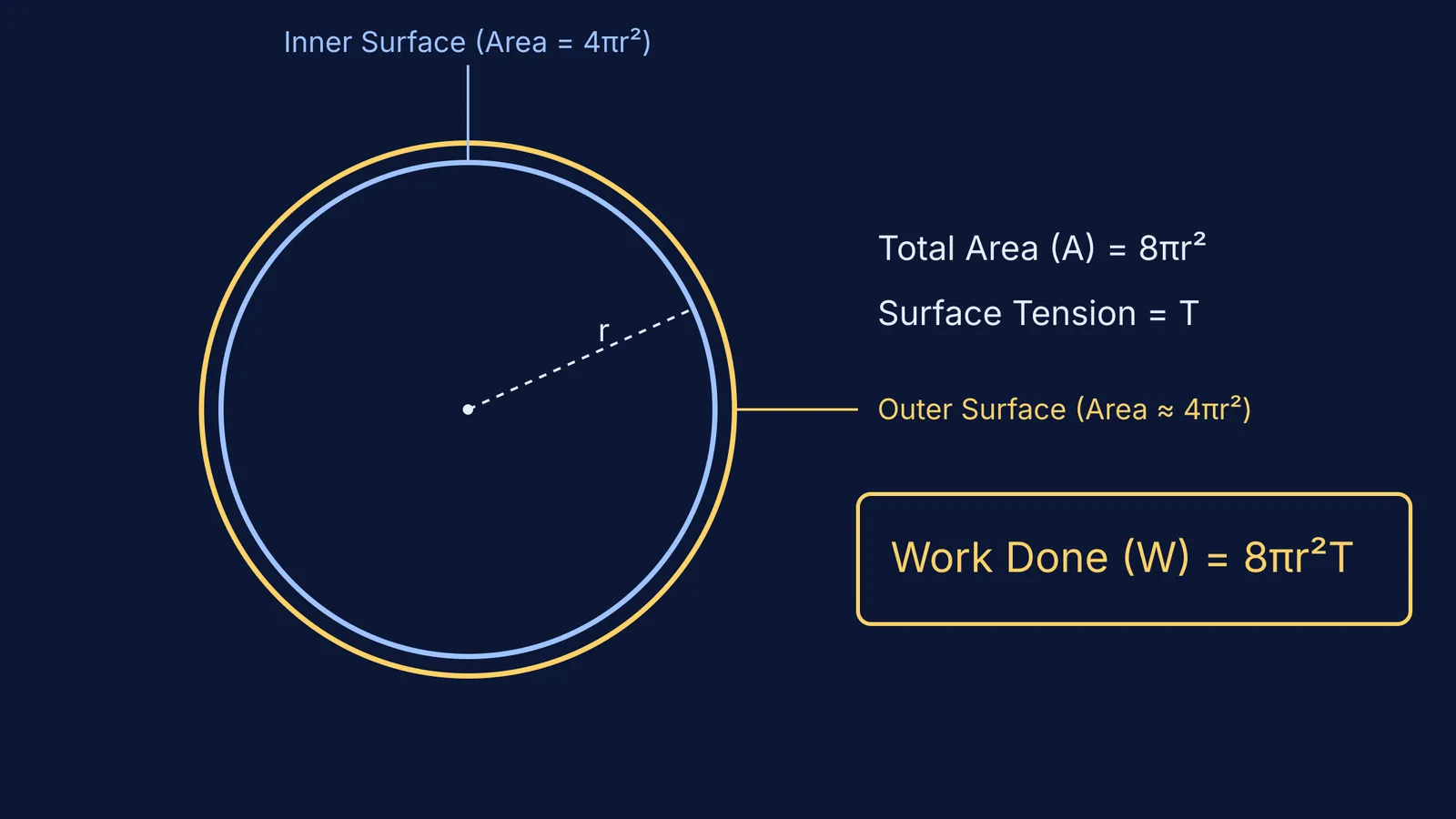
A soap bubble, however, is hollow. It consists of a very thin layer of soap solution trapping air inside it. This means the liquid film is in contact with air in two places:
The inner surface: where the soap film touches the trapped air inside the bubble.
The outer surface: where the soap film touches the surrounding atmosphere.
Because the film is extremely thin, the inner radius and outer radius are effectively the same (r). The surface area of a sphere is 4πr². Since there are two surfaces, the total surface area (A) is:
A = 2 × 4πr² = 8πr²
Formula for work done in blowing a soap bubble of radius r
If you start with a flat film of soap solution and blow it into a bubble of radius r, the initial surface area is practically zero.
Initial Area = 0
Final Area = 8πr²
Increase in Area (ΔA) = 8πr² − 0 = 8πr²
Multiplying the total increase in area by the surface tension gives the final formula:
W = 8πr²T
The work you do by blowing air into the bubble is not lost; it is stored as potential energy in the stretched surface of the film. This is why a bubble will naturally shrink and collapse if you stop blowing and leave the tube open—the stored surface energy is released as the surface tension pulls the film back to its minimum possible area.
Work done to increase the radius from r₁ to r₂
Exam questions frequently ask for the work required to expand an already existing bubble. If a bubble is enlarged from an initial radius r₁ to a larger radius r₂:
Initial Total Area = 8πr₁²
Final Total Area = 8πr₂²
Change in Area (ΔA) = 8π(r₂² − r₁²)
The work done to expand the bubble is therefore:
W = 8πT(r₂² − r₁²)
Worked example: calculating the work done
Let us calculate the energy required to blow a standard soap bubble.
Problem: Find the work done in blowing a soap bubble of radius 2 cm. The surface tension of the soap solution is 0.03 N/m.
Step 1: Convert all values to standard SI units. Radius (r) = 2 cm = 0.02 m. Surface tension (T) = 0.03 N/m.
Step 2: State the formula for a soap bubble. W = 8πr²T
Step 3: Substitute the values. W = 8 × 3.1416 × (0.02)² × 0.03 W = 8 × 3.1416 × 0.0004 × 0.03 W = 0.0003016 Joules (or 3.016 × 10⁻⁴ J).
If you are practising these calculations for competitive exams, it is easy to forget the factor of two and accidentally calculate the work done for a liquid drop instead. The Fermi Problem Library has worked problems with a step-by-step solver that explains the reasoning rather than printing an answer, ensuring you do not miss hidden multipliers. If you have concept gaps, you can turn to the Fermi Concept Library for its lesson on surface energy.
A checklist for exam problems on bubbles
Before you solve a numerical problem involving bubbles, check these three things:
Is it a drop or a bubble? Drops use 4πr²; bubbles use 8πr².
Are the units consistent? Surface tension is often given in CGS units (dynes/cm). Convert it to N/m, and ensure the radius is in metres to get your answer in Joules.
Are you forming or expanding? If forming from scratch, use W = 8πr²T. If expanding an existing bubble, use the difference in the squares of the radii: W = 8πT(r₂² − r₁²).
For more physics insights, see how electrostatic pressure on a charged conductor behaves similarly to pressure in a bubble, or read about the history of the bubble chamber detector.


