

On this page
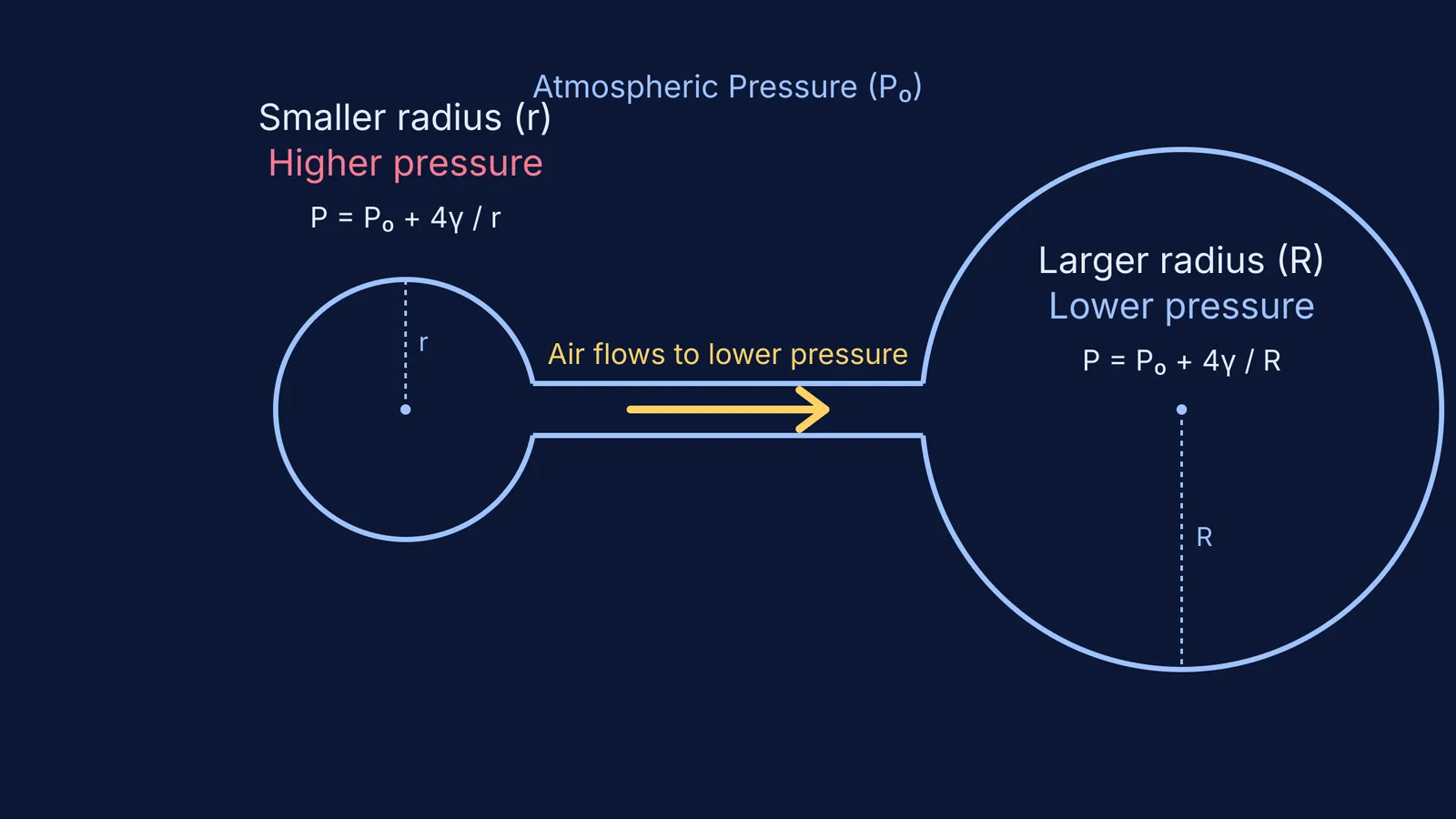
When two soap bubbles of unequal size are connected by a pipe, your intuition probably tells you they will equalise. You might expect air to flow from the larger bubble into the smaller one until they are the same size. But if you actually run the experiment, the opposite happens: the smaller bubble shrinks and the larger one grows.
This counter-intuitive result is governed by the physics of surface tension and pressure. It is a classic demonstration that frequently appears in physics exams to test whether a student will trust the mathematics over their everyday assumptions.
Why does the smaller bubble shrink?
To understand why this happens, we have to look at the pressure inside the bubbles. The pressure difference across the surface of a soap bubble is described by the Young-Laplace equation: P_{inside} - P_{outside} = 4γ/r, where γ is the surface tension of the soap solution and r is the radius of the bubble.
Because the radius r is in the denominator, the pressure difference is inversely proportional to the size of the bubble. A smaller bubble has a smaller radius, which means it has a higher internal pressure than a larger bubble.
When you open a valve connecting the two bubbles, you are connecting a region of high pressure (the small bubble) to a region of low pressure (the large bubble). Air naturally flows from high pressure to low pressure. As a result, the smaller bubble pushes its air into the larger one, causing the smaller bubble to shrink and the larger one to expand.
What is the final state?
The smaller bubble does not just shrink into nothingness and pop. As it loses air, its radius of curvature gets smaller, which means its internal pressure gets even higher, accelerating the flow of air.
However, once it shrinks down to the diameter of the connecting tube, it begins to flatten out across the tube's opening. As it flattens, its radius of curvature actually *increases* again, which lowers its pressure. The flow stops when the pressure in both spaces is equal. In the end, the smaller bubble becomes a spherical cap covering the end of the tube, and this cap will have the exact same radius of curvature as the final enlarged bubble.
If you are having trouble visualizing how pressure and surface tension interact, you can explore interactive models in the Fermi Simulation Lab.
Why does this trick us?
We are used to things balancing out. If you connect two tanks of water at different heights, they level off until the water levels are exactly equal. If you connect two hot objects, heat flows until they reach a middle temperature. In most everyday physical systems, the flow of matter or energy works to equalise the size or amount of the substance between the two containers.
But soap bubbles are different because the "skin" holding them together behaves differently. A rubber balloon is even more complicated: its elasticity changes as it stretches, meaning the pressure curve goes up, then down, then up again.
This is why this specific problem is a favourite in physics exams. It tests your ability to apply the formula ΔP = 4γ/r mathematically, rather than guessing based on how you feel the system should behave. For a complete breakdown of the Young-Laplace equation and other fluid mechanics principles, head to the Fermi Concept Library.
If you are reviewing for your exams, make sure you don't fall for other common traps in fluids and pressure. You can review Fluid mechanics: pressure, buoyancy and Bernoulli mistakes to avoid, or test your understanding of Pressure at depth and gauge pressure: hydrostatics problems. For another look at surface tension, read Electrostatic pressure on a charged conductor and soap bubbles.


