

On this page
Gauss's law is a fundamental principle in electromagnetism that relates the distribution of electric charge to the resulting electric field. A classic application of this law involves finding the electric flux through the faces of a cube when a point charge is placed inside it. This scenario frequently appears in physics exams because it tests a student's grasp of both mathematical rules and spatial symmetry.
What is the total flux through the cube?
Understanding this scenario requires a firm grasp of What is Gauss's law in electrostatics in Class 12?. According to Gauss's law, the total electric flux (Φ) through any closed surface—often called a Gaussian surface—is equal to the net charge enclosed (q_enc) divided by the permittivity of free space (ε₀).
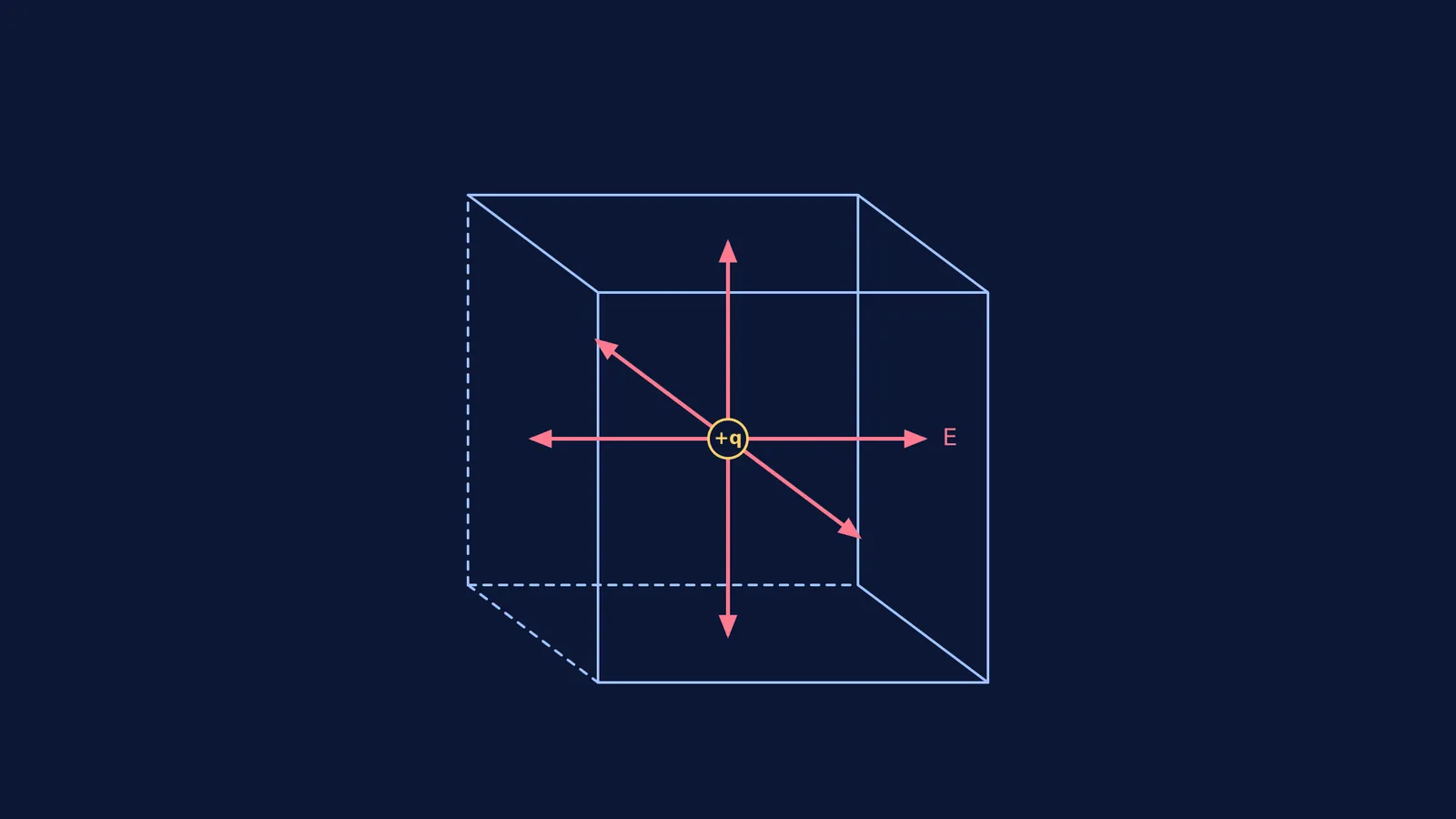
Electric flux can be visualised as the total number of electric field lines piercing outward through a surface. In this scenario, the cube itself acts as the closed Gaussian surface. Because the cube completely encloses the point charge q, the total electric flux passing through all six faces combined is exactly q/ε₀. It does not matter how large the cube is or where exactly the charge is located inside it; as long as the charge remains fully enclosed, the total outward flux remains q/ε₀.
What is the flux through each face when the charge is at the centre?
When the point charge is positioned exactly at the geometric centre of the cube, we can use the principle of symmetry to find the flux through a single face. Similar to finding the Electric field at centre of polygon with identical charges, exploiting geometric symmetry saves you from setting up complex integral calculations.
A cube has six identical square faces. Because the charge is exactly at the centre, its distance and orientation relative to each of the six faces are identical. The electric field lines radiate outwards uniformly in all directions from the central point charge. There is no physical reason for field lines to prefer one face over another. Consequently, the total electric flux is distributed evenly across the six faces.
To find the flux through just one face, you simply divide the total flux by six: Flux through one face = q / (6ε₀)
If you need to practise these symmetry applications, the Fermi Concept Library has every concept in physics, chemistry, biology, mathematics and computing, each with its own lesson and its place in the map.
What happens if the charge is moved from the centre?
If you shift the charge so that it is no longer at the centre of the cube, the symmetry is broken. The total electric flux through the entire cube remains q/ε₀ because the cube still encloses the exact same amount of net charge.
However, the flux is no longer shared equally among the faces. The faces that are closer to the charge will intercept a denser concentration of electric field lines, meaning the flux through those closer faces will increase. Conversely, the faces further away will see a decrease in flux. In these asymmetric cases, calculating the exact flux through a single face is significantly harder. You can no longer just divide by six; it requires a direct integration of the electric field over that specific face area.
How do you solve related problems?
Many exam problems test your ability to apply Gauss's law using imaginary Gaussian surfaces. The ability to spot symmetries is crucial for solving these without advanced calculus. Here is a reliable framework for approaching them:
Identify the enclosed charge: Determine the total net charge purely inside the volume. Charges outside the closed surface contribute zero net flux.
State the total flux: Write down Φ = q_enc / ε₀.
Look for symmetry: Check if the physical surface can be divided into identical segments relative to the charge location.
Divide appropriately: If symmetry holds exactly, divide the total flux by the number of segments to find the flux per segment.
Example: A point charge of +12 µC is placed at the centre of a hollow cube. What is the electric flux through one face?
Total flux: Φ = 12 µC / ε₀.
Symmetry: The charge is exactly central, so the six identical square faces share the flux equally.
Flux per face: (12 µC / ε₀) / 6 = 2 µC / ε₀.
By trusting the geometric symmetry and remembering the core rule of enclosed charge, you can answer these electrostatics questions quickly and accurately.


