On this page
Magnetism in JEE Advanced rarely tests one formula; it joins a field with energy, motion or a circuit.
JEE (Advanced) 2027, organised by IIT Delhi, is on 23 May 2027 (Sunday), per the official website. You need to be in the top 2,50,000 of the JEE (Main) 2027 B.E./B.Tech paper (eligibility).
What does the JEE Advanced syllabus include for magnetism?
The 2027 syllabus is not published yet, so follow the JEE (Advanced) 2026 syllabus, which says it is the same as 2025. Under Electricity and Magnetism it lists:
Biot–Savart's law and Ampere's law
Magnetic field near a current-carrying straight wire, along the axis of a circular coil and inside a long straight solenoid
Force on a moving charge and on a current-carrying wire in a uniform magnetic field
Magnetic moment of a current loop; effect of a uniform magnetic field on a current loop
Moving coil galvanometer, voltmeter, ammeter and their conversions
Magnetic materials are not listed; the dipole appears only as a current loop's moment.
How is JEE Advanced magnetism different from JEE Main?
The JEE (Main) 2027 syllabus also lists bar magnets, the field of a dipole, para-, dia- and ferromagnetic substances, and the force between parallel currents. The Advanced list names nothing Main leaves out; the gap is depth. The 2026 Information Brochure said the 2026 exam had two compulsory three-hour papers testing comprehension, reasoning and analytical ability, with the marking scheme given in the paper. Our JEE Main magnetism guide covers the base, and the guide to partial marking in multiple-correct questions explains why a careless extra tick costs you.
Worked example 1: two particles, one field strip
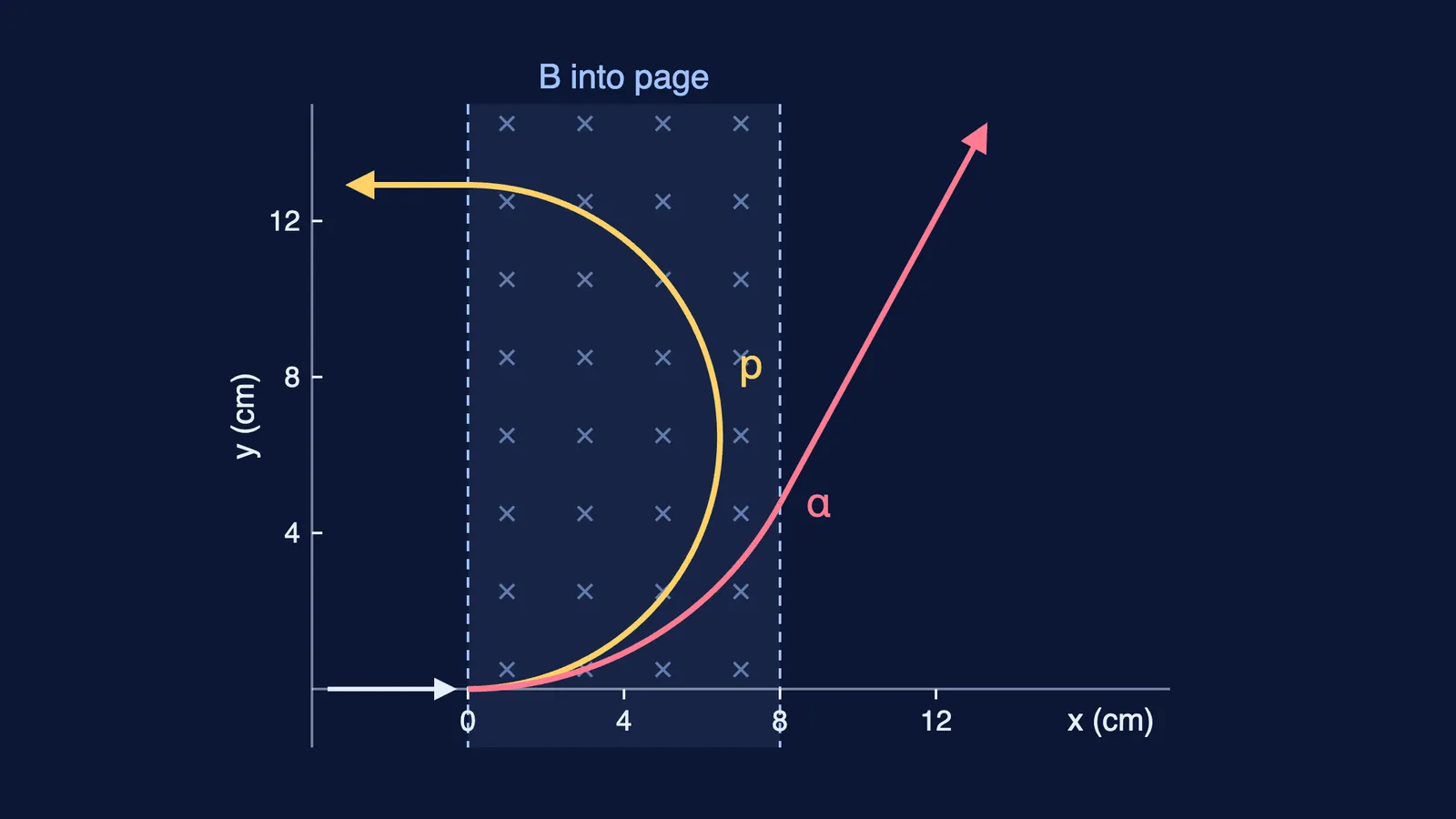
A proton and an alpha particle, each accelerated from rest through 2.0 kV, enter at right angles an 8.0 cm wide strip of uniform field B = 0.10 T, into the page. Take e = 1.602 × 10⁻¹⁹ C, masses 1.673 × 10⁻²⁷ kg (proton) and 6.645 × 10⁻²⁷ kg (alpha). Which are true? (A) Both gain the same kinetic energy. (B) The alpha's radius is about √2 times the proton's. (C) The proton comes back out of the side it entered. (D) The alpha leaves the far side, turned through about 61°.
Kinetic energy qV is 2.0 keV for the proton, 4.0 keV for the alpha (charge 2e). (A) is false.
r = mv/(qB) = √(2mV/q)/B. Proton: v = 6.19 × 10⁵ m/s, r = 6.46 cm. Alpha: r = 9.11 cm. Ratio 1.41, since m/q almost exactly doubles. (B) is true.
6.46 cm is less than 8.0 cm, so the proton makes a half circle and leaves the near side 12.9 cm above its entry point, after 3.28 × 10⁻⁷ s. (C) is true.
The alpha crosses: sin θ = 8.0/9.11, θ = 61.4°. (D) is true.
Answer: B, C, D. The magnetic force does no work, so speeds are unchanged.
Hard to picture? The Fermi Simulation Lab has interactive simulations for the ideas that are easier to see than to read.
Worked example 2: from coil to meter
A galvanometer coil has 50 turns of 2.0 cm × 2.5 cm in a radial field of 0.20 T. Torsion constant 2.5 × 10⁻⁷ N m/rad, full scale 1.0 rad, coil resistance 100 Ω. Make a 0–1 A ammeter and a 0–10 V voltmeter.
Radial field: torque NIAB at every angle, balanced by kθ: θ/I = NAB/k = (50 × 5.0 × 10⁻⁴ × 0.20)/(2.5 × 10⁻⁷) = 2.0 × 10⁴ rad/A.
Full-scale current: Ig = 1.0/(2.0 × 10⁴) = 50 μA.
Ammeter: shunt S = IgG/(I − Ig) = 5.0 × 10⁻³ Ω in parallel.
Voltmeter: series R = V/Ig − G = 2.0 × 10⁵ − 100 = 199,900 Ω.
Limit check: double B and full scale comes at 25 μA, a more sensitive meter.
How should you plan four weeks of practice?
Week 1: Biot–Savart for arcs and segments; Ampere's law for wire and solenoid. Direction before size.
Week 2: forces on charges and wires; circular and helical paths.
Week 3: magnetic moment and torque on a loop; galvanometer conversions.
Week 4: timed mixed sets.
Practice (our own; μ₀ = 4π × 10⁻⁷ T m/A):
A 40-turn coil of radius 3.0 cm carries 0.50 A. How far along its axis does the field fall to one-eighth of its value at the centre? Answer: √3 × 3.0 = 5.20 cm.
A loop of radius 2.0 cm carries 4.0 A in 0.30 T, its moment at 30° to the field. Work to turn it until the moment is opposite to B? Answer: mB(cos 30° + 1) = 2.81 × 10⁻³ J.
An electron at 2.0 × 10⁶ m/s moves at 30° to the axis inside a long solenoid (2000 turns per metre, 1.5 A). Find the pitch of its helix (mₑ = 9.109 × 10⁻³¹ kg). Answer: B = 3.77 × 10⁻³ T, pitch = 1.64 cm.
Tag each mistake as a wrong idea, wrong direction or arithmetic slip, and revise by type.