On this page
Board physics rewards stepwise answers an examiner can tick. This guide is for CBSE Class 12 students working from NCERT; for entrance preparation, see our Current Electricity guide for JEE Main.
How many marks is Current Electricity in the Class 12 board exam?
In the official CBSE Class XII Physics curriculum for 2026-27, Unit II (Current Electricity) and Unit I (Electrostatics) together carry 16 of the 70 theory marks. CBSE gives no separate figure for Current Electricity.
The CBSE 2026-27 Physics sample paper has 33 questions: 1-mark MCQs and assertion-reason items, 2-, 3- and 5-mark answers, and two 4-mark case studies.
Which NCERT derivations should you practise?
All are in NCERT Class 12 Physics Chapter 3 (reprint 2026-27). Write each from a blank page:
Drift velocity, vd = −eEτ/m, using the relaxation time τ.
Current from drift, I = neAvd, leading to conductivity σ = ne²τ/m, so resistivity ρ = m/(ne²τ).
Mobility, μ = |vd|/E = eτ/m.
Terminal voltage, V = ε − Ir, so I = ε/(R + r).
Cells in series (εeq = ε1 + ε2, req = r1 + r2) and in parallel (1/req = 1/r1 + 1/r2, εeq/req = ε1/r1 + ε2/r2).
Kirchhoff's junction and loop rules, with why each holds (charge conservation; potential depends only on position).
Wheatstone bridge balance, R2/R1 = R4/R3, from two loop equations with zero galvanometer current.
The NCERT chapter gives the meter bridge one line, as the practical form of the bridge, and does not include the potentiometer. Metre bridge experiments sit in the CBSE practical list, so prepare them for your lab exam and viva.
How do you set out 2-, 3- and 5-mark answers?
The CBSE 2026-27 Physics marking scheme splits answers into half-mark steps, so each step earns credit.
2 marks: law or formula, one line of working, answer with unit.
3 marks: labelled diagram, starting relation, short derivation lines, result underlined.
5 marks: a circuit with assumed current directions, rules stated in words, numbered equations, solution, check.
A worked 5-mark numerical, solved two ways
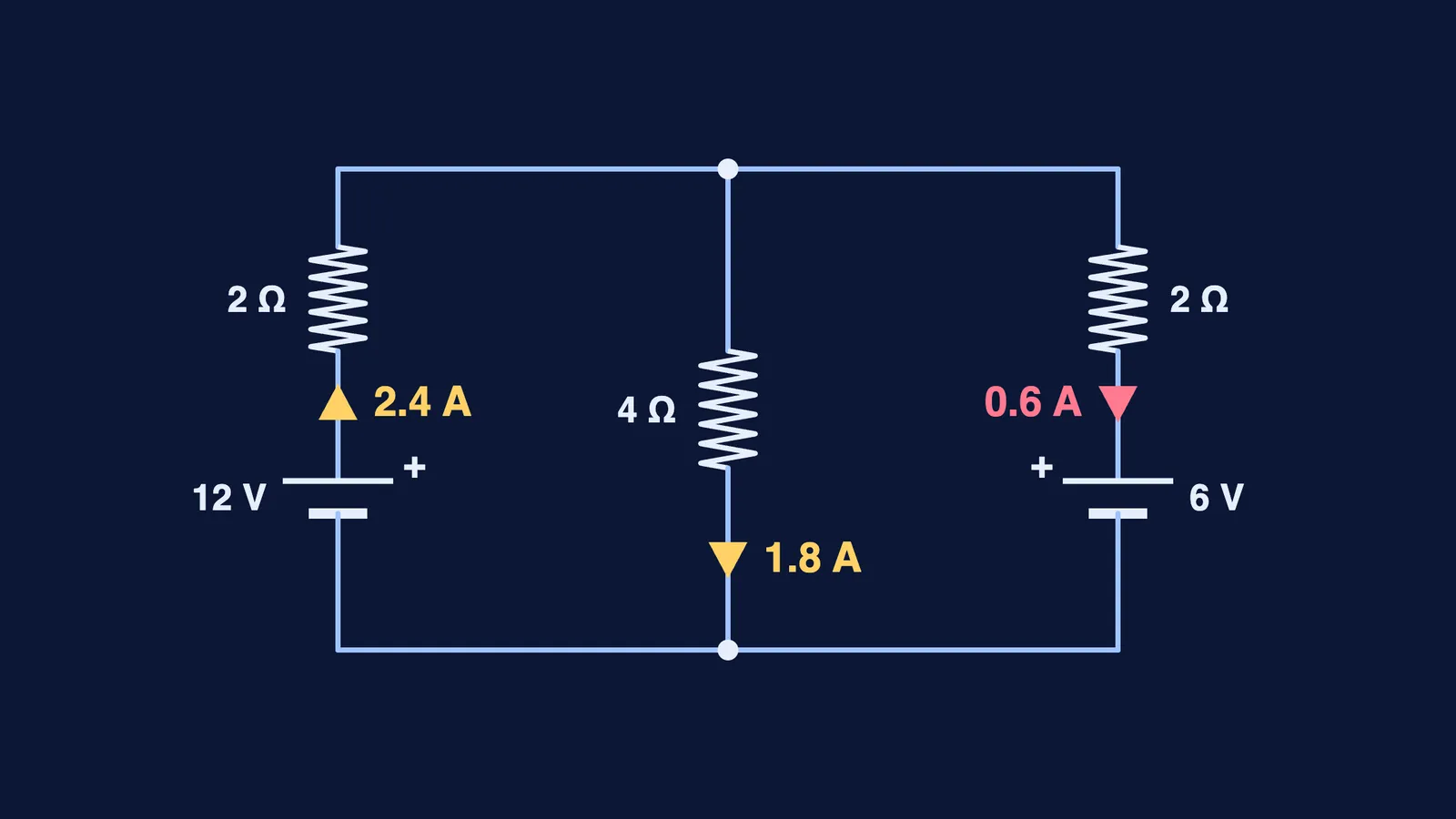
A 12 V cell in series with 2 Ω and a 6 V cell in series with 2 Ω are joined in parallel, positive terminals together, across 4 Ω. The cells themselves are ideal. Find each branch current.
Method 1: Kirchhoff's rules. Take I1 up the 12 V branch and I2 up the 6 V branch; by the junction rule, I1 + I2 flows down through 4 Ω.
Left loop: 12 − 2I1 − 4(I1 + I2) = 0, so 3I1 + 2I2 = 6.
Right loop: 6 − 2I2 − 4(I1 + I2) = 0, so 2I1 + 3I2 = 3.
Three times the first minus twice the second: 5I1 = 12, so I1 = 2.4 A.
Substitute: 2I2 = 6 − 7.2, so I2 = −0.6 A, and 4 Ω carries 1.8 A.
Method 2: one equivalent cell. Treat each 2 Ω as internal resistance and use NCERT's parallel-cell result: εeq/req = 12/2 + 6/2 = 9 and 1/req = 1/2 + 1/2, so req = 1 Ω and εeq = 9 V. So 9/(1 + 4) = 1.8 A flows in 4 Ω, putting the top wire at 7.2 V. Hence I1 = (12 − 7.2)/2 = 2.4 A and I2 = (6 − 7.2)/2 = −0.6 A. Same answers.
Write Method 1; use Method 2 as a rough-work check. If your loop signs keep going wrong, the Fermi Problem Library has worked problems with a step-by-step solver that explains the reasoning rather than printing an answer.
What are the assertion-reason and case-study traps?
In the 2026-27 sample paper, the fourth assertion-reason option is "both false", with no option for a false assertion and true reason, so read all four. Our assertion-reason strategy covers the method. Chapter traps:
In NCERT's Examples 3.1 and 3.2, 1.5 A in a thin copper wire means a drift speed of about 1.1 mm/s, yet current starts almost at once because the field spreads through the circuit at nearly light speed.
Resistivity depends on material and temperature, not on length or area.
In a balanced bridge, the galvanometer arm carries no current, so its resistance is irrelevant. The sample paper's bridge MCQ tests this.
Emf is not a force but the open-circuit potential difference, so it equals terminal voltage only at zero current.
For case studies, list the passage's given values first and answer only the sub-part asked; see our guide to case-based questions.
A two-week revision plan
Days 1-3: drift velocity, mobility and resistivity derivations from memory, checked against NCERT.
Days 4-5: internal resistance and both cell combinations.
Days 6-8: one two-loop circuit a day, solved both ways.
Days 9-10: Wheatstone bridge derivation and NCERT's bridge example.
Days 11-12: every Chapter 3 exercise, timed.
Days 13-14: the sample paper's circuit questions, marked against the official scheme.
If drift still feels abstract, the Fermi Simulation Lab has interactive simulations for ideas that are easier to see than to read.