On this page
Genetics questions in NEET-UG look short, but each hides a ratio, a probability or one NCERT line. These 8 original MCQs run from a simple cross to a pedigree probability, and each solution names the most tempting wrong option.
The NEET (UG)-2026 syllabus lists, under Unit 7 Genetics and Evolution, Mendelian inheritance and its deviations, polygenic inheritance, sex determination, linkage, sex-linked inheritance and Mendelian disorders. Every fact-based option below is checked against the NCERT Class 12 Biology chapter on Principles of Inheritance and Variation (Reprint 2026-27).
How should you use this practice set?
Cover the answers and give yourself about a minute per question.
Write the parents' genotypes and gametes before you touch a ratio.
Read every solution and trap, even when you got it right.
Tally which trap caught you; that is your revision list.
If the multiplication of probabilities is shaky, start with the product rule and sum rule in genetics. For the whole chapter plan, read how to prepare Principles of Inheritance and Variation for NEET.
Easy: can you read a cross at a glance?
Each tests one NCERT idea (NCERT chapter).
Q1 (easy). In snapdragon, red (RR) and white (rr) flower colour show incomplete dominance, and Rr is pink. A pink plant is crossed with a white plant. What is the expected phenotype ratio in the offspring?
(A) 3 pink : 1 white (B) 1 pink : 1 white (C) 1 red : 2 pink : 1 white (D) All pink
Answer: (B). Rr × rr gives gametes R, r from one parent and only r from the other, so offspring are Rr (pink) and rr (white) in equal numbers. Trap: (C) is the F2 ratio from selfing pink plants, not this cross.
Q2 (easy). A man with blood group AB marries a woman with blood group O. Which blood groups can their children have?
(A) A and B only (B) A, B, AB and O (C) AB and O only (D) A, B and AB
Answer: (A). The man passes either I^A or I^B; the woman can pass only i. Children are I^A i (group A) or I^B i (group B), half each. Trap: (D) assumes the AB parent can pass both alleles to one child.
Q3 (easy). In honey bees, a drone develops from an unfertilised egg. How many chromosomes does it have, and how does it make sperm?
(A) 32, by meiosis (B) 16, by meiosis (C) 16, by mitosis (D) 32, by mitosis
Answer: (C). NCERT states that females are diploid with 32 chromosomes, males are haploid with 16, and males produce sperm by mitosis. Trap: (B) applies the usual rule that gametes come from meiosis, which a haploid drone does not need.
Medium: how do test crosses, linkage and X-linked genes change the ratio?
Linkage and X-linked colour blindness are both in the NCERT chapter; the numbers here are our own.
Q4 (medium). A plant heterozygous for two unlinked genes (AaBb) is crossed with an aabb plant. Out of 640 offspring, how many are expected to show both recessive traits?
(A) 40 (B) 120 (C) 160 (D) 360
Answer: (C). AaBb makes four gamete types in equal numbers; aabb makes only ab. So aabb offspring are 1/4 of the total: 640 × 1/4 = 160. Trap: (A) uses 1/16 from the 9:3:3:1 dihybrid F2 ratio, which applies to AaBb × AaBb.
Q5 (medium). Genes P and Q lie on the same chromosome and show 12 per cent recombination. A PQ/pq plant is test crossed with pq/pq, giving 1,000 offspring. How many are expected to be Pq/pq?
(A) 60 (B) 120 (C) 250 (D) 440
Answer: (A). Recombinants make up 12 per cent of 1,000, which is 120, split equally between Pq and pQ, so 60 each. Trap: (B) is the total of both recombinant classes; (C) treats the genes as unlinked.
Q6 (medium). A colour-blind man marries a woman with normal vision whose father was colour blind. What fraction of their daughters are expected to be colour blind?
(A) 0 (B) 1/4 (C) 1/2 (D) 1
Answer: (C). The woman must carry her father's X^c, so she is X^C X^c. Every daughter receives the man's X^c, and half receive X^c from the mother, so half the daughters are X^c X^c. Trap: (B) is the fraction of all children who are colour-blind daughters, not the fraction of daughters.
Hard: can you handle polygenic traits and pedigree probability?
Both use NCERT's own models: three additive genes for human skin colour, and sickle-cell anaemia as an autosomal recessive trait (NCERT chapter).
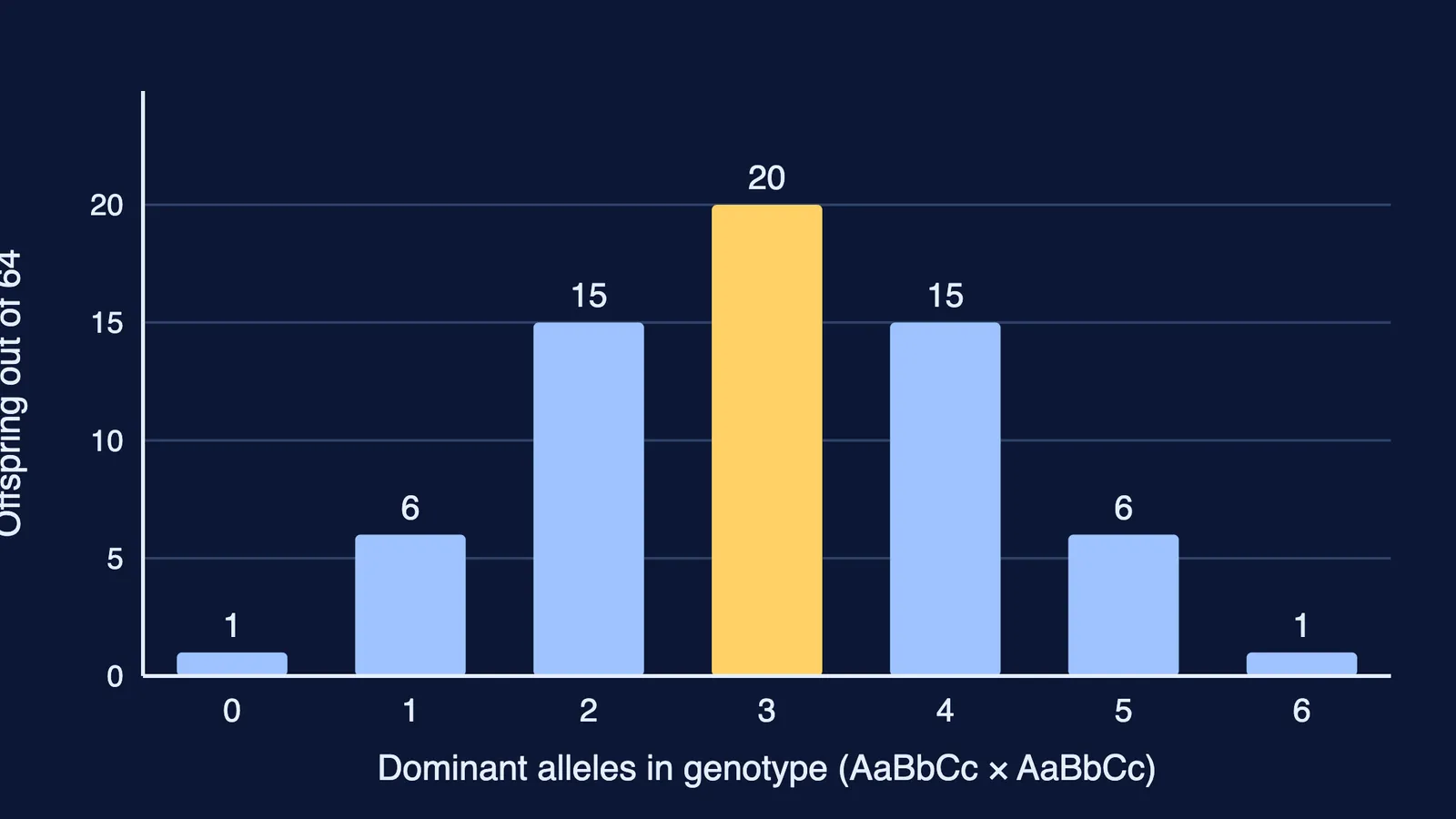
Q7 (hard). Using the NCERT model where three genes A, B and C act additively on skin colour, two AaBbCc parents have children. What fraction of children are expected to have exactly three dominant alleles (the intermediate shade)?
(A) 1/64 (B) 6/64 (C) 15/64 (D) 20/64
Answer: (D). Each child receives six alleles, and each is dominant with probability 1/2. The number of ways to pick three of six is 20, so the fraction is 20/64, or 5/16. Trap: (C) is the share with two (or four) dominant alleles, the bar next to the peak.
Q8 (hard). Two unaffected parents have a child with sickle-cell anaemia. Their unaffected daughter marries a man known to be a carrier (Hb^A Hb^S). What is the probability that their first child has sickle-cell anaemia?
(A) 1/4 (B) 1/6 (C) 1/8 (D) 2/3
Answer: (B). Both grandparents must be carriers. Among their unaffected children, the ratio Hb^A Hb^A : Hb^A Hb^S is 1 : 2, so the daughter is a carrier with probability 2/3. Two carriers have an affected child with probability 1/4, so 2/3 × 1/4 = 1/6. Trap: (A) assumes the daughter is surely a carrier and ignores the 2/3 step.
What should you revise after this set?
Missed Q1, Q2 or Q4: redo the gamete step for every cross in the chapter, including test crosses.
Missed Q5: work through recombination frequency and gene maps until "split the recombinants in two" is automatic.
Missed Q6 or Q8: draw the pedigree before computing anything, and write each person's possible genotypes.
Missed Q7: count dominant alleles rather than listing all 64 boxes.
When a solution step still does not make sense, the Fermi Problem Library has worked problems with a step-by-step solver that explains the reasoning rather than printing an answer.