On this page
Most school genetics questions ask one thing: what fraction of the offspring will have this genotype or phenotype? You can draw a Punnett square every time, but a dihybrid square has 16 boxes and a trihybrid one has 64. Two probability rules do the same work in a few lines, and handle questions a square makes awkward, such as "at least one".
What are the product rule and the sum rule in genetics?
The product rule: the probability of two independent events occurring together is found by multiplying their individual probabilities, as stated in OpenStax Biology 2e, section 12.1.
The sum rule: the probability of one event or the other, when the two are mutually exclusive, is the sum of their individual probabilities.
In short, "and" means multiply, "or" means add. Each comes with a condition. Multiply only when one event does not change the chance of the other. Add only when the two outcomes cannot both happen.
Genetics fits these conditions well. An Rr parent passes R or r with a chance of 1/2 each, and the egg's allele does not affect the pollen's. Genes that assort independently, as Mendel's seed shape and colour did, can be solved as separate crosses and multiplied. Genes close together on one chromosome tend to be inherited together, so do not multiply across them.
How do you use them in a monohybrid cross?
Take Rr x Rr, where R (round seed) is dominant over r (wrinkled).
RR needs R from the mother and R from the father: 1/2 x 1/2 = 1/4. The same reasoning gives rr = 1/4.
Rr can happen two ways: R from the mother and r from the father (1/4), or r from the mother and R from the father (1/4). These routes cannot both happen, so add them: 1/4 + 1/4 = 1/2.
A round seed is RR or Rr: 1/4 + 1/2 = 3/4. A wrinkled seed is 1/4.
Mendel's data match this. In his 1865 paper (English translation on MendelWeb), 253 hybrid plants gave 7,324 seeds, of which 5,474 were round and 1,850 wrinkled, a ratio he gave as 2.96:1. That is 74.7% round, close to the 3/4 the rules predict.
How do you get 9:3:3:1 without a Punnett square?
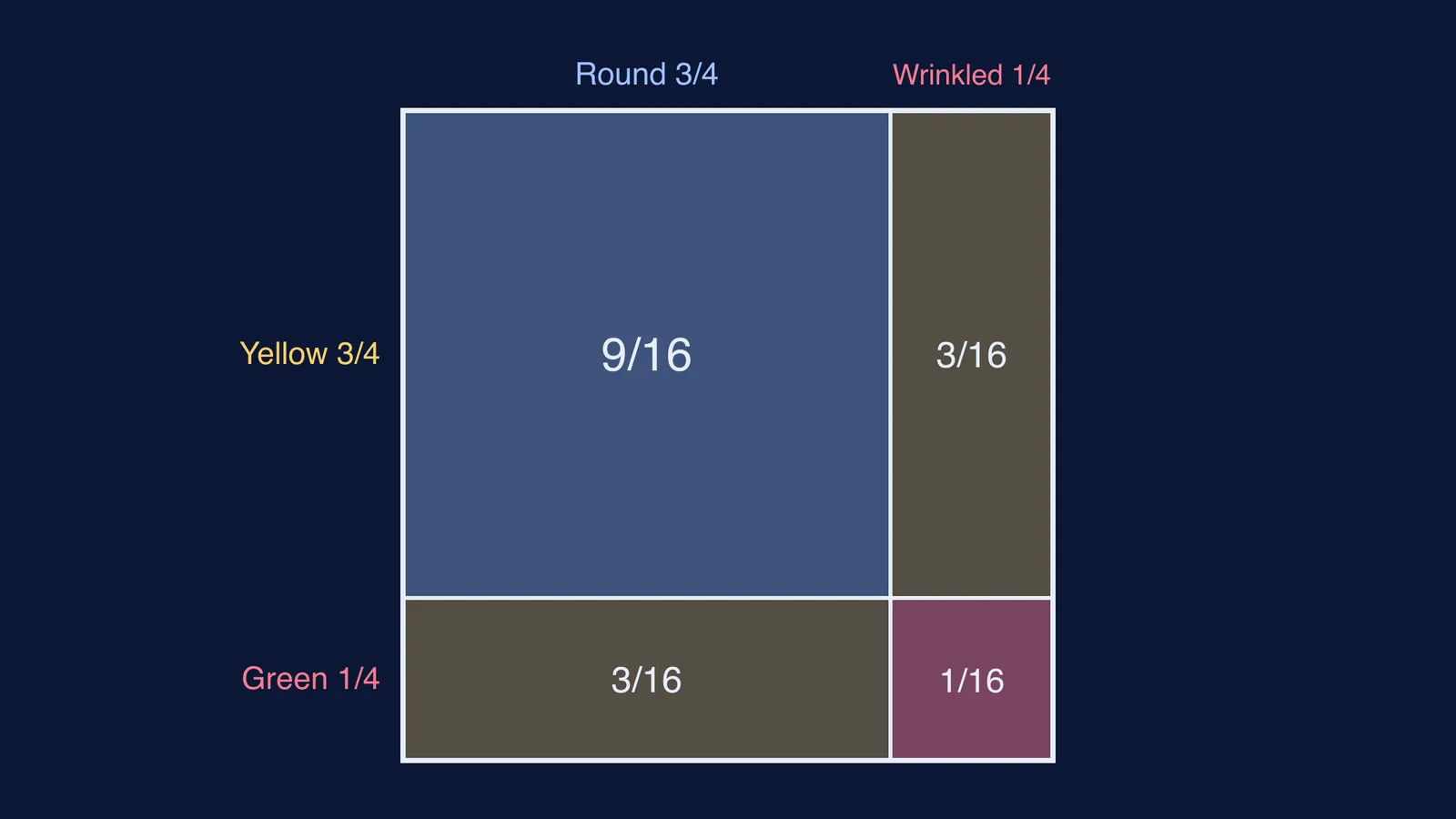
Now cross RrYy x RrYy, where Y (yellow) is dominant over y (green). Solve each gene on its own (round 3/4, wrinkled 1/4; yellow 3/4, green 1/4), then multiply.
Round and yellow: 3/4 x 3/4 = 9/16
Round and green: 3/4 x 1/4 = 3/16
Wrinkled and yellow: 1/4 x 3/4 = 3/16
Wrinkled and green: 1/4 x 1/4 = 1/16
In Mendel's dihybrid experiment, 15 plants yielded 556 seeds: 315 round and yellow, 101 wrinkled and yellow, 108 round and green, and 32 wrinkled and green. The rules predict about 313, 104, 104 and 35 from 556 seeds, a close fit.
The rules also answer questions the ratio alone does not:
Chance an offspring is RrYy: 1/2 x 1/2 = 1/4.
Chance it shows exactly one dominant trait: round-green or wrinkled-yellow, which are exclusive, so 3/16 + 3/16 = 3/8.
Chance a round yellow seed is true-breeding (RRYY): RRYY is 1/4 x 1/4 = 1/16 of all seeds, and round yellow is 9/16, so 1 in 9 round yellow seeds.
Trihybrid AaBbCc x AaBbCc, chance of aabbcc: 1/4 x 1/4 x 1/4 = 1/64. Chance of all three dominant traits: 3/4 x 3/4 x 3/4 = 27/64.
Our post on the forkline method for dihybrid crosses draws the same branching out step by step.
Which mistakes should you watch for?
Forgetting the second route to a heterozygote. Rr is 1/2, not 1/4, because it can arise two ways.
Adding where you should multiply. Round and yellow is not 3/4 + 3/4; any answer above 1 gives it away.
Mixing genotype and phenotype. Dominant phenotype is 3/4; the RR genotype is only 1/4.
Counting "at least one" the long way. Use 1 minus the chance of none. Two parents who both carry a recessive condition, with three children: the chance at least one child is affected is 1 - (3/4)^3 = 37/64. Our post on why two albinism carriers have a 1 in 4 chance explains the starting fraction, and pedigree probability for carriers takes it into family trees.
A five-step routine for any cross question
Split the cross into one gene at a time.
Write each gene's genotype fractions (1/4, 1/2, 1/4) and phenotype fractions (3/4, 1/4).
Rewrite the question in words using "and" and "or".
Multiply across genes, add across separate routes to the same outcome.
If you listed every possible outcome, check that they add up to 1.
If your fraction keeps coming out wrong, the Fermi Problem Library has worked problems with a step-by-step solver that explains the reasoning rather than printing an answer. If independence itself feels shaky, the Fermi Concept Library gives each concept in biology and mathematics its own lesson.
Try the routine on one past cross question today, then check it once with a Punnett square.