

On this page
A Punnett square for AaBb × AaBb has 16 boxes, and OpenStax Biology 2e points out that a cross involving four genes would need a 16 × 16 grid of 256 boxes. The forked-line method, often called the forkline method, gets the same answer in a few lines.
What is the forkline method in genetics?
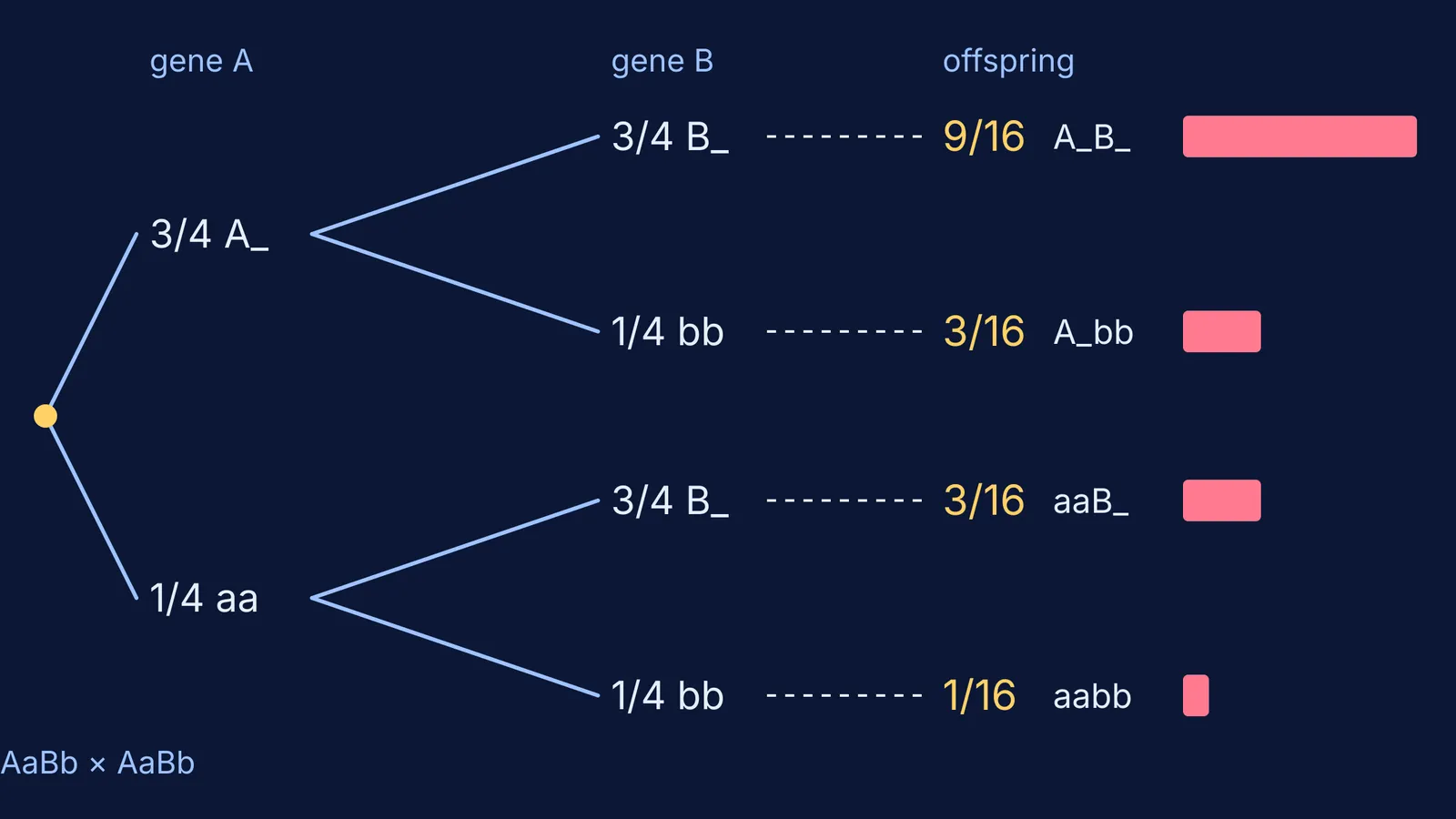
The forked-line method is a branching diagram that treats each gene as a separate monohybrid cross and multiplies the probabilities along each branch; OpenStax calls it "a diagrammatic version of the product rule".
It works because of Mendel's law of independent assortment: genes sort into gametes independently of each other, so every combination of alleles is equally likely, as the same OpenStax chapter puts it.
Mendel's own peas show the ratio is real. In the 2016 English translation of his paper published in Genetics, he reports 556 seeds from 15 plants: 315 round and yellow, 101 angular and yellow, 108 round and green, and 32 angular and green. A 9:3:3:1 split of 556 predicts about 313, 104, 104 and 35, so his counts sit close to the prediction.
How do you solve a dihybrid cross quickly without a Punnett square?
Use these five steps for any cross where the genes assort independently and one allele is fully dominant.
Split the cross gene by gene: AaBb × AaBb becomes Aa × Aa and Bb × Bb.
Write each single-gene result as fractions: Aa × Aa gives 3/4 A_ and 1/4 aa, where A_ means at least one dominant allele.
Draw the fork: from each outcome for gene A, branch into the outcomes for gene B.
Multiply along each path.
Put the products over a common denominator and read off the ratio.
For AaBb × AaBb the four paths are 3/4 × 3/4 = 9/16 A_B_, 3/4 × 1/4 = 3/16 A_bb, 1/4 × 3/4 = 3/16 aaB_ and 1/4 × 1/4 = 1/16 aabb. That is 9:3:3:1, the same ratio OpenStax reads off its 16-box square.
What about crosses that are not AaBb × AaBb?
This is where the fork earns its place, because exam crosses are often lopsided. Take AaBb × Aabb. Gene A gives 3/4 A_ and 1/4 aa as before. Gene B is Bb × bb, which gives 1/2 B_ and 1/2 bb. Multiplying along the branches, the product rule OpenStax describes, gives 3/8 A_B_, 3/8 A_bb, 1/8 aaB_ and 1/8 aabb, a 3:3:1:1 ratio.
Now check it with a Punnett square. AaBb makes four gametes (AB, Ab, aB, ab) and Aabb makes two (Ab, ab), so the square has 4 × 2 = 8 boxes:
AB row: AABb, AaBb (two A_B_)
Ab row: AAbb, Aabb (two A_bb)
aB row: AaBb, aaBb (one A_B_, one aaB_)
ab row: Aabb, aabb (one A_bb, one aabb)
That is 3 A_B_, 3 A_bb, 1 aaB_ and 1 aabb, or 3:3:1:1 again. Run this check on your first few problems; once the two methods keep agreeing, drop the square.
A dihybrid test cross, AaBb × aabb, is even shorter: 1/2 × 1/2 on every branch gives 1:1:1:1. Our guide to test crosses and back crosses for finding an unknown genotype shows how to read that result backwards.
How do you use it for a trihybrid cross?
For AaBbCc × AaBbCc, add a third column of branches. Each path multiplies three fractions, giving 27/64 A_B_C_, 9/64 for each of the three classes with one recessive trait, 3/64 for each of the three with two, and 1/64 for aabbcc. That is the 27:9:9:9:3:3:3:1 ratio OpenStax gives. The square would need 8 × 8 = 64 boxes, because an F1 with n heterozygous genes makes 2^n kinds of gamete, by the rule in the same chapter.
Most exam questions ask about one class, so you rarely need the whole fork:
Probability of A_bbC_: 3/4 × 1/4 × 3/4 = 9/64
Probability of aabbcc: 1/4 × 1/4 × 1/4 = 1/64
Probability of the genotype AaBbCc: use 1/4 AA, 1/2 Aa, 1/4 aa for each gene, so 1/2 × 1/2 × 1/2 = 1/8
The same chapter's 3^n rule counts the possible genotypes when both parents are heterozygous for every gene: 9 for two genes and 27 for three. For more ratio questions and the traps examiners set, see our Mendelian genetics guide for NEET.
When does the forkline method give the wrong answer?
Multiplying branches only works if the genes really do assort independently. OpenStax notes that genes physically close together on the same chromosome are more likely to be inherited as a pair, so a fork built for unlinked genes will mislead you there. Our explainer on linkage and crossing over covers what to do instead. If a gene shows incomplete dominance, use its 1:2:1 phenotype split on that branch rather than 3:1.
If your answers keep going wrong at one step, the Fermi Problem Library has worked problems with a step-by-step solver that explains the reasoning rather than printing an answer. If the gap is independent assortment itself, the Fermi Concept Library gives each concept its own lesson.


