

On this page
Two parents with ordinary skin and hair colour can have a child with albinism. A 2 × 2 grid explains why. Here is what goes wrong with melanin, why the trait is recessive, and how to work the Punnett square without the usual exam slips.
What is albinism, and why is no melanin made?
Oculocutaneous albinism is a group of conditions that affect the colour of the skin, hair and eyes, according to MedlinePlus Genetics. The same page links four genes (TYR, OCA2, TYRP1 and SLC45A2) to types 1 to 4 and says variants in any of them disrupt the ability of cells to make melanin.
The best-studied gene is TYR. The MedlinePlus TYR gene page explains that it carries the instructions for an enzyme called tyrosinase, which does the first step of melanin production: it converts the amino acid tyrosine into dopaquinone. Most TYR mutations eliminate the enzyme's activity, so pigment cells called melanocytes make no melanin throughout life; this form is called type 1A (OCA1A).
Melanin matters beyond colour. MedlinePlus notes that a lack of melanin in the retina leads to the vision problems of oculocutaneous albinism. It estimates that the condition affects 1 in 4,000 to 7,000 people in African populations and 1 in 12,000 to 15,000 in European populations, with figures varying by type and country, per MedlinePlus Genetics.
Why is albinism a recessive trait?
You have two copies of each of these genes, one from each parent. For TYR, one working copy is enough for normal pigment. Only when both copies fail does melanin production stop.
That is what recessive means here. MedlinePlus states that oculocutaneous albinism is inherited in an autosomal recessive pattern, which means both copies of the gene in each cell must have a variant to cause the disorder. A person with one working copy and one non-working copy is a carrier: the CDC describes carriers as people who carry the genetic change but do not have the condition themselves.
Recessive does not mean rare or weak, and dominant does not mean common. We cover that mix-up in why a dominant trait is not always the more common one.
How can two parents without albinism have a child with albinism?
Both parents must be carriers. Use A for the working allele (makes tyrosinase) and a for the non-working one.
Write each parent's genotype: mother Aa, father Aa.
List each parent's gametes. Meiosis separates the two copies, so half of each parent's eggs or sperm carry A and half carry a.
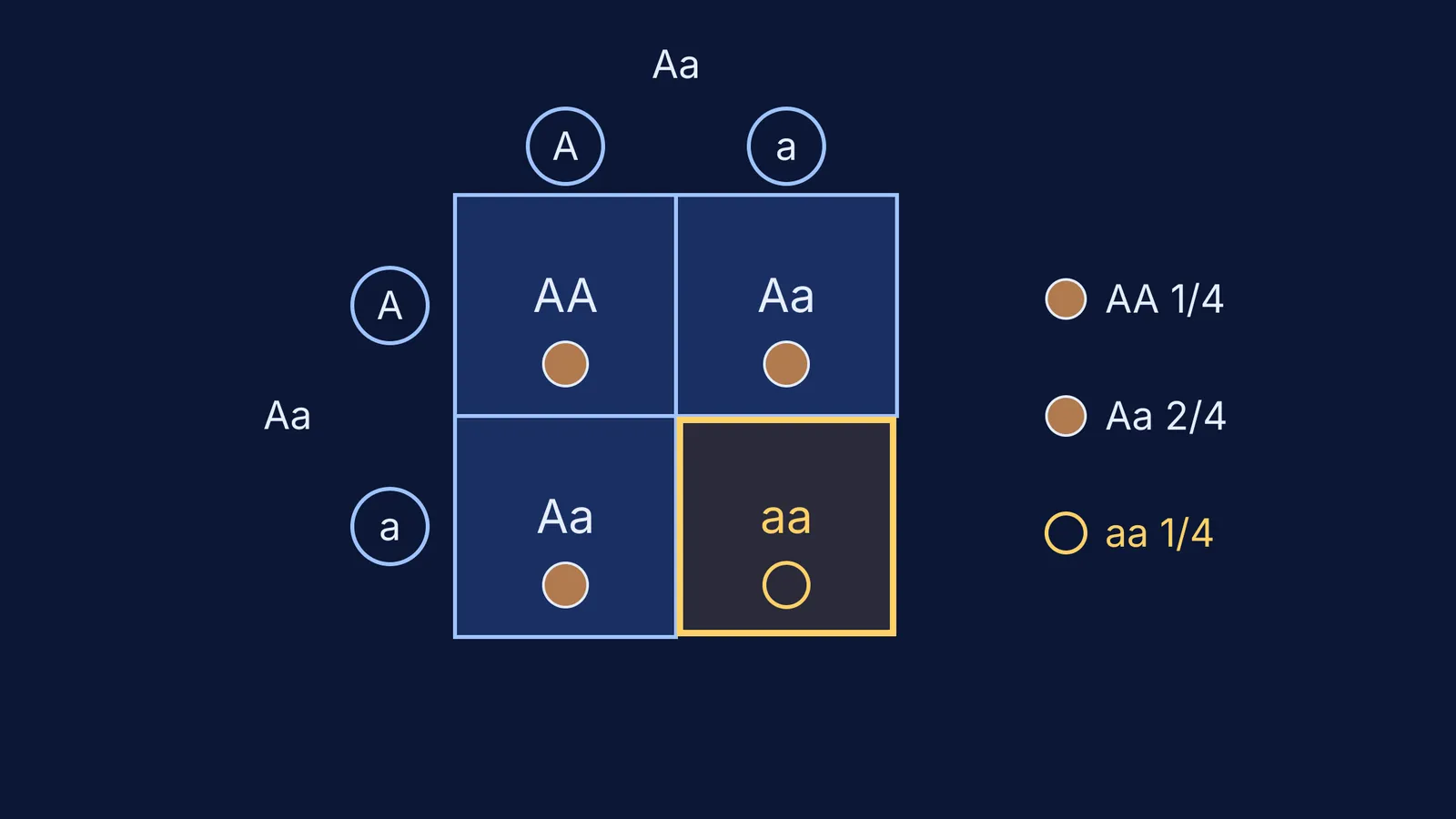
Draw a 2 × 2 grid. Put the father's gametes (A, a) across the top and the mother's (A, a) down the side.
Fill each box by combining its row and column: AA, Aa, Aa, aa.
Read the genotypes: 1 AA : 2 Aa : 1 aa.
Read the phenotypes: AA and Aa both make melanin; only aa does not. So 3 pigmented : 1 albinism.
The CDC says that if both parents are carriers, each child has a 25% (1 in 4) chance of inheriting two copies of the changed gene and having the condition. The NHS Genomics Education Programme adds the other boxes: a 1-in-2 (50%) chance that a child is a carrier and a 1-in-4 (25%) chance that a child is neither affected nor a carrier.
What are the common Punnett square mistakes in exams?
Check these before you answer:
Genotype or phenotype? 1 : 2 : 1 is the genotype ratio; 3 : 1 is the phenotype ratio. Answer the one the question asks for.
Whole family or only pigmented children? If a child of two carriers is known to have normal pigment, the aa box is ruled out. Of the three boxes left, two are Aa, so the chance that child is a carrier is 2/3, not 1/2. Our post on carrier chance in pedigree questions works through more of these.
Two children, not one? For "both children have albinism", multiply: 1/4 × 1/4 = 1/16.
If you keep mixing up alleles, genotypes and phenotypes, the Fermi Concept Library has a lesson for each biology concept and shows its place in the map, so you can fix the gap before practising crosses.
Why does a recessive condition stay in a population?
Carriers typically show no sign of the condition, so the allele passes quietly through generations. That is also why autosomal recessive conditions are typically not seen in every generation of a family, as MedlinePlus notes. Sickle cell is a famous case where carriers even gain something, explained in the sickle cell carrier advantage against malaria.
When you are ready to practise, try a few monohybrid crosses in the Fermi Problem Library, where the step-by-step solver explains the reasoning rather than printing an answer.


