On this page
These eight NEET-UG Physics questions were written for this set. They climb from a neutral point between two charges to a charged shell, and each solution names the trap behind the tempting wrong option.
What does NEET test in Electrostatics?
The NEET (UG)-2026 syllabus published by the National Medical Commission lists Electrostatics as Unit 11. It covers Coulomb's law, field and dipoles, Gauss's law (wire, sheet, thin shell), potential and potential energy, and capacitors with and without a dielectric. Every question stays inside that list. New to the chapter? Read our guide on how to prepare Electrostatics for NEET first.
How should you use this practice set?
Cover each answer. Allow a minute for easy questions, two for hard ones.
Write your formula and its condition before the numbers.
Convert µC, cm and pF to SI first.
Read every trap, and list the ones that caught you.
Take k = 9 × 10⁹ N m² C⁻² and ε₀ = 8.85 × 10⁻¹² C² N⁻¹ m⁻² throughout.
If fields feel abstract, the Fermi Simulation Lab has interactive simulations for the ideas that are easier to see than to read.
Easy: Coulomb's law, capacitance and flux
Q1 (easy). Point charges of +2 µC and +8 µC are fixed 30 cm apart. Where on the line joining them is the net electric field zero?
(A) 6 cm from the +2 µC charge (B) 10 cm from the +2 µC charge (C) 15 cm from either charge (D) 20 cm from the +2 µC charge
Answer: (B). Equal fields: 2/x² = 8/(30 − x)², so (30 − x)/x = 2 and x = 10 cm, nearer the smaller charge.
Trap: (A) splits 30 cm in the ratio 2 : 8. Field falls as 1/r², so distances go as the square roots of the charges.
Q2 (easy). An air parallel-plate capacitor of 20 pF has its plate separation tripled and the whole gap filled with a dielectric of constant 4.5. What is the new capacitance?
(A) 6.7 pF (B) 30 pF (C) 90 pF (D) 270 pF
Answer: (B). C = Kε₀A/d, so C changes by a factor of 4.5/3 = 1.5: 20 × 1.5 = 30 pF.
Trap: (D) multiplies by 3. A wider gap means less capacitance, not more.
Q3 (easy). A closed surface encloses charges of +5 nC and −2 nC. A +4 nC charge sits just outside it. What is the total electric flux through the surface?
(A) 3.4 × 10² N m² C⁻¹ (B) 7.9 × 10² N m² C⁻¹ (C) 1.2 × 10³ N m² C⁻¹ (D) zero
Answer: (A). Gauss's law: Φ = q_enclosed/ε₀ = (3 × 10⁻⁹)/(8.85 × 10⁻¹²) ≈ 3.4 × 10² N m² C⁻¹.
Trap: (B) counts the outside charge, whose net flux through a closed surface is zero.
Medium: dipoles, potential and shared charge
Q4 (medium). An electric dipole of moment 3 × 10⁻⁹ C m lies along a uniform field of 4 × 10⁴ N/C. How much work turns it slowly through 60°?
(A) 6.0 × 10⁻⁵ J (B) 1.0 × 10⁻⁴ J (C) 1.2 × 10⁻⁴ J (D) 1.8 × 10⁻⁴ J
Answer: (A). W = pE(1 − cos 60°) = (1.2 × 10⁻⁴)(0.5) = 6.0 × 10⁻⁵ J.
Trap: (B) is pE sin 60°, the torque, not the work.
Q5 (medium). Charges of +3 µC and −1 µC are 20 cm apart. How much work is needed to bring a +2 µC charge from infinity to the midpoint between them?
(A) 0.18 J (B) 0.36 J (C) 0.72 J (D) zero
Answer: (B). V = k(3 − 1) × 10⁻⁶/0.1 = 1.8 × 10⁵ V, so W = qV = 2 × 10⁻⁶ × 1.8 × 10⁵ = 0.36 J.
Trap: (C) adds the sizes of the charges. Potential is a scalar, so −1 µC keeps its sign.
Q6 (medium). A 5 µF capacitor charged to 40 V is disconnected from its battery and joined across an uncharged 3 µF capacitor. How much energy is lost as the charge shares out?
(A) zero (B) 1.5 mJ (C) 2.5 mJ (D) 4.0 mJ
Answer: (B). 200 µC shared over 8 µF gives 25 V. Energy falls from ½ × 5 µF × 40² = 4.0 mJ to ½ × 8 µF × 25² = 2.5 mJ, so 1.5 mJ is lost.
Trap: (A) assumes energy is conserved because charge is. See which capacitor energy formula to use.
Hard: dielectrics and Gauss's law for a shell
Q7 (hard). A 10 pF air capacitor is charged to 100 V and the battery is removed. A slab of dielectric constant 5 is then slid in to fill the gap. What happens to the stored energy?
(A) It falls from 50 nJ to 10 nJ (B) It rises from 50 nJ to 250 nJ (C) It stays at 50 nJ (D) It falls from 50 nJ to 2 nJ
Answer: (A). Q = CV = 1 nC stays fixed. C becomes 50 pF, so U = Q²/2C falls fivefold to 10 nJ, and V drops to 20 V.
Trap: (B) holds V at 100 V, true only with the battery connected.
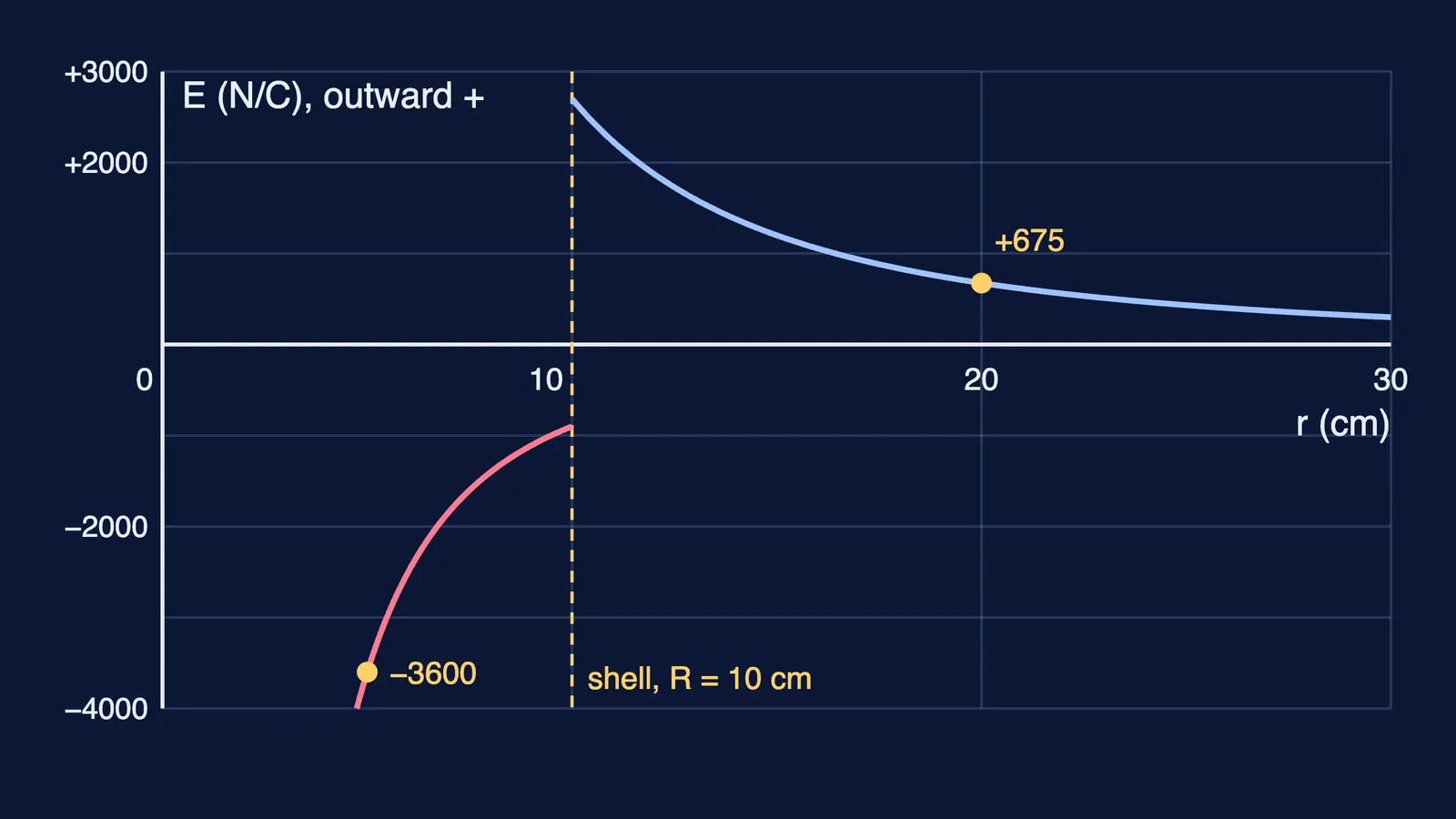
Q8 (hard). A thin spherical shell of radius 10 cm carries +4 nC spread uniformly over it. A point charge of −1 nC is fixed at its centre. What is the electric field at 5 cm and at 20 cm from the centre?
(A) 3600 N/C inward; 675 N/C outward (B) zero; 675 N/C outward (C) 3600 N/C inward; 900 N/C outward (D) 3600 N/C inward; 1125 N/C outward
Answer: (A). At 5 cm a Gaussian sphere encloses only −1 nC: E = 9 × 10⁹ × 10⁻⁹/0.05² = 3600 N/C inward. At 20 cm it encloses +3 nC: E = 9 × 10⁹ × 3 × 10⁻⁹/0.2² = 675 N/C outward.
Trap: (B) forgets the centre charge; only the shell's own field is zero inside. See the field of a charged spherical shell using Gauss's law.
Redo the set in a week without the solutions, starting with the questions whose traps caught you.