On this page
Electrostatics rewards knowing a handful of results cold and spotting, in seconds, which one a question needs. Here is the official scope, two worked examples and a plan.
What does Electrostatics cover in the NEET syllabus?
The National Medical Commission's updated syllabus for NEET (UG) 2026, dated 22 December 2025 (NMC syllabus PDF), lists Electrostatics as Physics Unit 11. It covers charge and Coulomb's law with superposition, field and field lines, the dipole and its torque, flux and Gauss's law (wire, plane sheet, thin shell), potential and equipotentials, potential energy, conductors, dielectrics, capacitor combinations, the parallel plate capacitor with and without a dielectric, and stored energy.
All of it sits in two chapters of the NCERT Class 12 Physics Part I book (Reprint 2026-27), per its contents page:
Chapter 1, Electric Charges and Fields: sections 1.2 to 1.14, from charge to the applications of Gauss's law.
Chapter 2, Electrostatic Potential and Capacitance: sections 2.2 to 2.15, from potential to energy stored in a capacitor.
Every item on the NMC list has a matching NCERT section. Our Class 12 guide to Electric Charges and Fields and the one on Electrostatic Potential and Capacitance go chapter by chapter.
How is Electrostatics tested in NEET?
In NEET-UG 2026, the NTA information bulletin set 180 compulsory questions in 180 minutes, with 45 in Physics. Every question was a single-correct MCQ with four options: +4 for a correct answer, -1 for a wrong one, 0 if left blank. That is about a minute per question and no numerical-value section, unlike JEE Main (see our Electrostatics guide for JEE Main). So:
Recall, not derivation. Know the wire, sheet and shell fields from NCERT section 1.14 by heart.
Statement questions. NCERT results, such as zero field inside a charged shell, become assertion-reason items. Read the chapter summaries closely.
Ratios and elimination. Options often differ by a factor of K or 2. Ask what should rise or fall, then check units.
Which worked examples should you master?
Example 1: dielectric with the battery on or off
A 4 µF air capacitor is charged by a 12 V battery, so Q = CV = 48 µC and U = ½CV² = 288 µJ. A slab with K = 3 now fills the gap, and NCERT gives C = KC₀ = 12 µF.
Battery still connected: V stays 12 V. Q = 12 µF × 12 V = 144 µC and U = ½ × 12 µF × (12 V)² = 864 µJ. Energy triples.
Battery removed first: Q stays 48 µC. V = Q/C = 4 V and U = Q²/2C = 96 µJ. Energy falls to a third.
Rule: decide what is fixed (V or Q), then use the energy formula built on it.
Example 2: zero field, but not zero potential
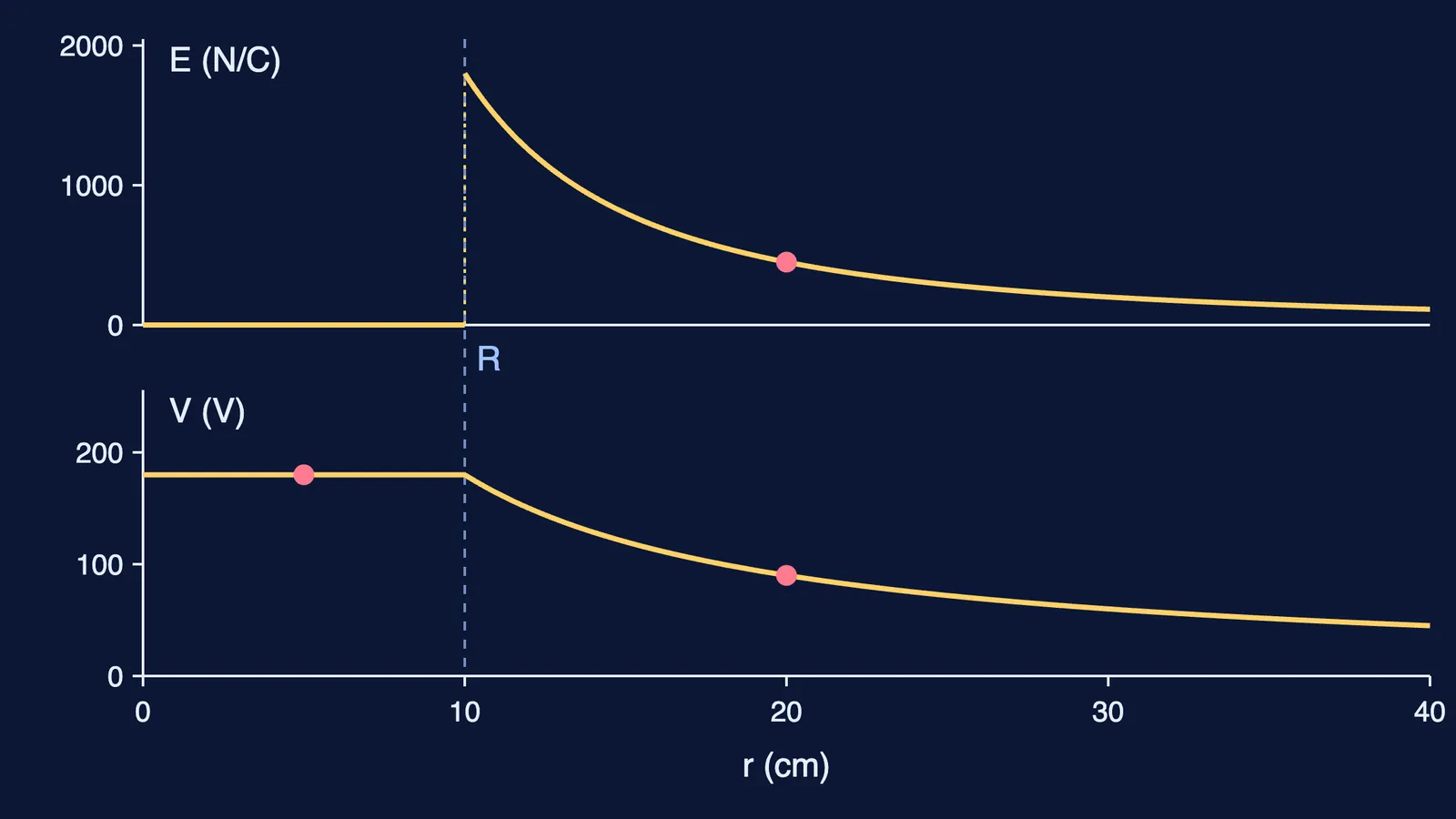
A thin spherical shell of radius 10 cm carries +2 nC. Take k = 9 × 10⁹ N m² C⁻².
At r = 5 cm (inside): Gauss's law gives E = 0, but V = kQ/R = 18/0.10 = 180 V, the same as on the surface.
At r = 20 cm (outside): E = kQ/r² = 18/0.04 = 450 N/C and V = kQ/r = 18/0.20 = 90 V.
The graph at the top plots both: E jumps at the surface, V is flat inside. Zero field means constant potential, not zero potential.
What are the common traps?
Adding forces from several charges as numbers instead of vectors.
Treating the null point of two like charges as the midpoint; it lies closer to the smaller charge.
Swapping series and parallel rules: capacitors in series combine like resistors in parallel.
Writing τ = pE instead of τ = pE sin θ, and dipole energy without the minus sign: U = −pE cos θ.
Forgetting the factor of 2 between a sheet (σ/2ε₀) and the field between capacitor plates (σ/ε₀).
Stuck on a step? The Fermi Problem Library has worked problems with a step-by-step solver that explains the reasoning rather than printing an answer. If field lines are hard to picture, the Fermi Simulation Lab has interactive simulations for the ideas that are easier to see than to read.
How should you plan your Electrostatics practice?
A two-week plan beside your other subjects:
Days 1-3: NCERT Chapter 1 and its in-text examples; a one-page formula sheet.
Days 4-6: Chapter 2 the same way, plus a capacitor-combination drill.
Days 7-9: 20 mixed MCQs in 20 minutes daily; tag each mistake concept, formula or arithmetic.
Days 10-12: rework tagged mistakes; reread both chapter summaries.
Days 13-14: a full timed Physics section.
Three-minute check:
Charges of +4 µC and +1 µC are 30 cm apart. Where between them is the field zero?
Three 6 µF capacitors: what is the ratio of parallel to series capacitance?
A dipole of ±4 µC, 2.5 mm apart, sits at 60° to a field of 3 × 10⁴ N/C. Find the torque.
Answers: 20 cm from the +4 µC charge; 9 (18 µF against 2 µF); about 2.6 × 10⁻⁴ N m.