On this page
Chapter 2 of NCERT Class 12 Physics rewards steady practice: the derivations repeat, the numericals use a few formulas, and most lost marks come from presentation. This guide is for the board paper; for JEE, see our Electrostatics plan for JEE Main.
What does CBSE 2026-27 test from this chapter?
The CBSE Class XII Physics curriculum for 2026-27 puts Unit I, Electrostatics (Chapter 1, Electric Charges and Fields, plus this chapter), and Unit II, Current Electricity, in one marks cell: 16 of the 70 theory marks for the two units together. There is no separate figure for Electrostatics.
It covers potential due to a point charge, a dipole and a system of charges; equipotentials; potential energy of charges and of a dipole in a field; conductors and dielectrics; capacitor combinations; and the parallel plate capacitor with and without a dielectric. Energy stored in a capacitor is marked "no derivation, formulae only".
Which derivations should you practise?
The NCERT chapter (reprint 2026-27) contains these, each with a result to box:
Dipole potential (2.4): V = p cos θ / (4πε0r²). Zero on the equatorial plane; falls as 1/r².
Energy of a system of charges (2.7): U = q1q2 / (4πε0r12), one term per pair.
Parallel plate capacitor (2.12): field σ/ε0 between the plates, zero outside, so C = ε0A/d.
Dielectric (2.13): C = Kε0A/d, and K = C/C0.
Series and parallel (2.14): 1/C = 1/C1 + 1/C2; C = C1 + C2.
Energy stored (2.15): U = Q²/2C = ½CV² = ½QV, and u = ½ε0E². CBSE asks for these formulas, not the derivation.
Diagrams to draw quickly: the dipole with r1, r2 and θ; field lines crossing equipotentials at right angles; the parallel plate field (see the field between two charged sheets); and a dielectric slab with induced surface charges.
How do you set out 2-, 3- and 5-mark answers?
The CBSE 2026-27 sample paper has 1-mark MCQs and four assertion-reasoning items, 2- and 3-mark short answers, two 4-mark case studies and three 5-mark long answers. Its marking scheme awards half-mark steps, so every written step counts.
2 marks: formula, substitution with units, answer.
3 marks: labelled diagram, starting equation, key step, boxed result.
5 marks: usually split into parts; the sample capacitor question, 31(A), is marked 2+2+1. Label each part and finish it before the next.
More on layout: how to write numericals for full step marks.
A board-style capacitor numerical, solved two ways
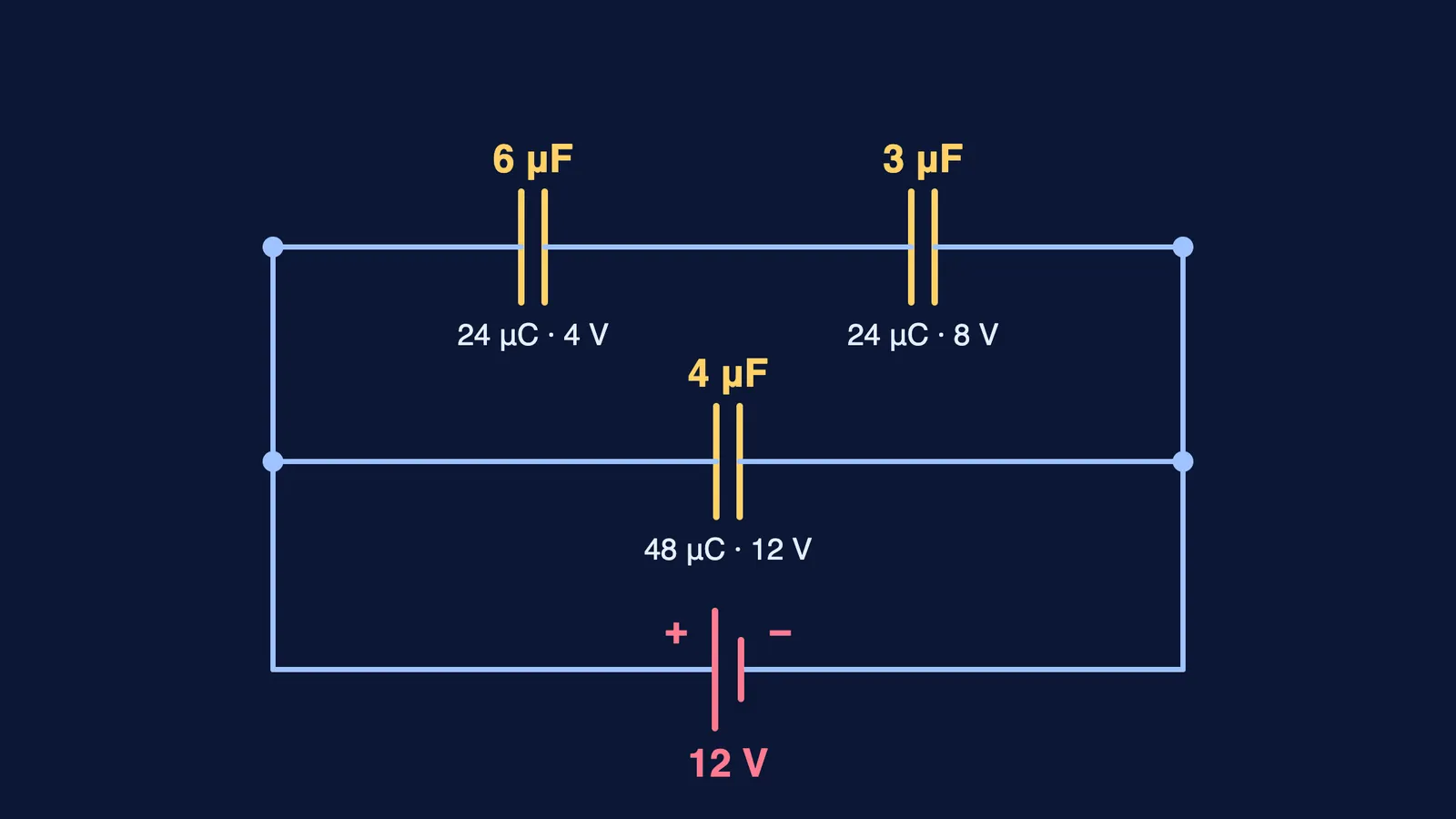
Using NCERT Sections 2.14 and 2.15: a 6 μF and a 3 μF capacitor in series are connected in parallel with a 4 μF capacitor across 12 V. Find the equivalent capacitance, each charge and voltage, and the energy stored.
Way 1, equivalent capacitor:
Series: 1/Cs = 1/6 + 1/3, so Cs = 2 μF.
Parallel: C = 2 + 4 = 6 μF.
Q = CV = 6 μF × 12 V = 72 μC.
U = ½CV² = ½ × 6 × 10⁻⁶ F × (12 V)² = 4.32 × 10⁻⁴ J.
Way 2, capacitor by capacitor:
Series pair: 2 μF × 12 V = 24 μC on each.
6 μF: 24/6 = 4 V; 3 μF: 24/3 = 8 V; 4 + 8 = 12 V.
4 μF: full 12 V, so 48 μC. Total 72 μC.
½CV² each: 48 + 96 + 288 = 432 μJ, matching Way 1.
Write Way 1; use Way 2 as your rough-work check. The smaller series capacitor takes the larger voltage.
Which assertion-reason and case-study traps catch students?
The classic is NCERT Exercise 2.9: a dielectric inserted with the supply connected, or after disconnecting it. Decide what stays fixed first.
Connected: V fixed. C becomes KC, so Q and ½CV² rise K times.
Disconnected: Q fixed. V and Q²/2C fall to 1/K.
Other traps:
Zero potential is not zero field: on a dipole's equatorial plane V = 0 but E is not.
Moving a charge along an equipotential takes no work.
Inside a conductor the field is zero and the potential is constant, not necessarily zero.
Sharing charge loses energy: in NCERT Example 2.10, a charged capacitor joined to an identical uncharged one ends with half the energy, lost as heat and radiation.
Series shares charge; parallel shares voltage.
For assertion-reason, judge the assertion, then the reason, then the link.
What is a good revision plan for this chapter?
Two weeks, about 40 minutes a day, from the NCERT chapter and exercises:
Days 1-6: one derivation a day, closed-book, then checked.
Days 7-8: Examples 2.9 and 2.10, Exercises 2.5 to 2.11.
Day 9: dielectric cases and traps, one-line reason each.
Days 10-11: sample paper electrostatics questions, timed, marked against the scheme.
Days 12-14: three- and four-capacitor networks, solved two ways.
If networks keep going wrong, the Fermi Problem Library has worked problems with a step-by-step solver that explains the reasoning rather than printing an answer. If dielectrics still feel abstract, the Fermi Simulation Lab has interactive simulations for the ideas that are easier to see than to read.
Start tonight with the dipole derivation.