On this page
Electric Charges and Fields opens Class 12 physics, and board answers here are marked on layout as much as on physics. Here is what to practise, how to set it out, and a one-week plan.
How many marks is Electric Charges and Fields worth in the CBSE Class 12 board exam?
In the CBSE Class XII Physics curriculum for 2026-27, Unit I Electrostatics and Unit II Current Electricity share one cell of 16 marks out of 70 in the theory paper. Unit I itself combines this chapter with Electrostatic Potential and Capacitance, so CBSE gives no separate figure for Chapter 1, or for Unit I alone.
The CBSE 2026-27 sample question paper has 33 questions in five sections: 1-mark MCQs and assertion-reason items, then 2-, 3-, 4-mark case-study and 5-mark questions. Calculators are not allowed, so practise by hand.
Which derivations and diagrams should you practise from NCERT?
The NCERT Class 12 Physics Chapter 1 (2026-27 reprint) contains these, and each is fair game:
Field of a dipole at a point on its axis, and on its equatorial plane, with the two-vector diagram for each.
Torque on a dipole in a uniform field: τ = p × E, magnitude pE sin θ, with the couple diagram.
Gauss's law applied to an infinitely long straight wire (E = λ/2πε₀r), an infinite plane sheet (E = σ/2ε₀) and a thin spherical shell (zero inside, q/4πε₀r² outside).
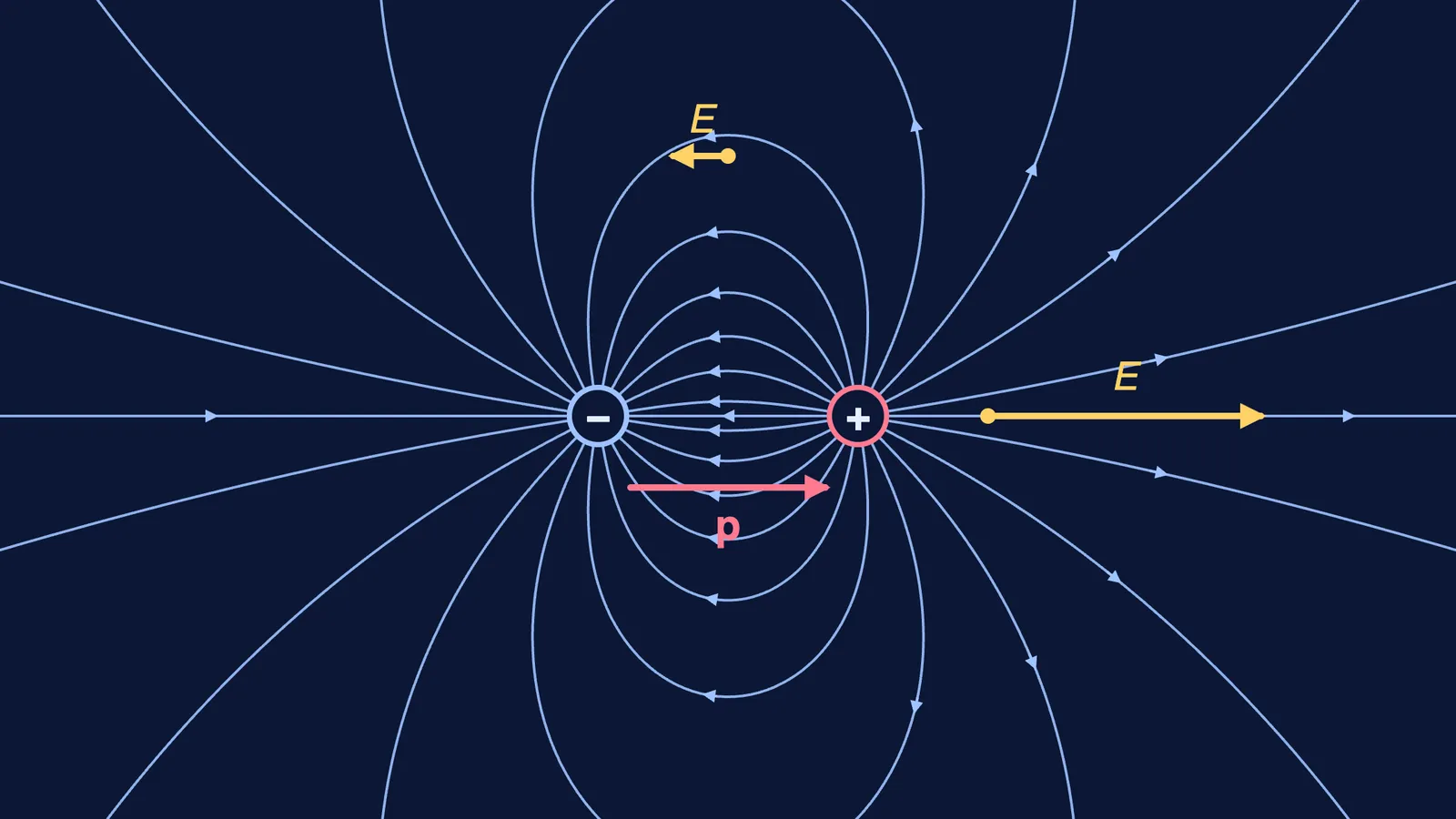
Field-line sketches for a single charge, two equal positive charges and a dipole, plus the four properties of field lines.
NCERT defines the dipole moment p as q × 2a, pointing from −q to +q, and shows that far from the dipole the field falls as 1/r³, not 1/r².
Our worked line-charge field using Gauss's law shows the cylinder step by step.
How do you set out 2-, 3- and 5-mark answers?
2 marks: one definition or statement in a full sentence, then the formula with symbols named. Add a small labelled sketch if direction matters.
3 marks: diagram first, then the two field contributions, how they combine, and the boxed result with direction. Mention the r ≫ a approximation if you use it.
5 marks: statement of the law, a labelled Gaussian surface, flux on each part of it, the result, and one line on what it means (for the shell, a field-versus-distance sketch).
For numericals: given values in SI units, formula, substitution, answer with unit and direction. Our guide on writing board numericals for full step marks goes further.
A worked board numerical, solved two ways
Question (3 marks): Charges +1 nC and −1 nC sit 2 cm apart. Find the field at a point on their axis 1 cm beyond the positive charge. Take k = 9 × 10⁹ N m² C⁻² (NCERT's value).
Method 1, superposition. The point is 1 cm from +q and 3 cm from −q. Here kq = 9 N m² C⁻¹.
From +q: 9 / (0.01)² = 9 × 10⁴ N C⁻¹, pointing away from +q.
From −q: 9 / (0.03)² = 1 × 10⁴ N C⁻¹, pointing back towards −q.
Net: 8 × 10⁴ N C⁻¹, along p (from −q towards +q, continuing outward).
Method 2, the exact axial formula. With a = 0.01 m and r = 0.02 m from the centre, E = 4kqar / (r² − a²)² = (7.2 × 10⁻³) / (9 × 10⁻⁸) = 8 × 10⁴ N C⁻¹. Same answer.
Which assertion-reason and case-study traps cost marks?
For assertion-reason, judge each statement separately, then ask whether the reason explains the assertion. Common traps:
"A dipole has zero net charge, so its field is zero." False: the fields only nearly cancel.
Flux through a closed surface depends only on the charge inside it, but the field on that surface depends on every charge, inside and outside.
In a uniform field a dipole feels no net force yet can feel a torque. In a non-uniform field it feels a net force, which is why a charged comb picks up paper bits.
Electrostatic field lines never cross and never form closed loops.
Case studies (4 marks) hide traps in units: nC and μC, cm and mm. Convert first, and state directions in words.
What one-week revision plan works?
Day 1: charge properties, Coulomb's law, superposition with vector diagrams.
Day 2: field lines and flux; draw all four sketches from memory.
Day 3: both dipole-field derivations, timed.
Day 4: torque on a dipole; Gauss's law statement.
Day 5: the three Gauss's law applications.
Day 6: ten assertion-reason items and one case study.
Day 7: a mixed timed set; redo every mistake.
Sitting JEE Main too? Keep speed drills for our Electrostatics for JEE Main plan and use this week for written answers. The Fermi Simulation Lab has interactive simulations for the ideas that are easier to see than to read. The Fermi Problem Library has worked problems with a step-by-step solver that explains the reasoning rather than printing an answer.