On this page
You open Instagram and see someone's all-day "study with me" timelapse. A Telegram group shares a mock score far above yours. You close the app feeling behind, even though your own day was fine. That feeling has a name, decades of research behind it, and a practical fix: change what you measure yourself against.
Why do other aspirants' study posts make you feel behind?
In 1954 the psychologist Leon Festinger proposed that people have a drive to evaluate their opinions and abilities, and that when no objective, non-social measure is available, they do it by comparing themselves with others (Festinger, Human Relations, 1954). He also argued that when an objective basis for judging yourself is readily available, you do not compare yourself with others.
"Am I preparing well enough?" is hard to answer from the inside, so the feed hands you a yardstick: other people's best days. Festinger also argued that a very divergent comparison gives no precise sense of where you stand. A stranger's highlight reel is that kind of comparison; you never see their bad weeks or whether those hours were focused.
What does research say about social comparison on social media?
Comparing yourself with someone who seems to be doing better is called upward comparison. In a 2014 paper, Erin Vogel, Jason Rose, Lindsay Roberts and Katheryn Eckles at the University of Toledo ran two studies on this (Vogel et al., 2014). In the first, a survey, people who used Facebook most often tended to have lower trait self-esteem, which the team linked to frequent upward comparisons (University of Toledo summary). In the second, brief exposure to made-up profiles of fit, well-supported students affected state self-esteem, meaning how participants felt about themselves in that moment.
The limits matter: the survey shows a link, not a cause, and the experiment used fitness profiles shown to US undergraduates, not study posts shown to Indian aspirants.
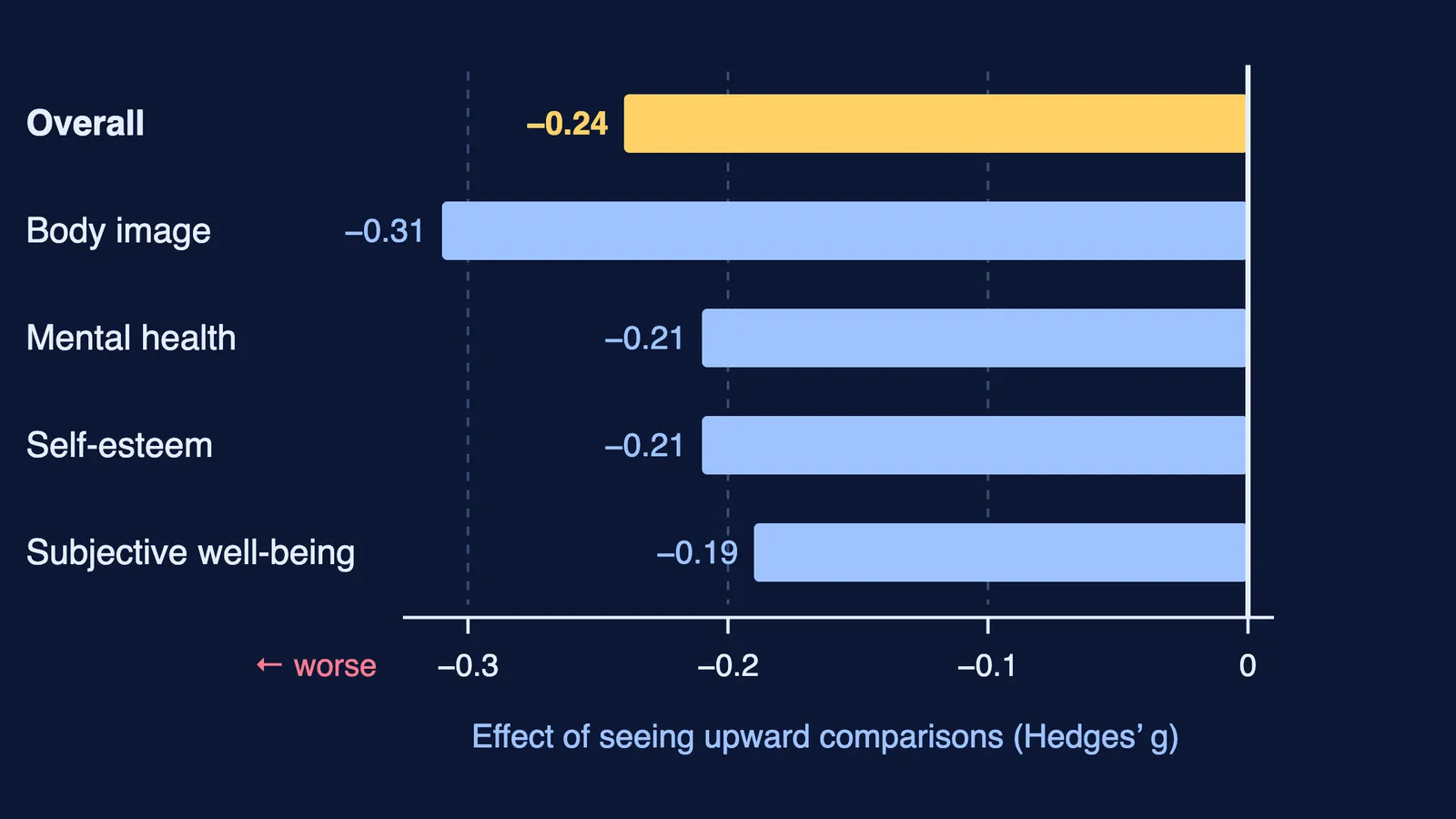
A larger picture comes from a 2023 meta-analysis by Carly McComb, Eric Vanman and Stephanie Tobin, which pooled 48 experimental articles with 7,679 participants (McComb et al., Media Psychology, 2023). Compared with seeing downward comparisons or control content, seeing upward comparison targets on social media worsened self-evaluations and emotions, with an overall effect size of g = −0.24. That is a small average effect: real, but it says nothing about your rank.
Does cutting back on social media help students?
One experiment tested it directly. Melissa Hunt and colleagues at the University of Pennsylvania randomly assigned 143 undergraduates either to limit Facebook, Instagram and Snapchat to 10 minutes per platform per day for three weeks, or to use them as usual (Hunt et al., 2018). The limited group showed significant reductions in loneliness and depression compared with the usual-use group. Both groups reported less anxiety and fear of missing out than at the start, which the authors suggest reflects a benefit of monitoring their own use.
It is one study at one university over three weeks, so treat it as a lead, not a rule.
How do you compare with yourself instead?
Try this seven-day mute-and-measure plan.
Day 1: pick one number you control. Focused hours from a timer, practice questions correct, or your mock trend using a three-mock moving average. Write down last week's figure.
Day 1: mute the trigger accounts. On Instagram, YouTube and Telegram, mute or turn off notifications for the accounts and groups that post hours logged or mock scores. Keep the ones that teach you something.
Days 2 to 6: log one line a day. Your number and one thing that went right, like the small wins method for studying.
Day 7: compare with your own last week. Use a short Sunday review of your study week and fill in: "Last week I ___. This week I ___. Next week I will change one thing: ___."
Then decide. Unmute only what you miss.
A made-up example: Riya, a JEE Main aspirant in Class 12, tracks physics practice questions. Last week she got 25 of 42 right; this week, after muting a few "study with me" accounts, 31 of 50. Most misses were in rotational motion, so next week's one change is a daily rotation set. If wrong answers keep coming from the same wrong method, the Fermi Problem Library has worked problems with a step-by-step solver that explains the reasoning rather than printing an answer.
When a post still stings, say this to yourself: "That is their best day, not their week. My number this week is ___, and last week it was ___."
When is it more than a bad scroll?
A pang after a topper's post is ordinary. If the feeling lasts for weeks, affects your sleep, or leaves you hopeless, talk to a parent, teacher or school counsellor. You can also call Tele MANAS, the government's 24x7 tele-mental-health service, on 14416 or 1800-89-14416 (Ministry of Health and Family Welfare).
Start tonight: pick your one number and write down last week's figure.