On this page
These eight straight lines questions follow the style of JEE Main Paper 1 mathematics, graded easy to hard. Every question is original, every answer was checked with a computer algebra system, and each solution ends with the trap: a tempting wrong option and why it tempts.
What does JEE Main test in straight lines?
NTA's syllabus for JEE (Main) 2027 places straight lines in Unit 10, Co-ordinate Geometry. It lists the various forms of the equation of a line, intersection of lines, angles between two lines, conditions for concurrence of three lines, the distance of a point from a line, and the coordinates of the centroid, orthocentre and circumcentre of a triangle. For the theory and a study plan first, read our guide on how to prepare Straight Lines for JEE Main.
How to use this set
Cover the solutions. Give yourself about 2 minutes per easy question and 3 to 4 per hard one.
Write your option down before you look.
For every miss, read the trap line and write which one caught you.
Redo the missed questions after three days without looking at the solution.
Easy: slopes and distances
Q1 (easy). The line through (2, −3) perpendicular to 4x − 3y + 7 = 0 is
(A) 4x − 3y − 17 = 0
(B) 3x + 4y + 6 = 0
(C) 3x − 4y − 18 = 0
(D) 4x + 3y + 1 = 0
Answer: (B). The given slope is 4/3, so the perpendicular slope is −3/4 and the line is 3x + 4y + k = 0. Putting in (2, −3): 6 − 12 + k = 0, so k = 6. Trap: (A) passes through the point but is parallel, not perpendicular.
Q2 (easy). The distance of the point (1, 2) from the line 5x + 12y − 3 = 0 is
(A) 26/17
(B) 2
(C) 32/13
(D) 26
Answer: (B). Distance = |5(1) + 12(2) − 3| / √(25 + 144) = 26/13 = 2. Trap: (A) divides by 5 + 12 instead of √(5² + 12²).
Q3 (easy). The distance between the parallel lines 6x − 8y + 5 = 0 and 3x − 4y − 5 = 0 is
(A) 1
(B) 3/2
(C) 2
(D) 3
Answer: (B). Rewrite the second line as 6x − 8y − 10 = 0 so the x and y coefficients match. Distance = |5 − (−10)| / √(36 + 64) = 15/10 = 3/2. Trap: (A) subtracts the constants 5 and −5 without first making the coefficients equal.
Medium: angles, concurrence and reflections
Q4 (medium). The acute angle between the lines y = 3x + 1 and x + 2y = 4 is
(A) π/4
(B) tan⁻¹(7/5)
(C) tan⁻¹ 7
(D) π − tan⁻¹ 7
Answer: (C). The slopes are 3 and −1/2. tan θ = |(3 + 1/2) / (1 + 3(−1/2))| = |3.5 / (−0.5)| = 7. Trap: (B) adds 3/2 in the denominator instead of subtracting it, forgetting that one slope is negative.
Q5 (medium). The lines 2x + y − 5 = 0, x − 3y + 1 = 0 and kx + 2y − 8 = 0 are concurrent. Then k equals
(A) −5
(B) 3
(C) 4
(D) 5
Answer: (B). The first two lines meet at (2, 1). For the third line to pass through it, 2k + 2 − 8 = 0, so k = 3. Trap: (C) comes from swapping the coordinates and substituting (1, 2).
Q6 (medium). The mirror image of the point (3, 1) in the line x − 2y + 4 = 0 is
(A) (2, 3)
(B) (1, 5)
(C) (5, −3)
(D) (1, −3)
Answer: (B). Use (x − 3)/1 = (y − 1)/(−2) = −2(3 − 2 + 4)/(1 + 4) = −2. So x = 1 and y = 5. Trap: (A) is the foot of the perpendicular, the halfway point; the image is twice as far.
Hard: triangle centres and a numerical question
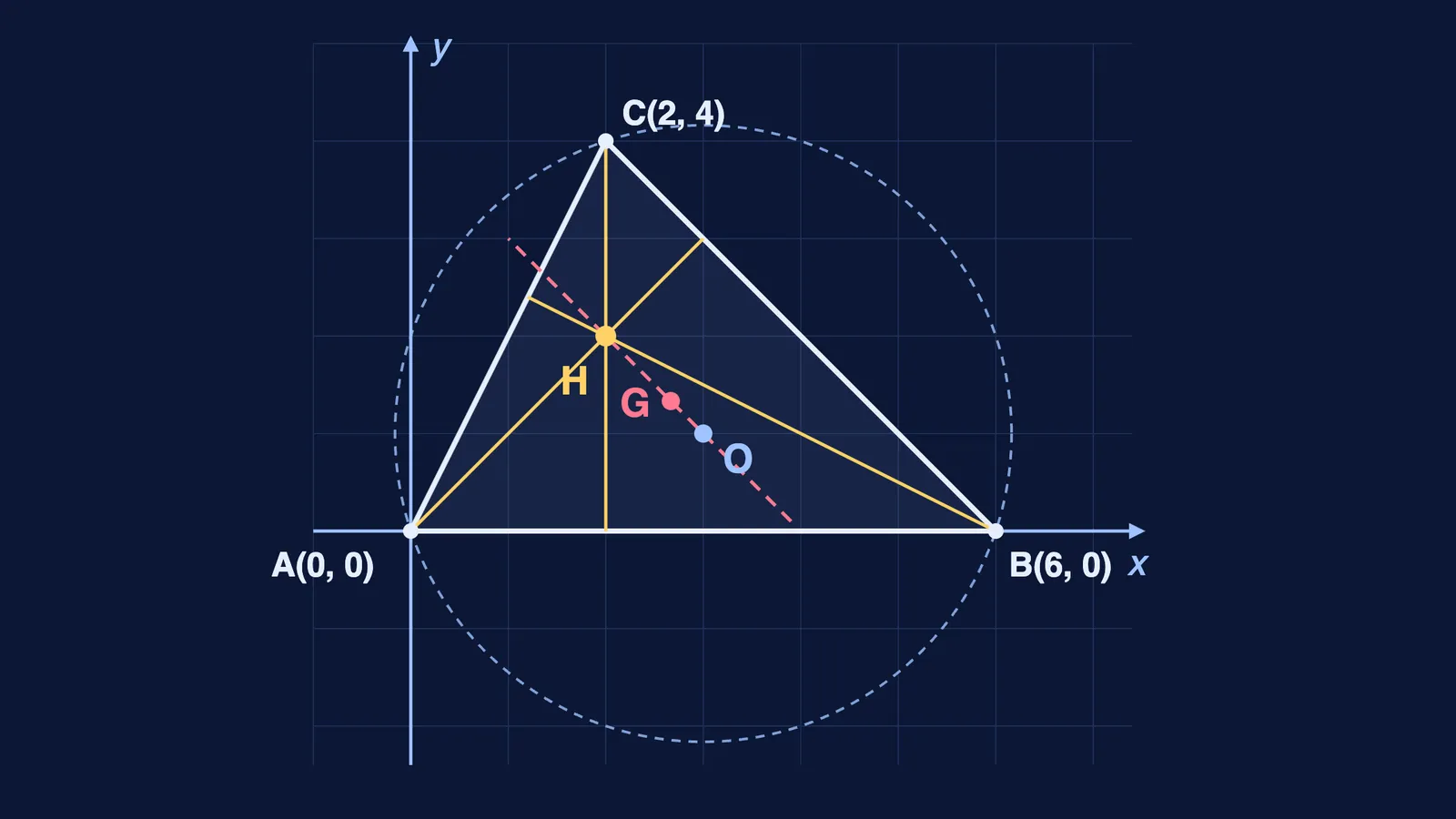
Q7 (hard). The orthocentre of the triangle with vertices A(0, 0), B(6, 0) and C(2, 4) is
(A) (8/3, 4/3)
(B) (3, 1)
(C) (2, 2)
(D) (2, −2)
Answer: (C). The altitude from C is x = 2, because AB lies on the x-axis. BC has slope −1, so the altitude from A has slope 1: y = x. They meet at (2, 2). Trap: (B) is the circumcentre and (A) the centroid; as a check, H, G and O lie on one line with HG = 2·GO, as the diagram at the top shows.
Q8 (hard, numerical answer). A line through P(3, 5) cuts the positive x-axis at A and the positive y-axis at B. If O is the origin, the least possible area of triangle OAB, in square units, is ____.
Answer: 30. Write the line as x/a + y/b = 1 with 3/a + 5/b = 1. By AM-GM, 1 = 3/a + 5/b ≥ 2√(15/(ab)), so ab ≥ 60 and the area ab/2 ≥ 30. Equality needs 3/a = 5/b = 1/2, so a = 6, b = 10 and P is the midpoint of AB. Trap: entering 60 means you found ab and forgot the half.
What should you do after this set?
Write down which trap caught you. If it was signs, redo Q1, Q3 and Q6 tomorrow. If it was the triangle centres, read our method for the equation of a perpendicular bisector, since two perpendicular bisectors give you the circumcentre. If the basics still feel shaky, the Class 11 Straight Lines guide covers the NCERT chapter from the start.
For more practice of the same kind, the Fermi Problem Library has worked problems with a step-by-step solver that explains the reasoning rather than printing an answer.