On this page
These eight original NEET-style kinematics questions climb from easy to hard. Each has one correct option, a worked solution, and a note on the most tempting wrong option.
Kinematics is Unit 2 of the physics syllabus in the NMC syllabus for NEET (UG)-2026 published by NTA. The unit covers straight-line motion and its graphs, uniformly accelerated motion, vectors, relative velocity, projectile motion and uniform circular motion.
How should you use this kinematics practice set?
Cover the answers and give yourself about a minute per question.
Write one line of working for each, so you can later tell a physics mistake from an arithmetic slip.
Mark each question right, wrong or guessed. A lucky guess counts as wrong.
For every miss, read the trap note and check whether it was your mistake.
Take g = 10 m/s² throughout and ignore air resistance. If a topic feels shaky, start with our guide on how to prepare kinematics for NEET, then come back.
Easy: can you read motion from an equation and a graph?
Q1 (easy). A scooter moves along a straight road. Its position is x = 4t² − 3t + 2, with x in metres and t in seconds. What is its velocity at t = 2 s?
(A) 12 m/s (B) 13 m/s (C) 16 m/s (D) 5 m/s
Answer: (B). Differentiate: v = dx/dt = 8t − 3. At t = 2 s, v = 16 − 3 = 13 m/s.
Trap: (A) is the position at t = 2 s, not the velocity. (D) is the average velocity over the first 2 s.
Q2 (easy). A ball is thrown straight up at 25 m/s and caught at the same height. What total distance does it travel?
(A) 0 m (B) 31.25 m (C) 62.5 m (D) 125 m
Answer: (C). It rises u²/2g = 625/20 = 31.25 m, then falls 31.25 m: 62.5 m in all.
Trap: (A) is the displacement, not the distance.
Q3 (easy). On parallel tracks, train P (150 m long, 54 km/h) catches up with train Q (100 m long, 36 km/h) moving the same way. How long does P take to completely overtake Q?
(A) 10 s (B) 30 s (C) 13.9 s (D) 50 s
Answer: (D). Relative velocity is 54 − 36 = 18 km/h = 5 m/s. P must gain 150 + 100 = 250 m, so t = 250/5 = 50 s.
Trap: (A) adds the speeds, which is right only for trains moving in opposite directions.
Medium: where do graphs and projectiles catch people out?
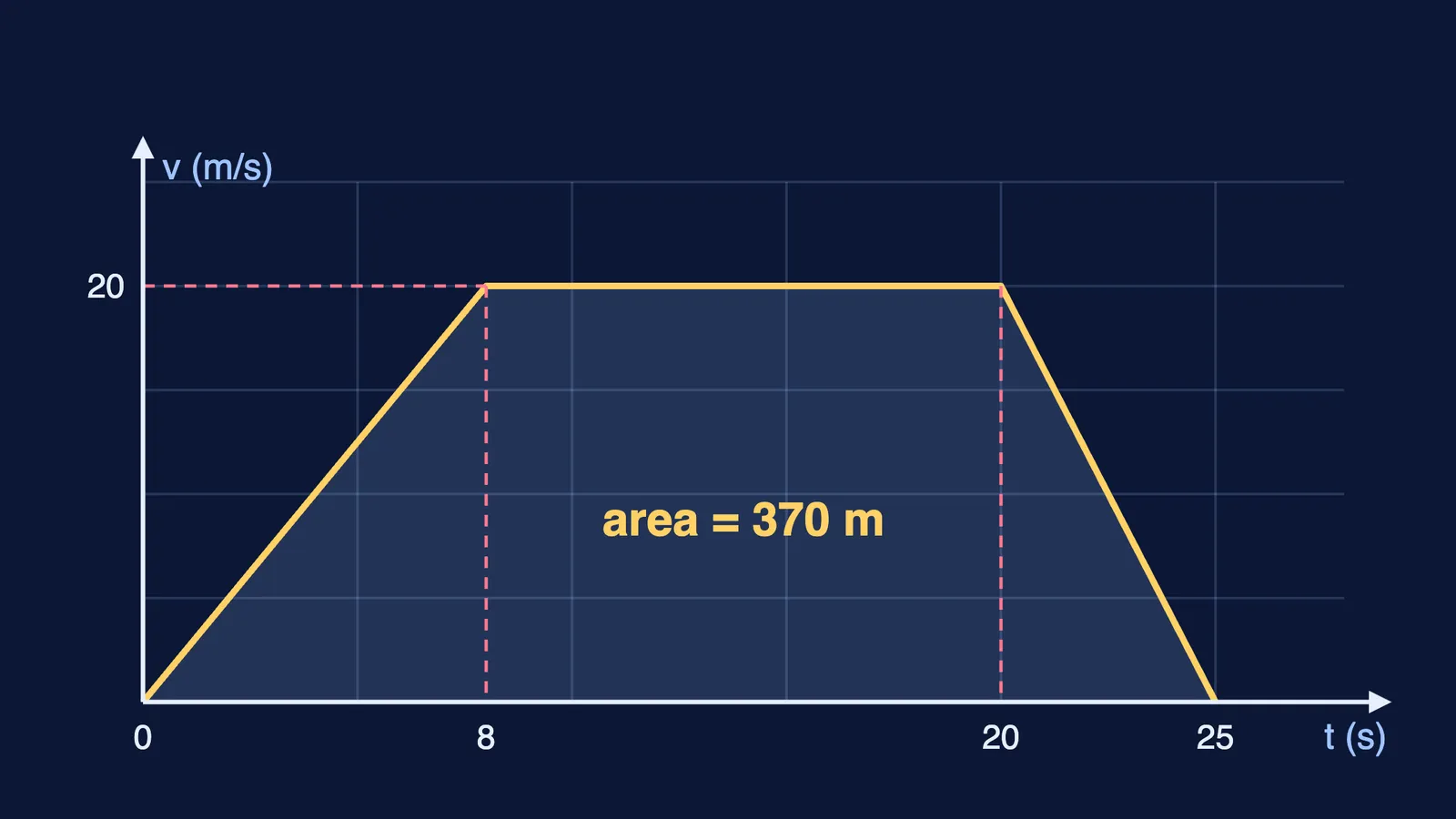
Q4 (medium). A car starts from rest, speeds up uniformly to 20 m/s in 8 s, cruises at 20 m/s for 12 s, then slows uniformly to rest in 5 s. What is its average speed for the trip?
(A) 10 m/s (B) 14.8 m/s (C) 13.3 m/s (D) 20 m/s
Answer: (B). Distance is the area under the velocity-time graph: ½ × 8 × 20 + 12 × 20 + ½ × 5 × 20 = 80 + 240 + 50 = 370 m. Average speed = 370/25 = 14.8 m/s.
Trap: (C) averages the three stage speeds (10, 20 and 10 m/s) without weighting them by time.
Q5 (medium). A stone is dropped from the top of a tower. It covers 35 m in the last second of its fall. What is the height of the tower?
(A) 45 m (B) 61.25 m (C) 125 m (D) 80 m
Answer: (D). Distance in the nth second of free fall from rest is (g/2)(2n − 1) = 5(2n − 1). Setting this equal to 35 gives n = 4 s, so h = ½ × 10 × 4² = 80 m.
Trap: (A) is the distance fallen in the first 3 s, before the last second starts.
Q6 (medium). A stone is thrown from level ground at 20 m/s, 30° above the horizontal. What are its speed at the highest point and its maximum height?
(A) 0 m/s and 5 m (B) 17.3 m/s and 5 m (C) 10 m/s and 5 m (D) 17.3 m/s and 15 m
Answer: (B). At the top only the horizontal component remains: 20 cos 30° ≈ 17.3 m/s. Maximum height is (u sin θ)²/2g = 10²/20 = 5 m.
Trap: (A) forgets the horizontal velocity, which never changes. For more component practice, see when a projectile's velocity is perpendicular to its initial velocity.
Hard: can you handle vectors in circular motion and river crossings?
Q7 (hard). A particle moves on a circle of radius 2 m at a constant speed of 4 m/s. What is the magnitude of its average acceleration over a quarter of a revolution?
(A) 8 m/s² (B) 0 (C) 7.2 m/s² (D) 5.1 m/s²
Answer: (C). After a quarter turn the velocity has rotated by 90°, so |Δv| = 4√2 m/s. The time is (π × 2/2)/4 = π/4 s. Average acceleration = 4√2 ÷ (π/4) = 16√2/π ≈ 7.2 m/s².
Trap: (A) is the instantaneous centripetal acceleration v²/r, not the average over the interval.
Q8 (hard). A river is 90 m wide and flows at 1.2 m/s. A swimmer can swim at 2 m/s relative to the water. If she wants to land directly opposite her starting point, how long does the crossing take?
(A) 45 s (B) 56.25 s (C) 75 s (D) 28.1 s
Answer: (B). She heads upstream so her upstream component cancels the current. Her speed across is √(2² − 1.2²) = 1.6 m/s, so t = 90/1.6 = 56.25 s.
Trap: (A) is the shortest-time crossing, swimming straight across. She would then drift 54 m downstream.
What should you do after checking your answers?
Group your mistakes by type. Misreading the question needs slower reading, the wrong equation needs mixed practice, and arithmetic slips need neater working. If graphs were the problem, our explainer on motion in a straight line for Class 11 goes through position-time and velocity-time graphs step by step.
For more practice, the Fermi Problem Library has worked problems with a step-by-step solver that explains the reasoning rather than printing an answer, so you can see exactly where your method went wrong.
Try the set again in a week without looking at your notes.