On this page
Kinematics opens NEET physics: describing motion with graphs, equations and vectors before forces arrive. NEET tests it as quick single-answer questions, so you need clean setups and an eye for the trap option. Here is the syllabus, the NCERT map, three worked examples and a two-week plan.
What does the NEET syllabus include in Kinematics?
The latest official syllabus is the NMC's updated syllabus for NEET (UG) 2026, dated 22-12-2025. Physics Unit 2, Kinematics, lists the frame of reference, motion in a straight line, position-time and velocity-time graphs, speed and velocity, uniform and non-uniform motion, average speed and instantaneous velocity, uniformly accelerated motion and its relations, scalars and vectors, vector addition and subtraction, scalar and vector products, unit vectors, resolution of a vector, relative velocity, motion in a plane, projectile motion and uniform circular motion. No 2027 syllabus is on the NTA NEET site yet; check there before you finalise your plan.
It maps to the 2026-27 NCERT Class 11 Physics Part I, with three gaps:
Chapter 2, Motion in a Straight Line runs from instantaneous velocity to acceleration, the kinematic equations and relative velocity. It has no section on frame of reference, displacement or average speed, though its summary notes that average speed is at least the magnitude of average velocity. Learn those definitions anyway; the syllabus names them.
Chapter 3, Motion in a Plane covers vectors, motion in a plane, projectiles and uniform circular motion. It has no separate relative velocity section; 2D cases appear only in worked examples (rain with wind, a motorboat in a current).
The scalar product is taught in Chapter 5, Section 5.1.1, and the vector product in Chapter 6, Section 6.5 (contents).
How is Kinematics tested in NEET?
As in NEET-UG 2026, the NTA information bulletin set 180 compulsory questions in 180 minutes, with 45 Physics questions worth 180 marks. Each is a four-option MCQ with one correct answer: +4 if right, -1 if wrong, 0 if unanswered.
That is about a minute per question, with no numerical-value section. So you need instant formula recall, a unit or dimension check to strike out options, and close reading of NCERT statements, such as its point that a particle momentarily at rest can still be accelerating.
How do you solve NEET Kinematics questions fast?
Example 1: distance from a v-t setup. A particle at 6 m/s has constant acceleration -2 m/s². Distance travelled in 5 s? Options: 5 m, 9 m, 13 m, 25 m.
Displacement is 6 × 5 − ½ × 2 × 25 = 5 m, which is the trap option. Velocity hits zero at t = 3 s after 9 m; the particle then returns ½ × 2 × 2² = 4 m. Distance = 9 + 4 = 13 m. If velocity changes sign, split at the turning point.
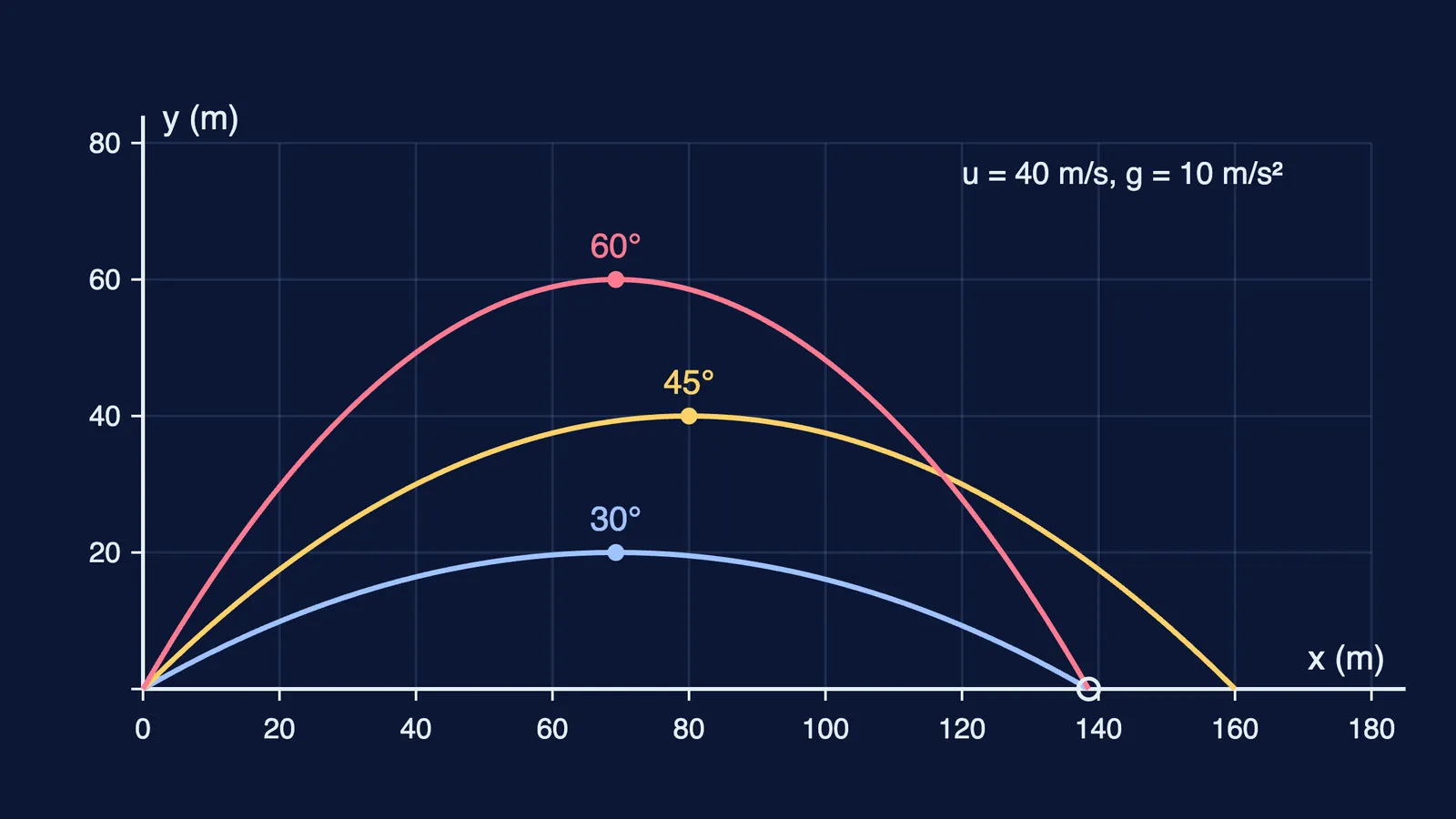
Example 2: projectile shortcuts. A ball is launched at 40 m/s at 30° above level ground (g = 10 m/s²). Vertical component 20 m/s, so time of flight T = 2 × 20/10 = 4 s and maximum height H = 20²/20 = 20 m. Range R = 40² × sin 60°/10 = 80√3 ≈ 138.6 m. Check with H/R = tan θ/4: 20/138.6 ≈ 0.144 and tan 30°/4 ≈ 0.144. At 60° the range is the same, but the ball climbs to 60 m.
Example 3: rain and a cyclist. Rain falls vertically at 8 m/s; you cycle east at 6 m/s. Rain relative to you is 6 m/s west and 8 m/s down: 10 m/s at about 37° from the vertical. Tilt the umbrella forward.
Stuck on a step? The Fermi Problem Library has worked problems with a step-by-step solver that explains the reasoning rather than printing an answer.
What should a two-week Kinematics plan look like?
Days 1-3: NCERT Chapter 2 line by line; one page of definitions, the three equations and graph rules (x-t slope is velocity, v-t area is displacement).
Days 4-6: vectors, resolution, scalar and vector products.
Days 7-9: projectiles and uniform circular motion; memorise T, H and R.
Days 10-11: relative velocity in 1D and 2D (trains, rain, boats).
Days 12-14: timed sets of 20 questions in 20 minutes; tag each mistake as concept, sign, unit or reading.
Practice questions
A car slows uniformly from 30 m/s to 10 m/s over 100 m. What is its deceleration?
A ball is released from rest at the top of an 80 m tower (g = 10 m/s²). How long does it take to reach the ground?
Trains 150 m and 100 m long run the same way at 54 km/h and 36 km/h. How long does overtaking take?
Answers: 1. 4 m/s² (from v² = u² + 2as). 2. 4 s. 3. 50 s (5 m/s relative, 250 m).
For board-level theory, see our guides to Motion in a Straight Line for Class 11 and Motion in a Plane for Class 11. Taking JEE too? Read our Kinematics for JEE Main guide.