On this page
Motion in a Straight Line is Chapter 2 of NCERT Physics Part I and opens Unit II, Kinematics. Every later mechanics chapter reuses its graphs and sign rules.
What does the 2026-27 syllabus cover?
The CBSE 2026-27 Physics curriculum lists frame of reference, uniform and non-uniform motion, average speed, average and instantaneous velocity, uniformly accelerated motion, x-t and v-t graphs, elementary differentiation and integration for describing motion, and the relations for uniformly accelerated motion by graphs and by calculus.
The current NCERT chapter, marked "Reprint 2026-27", matches this: instantaneous velocity, acceleration and the kinematic equations, with examples on free fall, stopping distance and reaction time.
One trap: its contents box ("2.5 Relative velocity") and opening paragraph still mention relative velocity, but the reprint has no section on it and the curriculum does not list it. Treat it as dropped from this chapter for 2026-27.
How many marks does this chapter carry?
Marks are printed per group of units, not per chapter. Units I to III (Units and Measurements, both Kinematics chapters, and Laws of Motion) share 23 marks of the 70-mark Class 11 theory paper, according to the CBSE course structure. There is no separate figure for this chapter.
The same document splits the 70 marks into 27 for remembering and understanding, 22 for applying, and 21 for analysing, evaluating and creating.
How do you read x-t and v-t graphs?
The slope of the tangent to an x-t graph gives velocity at that instant.
The slope of a v-t graph gives acceleration.
The area under a v-t graph gives displacement.
With uniform acceleration, the x-t graph is a parabola and the v-t graph a straight line.
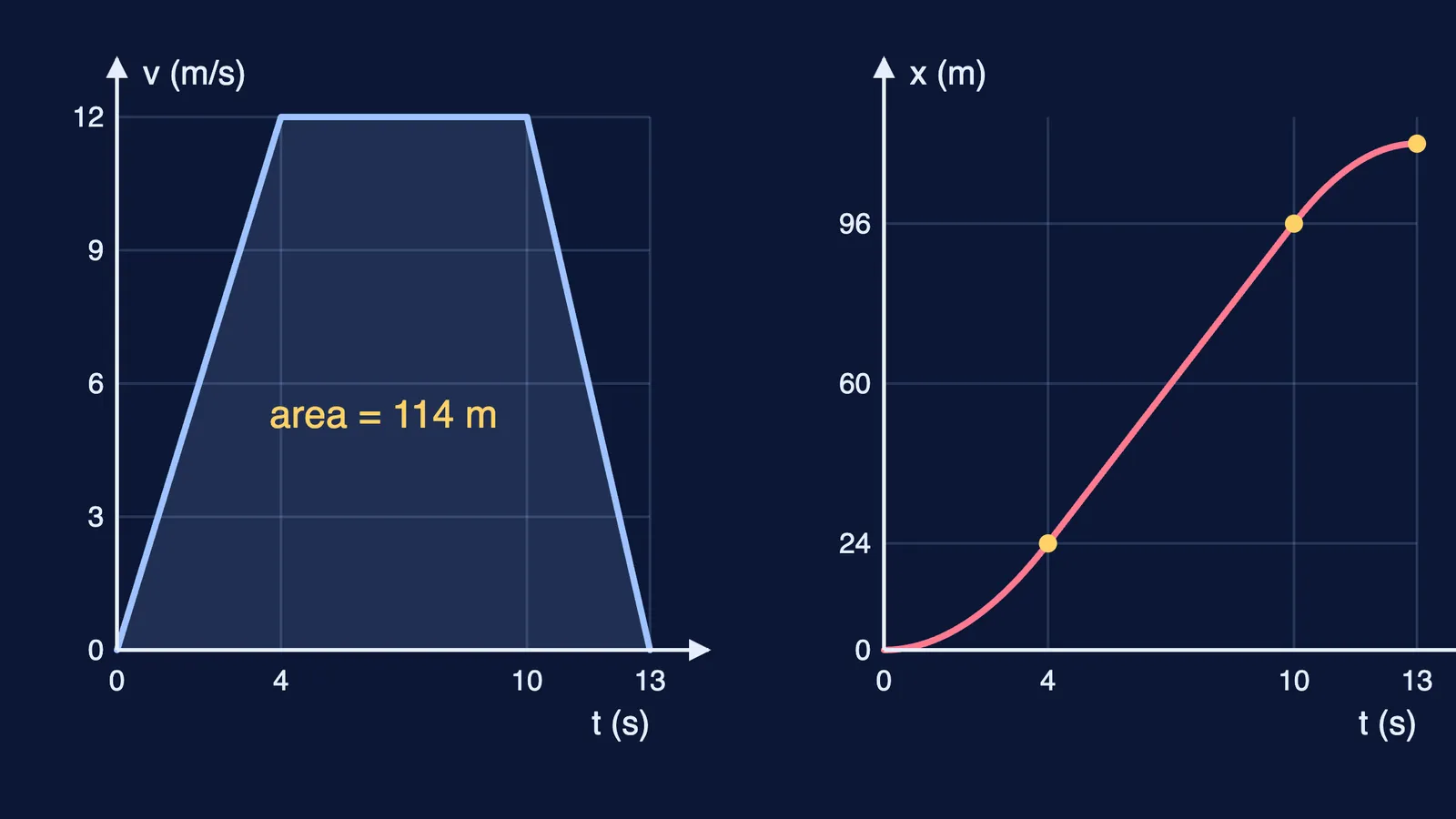
Worked example 1 (our numbers). A scooter starts from rest, speeds up uniformly to 12 m/s in 4 s, runs at 12 m/s for 6 s, then brakes uniformly to rest in 3 s.
First stage: a = (12 − 0)/4 = 3 m/s².
Last stage: a = (0 − 12)/3 = −4 m/s², opposite to the motion.
Displacement = area = ½ × 4 × 12 + 12 × 6 + ½ × 3 × 12 = 24 + 72 + 18 = 114 m.
Average velocity = 114 m ÷ 13 s ≈ 8.8 m/s.
The hero image shows this motion: the x-t curve bends upward, runs straight from 24 m to 96 m, then flattens at 114 m, where the slope (the velocity) falls to zero.
How do you use the kinematic equations without sign errors?
For constant acceleration, NCERT writes v = v0 + at, x = v0t + ½at² and v² = v0² + 2ax, replacing x by (x − x0) if the start is not at the origin. Fix the origin and positive direction first, then sign every quantity.
Worked example 2 (our numbers). A trolley is pushed up a long, smooth ramp at 6 m/s and slows at a steady 2 m/s². Take up the ramp as positive with the origin at the start, so v0 = +6 m/s and a = −2 m/s².
Farthest point: 0 = 6² − 2 × 2 × x, so x = 36 ÷ 4 = 9 m up the ramp.
When is it 5 m up? 5 = 6t − t², so t² − 6t + 5 = 0 and t = 1 s or 5 s: once on the way up, once on the way back.
Velocity at t = 5 s: v = 6 − 2 × 5 = −4 m/s, so 4 m/s down the ramp. Check: v² = 36 − 2 × 2 × 5 = 16.
If the same sign slip keeps returning, the Fermi Problem Library has worked problems with a step-by-step solver that explains the reasoning rather than printing an answer.
What board-style questions should you practise?
Our own questions, with answers in brackets:
(1 mark) What does a horizontal line on an x-t graph tell you about the body's velocity? [It is zero: the body is at rest.]
(2 marks) x = 2t³ − 6t² + 5 (x in m, t in s). When is the particle next at rest after t = 0, and what is its acceleration then? [t = 2 s; 12 m/s².]
(3 marks) Derive v² = v0² + 2ax from the v-t graph, then by calculus.
(3 marks) A driver at 20 m/s reacts after 0.5 s, then brakes at 5 m/s². Find the stopping distance. [10 m + 40 m = 50 m.]
(2 marks) Sketch the v-t graph of a ball thrown up and caught at the same height, upward positive. [A straight line from +v0 to −v0, crossing zero at the top.]
How should you revise this chapter?
Sketch a v-t graph for every numerical. Do one derivation a day, by graph and by calculus, until both feel routine.
Preparing for entrance exams too? Our kinematics for JEE Main guide adds harder problems. For the year ahead, try this weekly plan for Class 11 physics, and for more graph practice, the graphs of a bouncing ball.