On this page
If NEET biology feels like an endless pile of NCERT lines, the problem is usually not willpower. The method that feels most productive, rereading and highlighting, gives you almost no proof that anything is sticking, and motivation drains. If you keep putting the chapter off altogether, start with why we procrastinate and how to take the first step. This post gives you a different loop: small chunks, recall rounds you can score, and a sheet where you watch the numbers climb.
Why does rereading NCERT feel good but stop working?
Psychologists Elizabeth Bjork and Robert Bjork of UCLA describe the trap in a 2011 chapter on desirable difficulties. Rereading gives a sense of familiarity that we mistake for understanding, and conditions that make performance improve quickly often fail to support long-term memory.
Desirable difficulties are study conditions that feel harder but improve long-term learning: spacing sessions out, mixing topics, varying how you practise, and testing yourself instead of rereading (Bjork and Bjork, 2011).
The same chapter adds a limit: a difficulty only helps if you have the background to respond to it. For NEET biology, that means reading an NCERT section once, carefully, before you start testing yourself on it.
What does the research say about testing yourself?
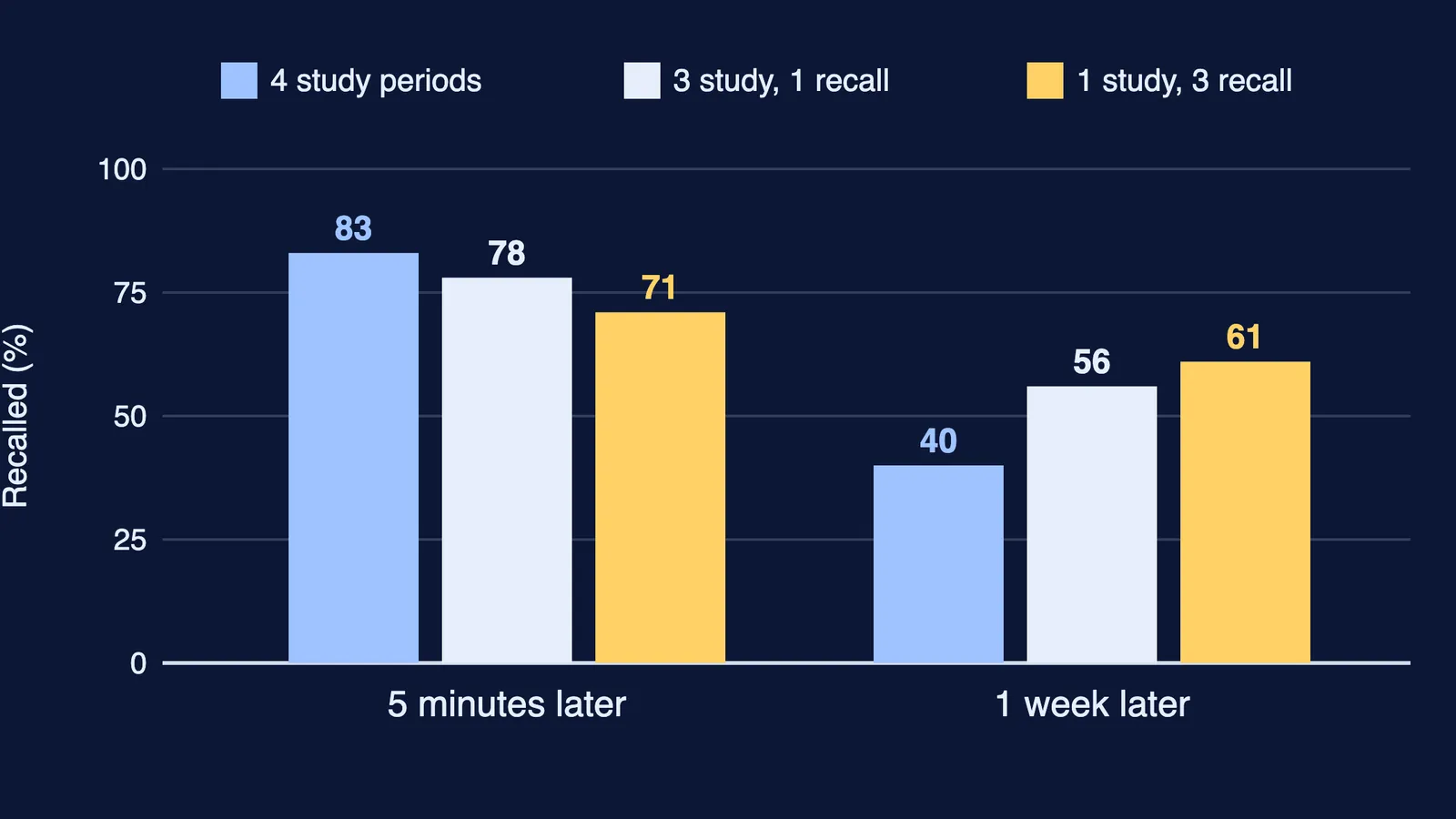
In a 2006 study by Henry Roediger and Jeffrey Karpicke, 180 Washington University undergraduates learned a short prose passage (on the sun or on sea otters) in four learning periods. One group spent all four periods reading it, one read it in three periods and recalled it once, and one read it in one period and then wrote down everything they remembered three times. Each version was tested on 30 students per delay.
Five minutes later, the rereaders were ahead: 83% recalled against 71% for the repeated-recall group. One week later the order flipped: 61% for repeated recall, 56% for one recall, and 40% for rereading (Roediger and Karpicke, 2006). The rereaders were also the most confident that they would remember the passage a week later.
The limits matter: these were college students in small groups, short prose passages and written recall without feedback, not NEET questions. But the gap between feeling and result shows up elsewhere too. In a 2008 study by Nate Kornell and Robert Bjork, people learned painters' styles better when the paintings were mixed, yet rated the grouped order as more effective, even after their own test showed the opposite. And a review by Cepeda and colleagues of 839 assessments in 317 experiments found that the best gap between sessions grows with how long you need to remember.
How do you chunk NCERT biology so it feels finite?
"Finish Human Physiology" never feels done. "Chunk 3: 18 out of 20" does. Split each chapter by its NCERT subheadings, and turn each chunk into 15 to 20 short questions in a notebook, answers hidden on the back.
Take Breathing and Exchange of Gases. Your chunks could be: respiratory organs, mechanism of breathing, respiratory volumes and capacities, exchange of gases, transport of gases, regulation of respiration, and disorders. A question from chunk 2: "Which muscles contract during inspiration?"
For the full chapter list, see how to prepare Human Physiology for NEET.
How do you score a recall round and see progress?
Close the book and answer one chunk's questions from memory, in writing.
Check every answer against NCERT and mark it right, partly right or blank.
Score it: right answers divided by total questions.
Log the date, chunk and score on one sheet per chapter.
Our rule of thumb, not a research finding: retest any chunk under 80% the next day; push chunks above 80% to three days later, then a week. The sheet is your proof of progress. Watching 9 out of 20 become 17 out of 20 is the kind of small win that keeps you going, as our post on the daily done-list method explains.
When an answer will not stick because the idea underneath is unclear, the Fermi Concept Library has a lesson for every concept in biology, so you can fix the understanding before you test the fact again.
A 7-day plan for one NEET biology chapter
Day 1: Read chunks 1 to 3 carefully once. Write their questions.
Day 2: Recall round on chunks 1 to 3 and log scores. Read chunks 4 and 5, write questions.
Day 3: Recall round on chunks 4 and 5. Retest any chunk under 80%.
Day 4: Mixed round: 15 questions drawn from all chunks, shuffled.
Day 5: Leave this chapter alone. Start chunking the next one.
Day 6: Full-chapter recall round. Score each chunk.
Day 7: Compare Day 2 with Day 6 scores. Book the next round for a week later.
If low mood or stress lasts for weeks, it is more than tiredness. Talk to a parent, teacher or school counsellor, or call the government's Tele MANAS helpline on 14416.
Pick one chapter tonight, write the questions for chunk 1, and run your first scored round tomorrow.