On this page
Prepare Human Physiology for NEET-UG from the official topic list, not an old guidebook: Digestion and Absorption is not on that list.
What does Human Physiology cover in the NEET 2026 syllabus?
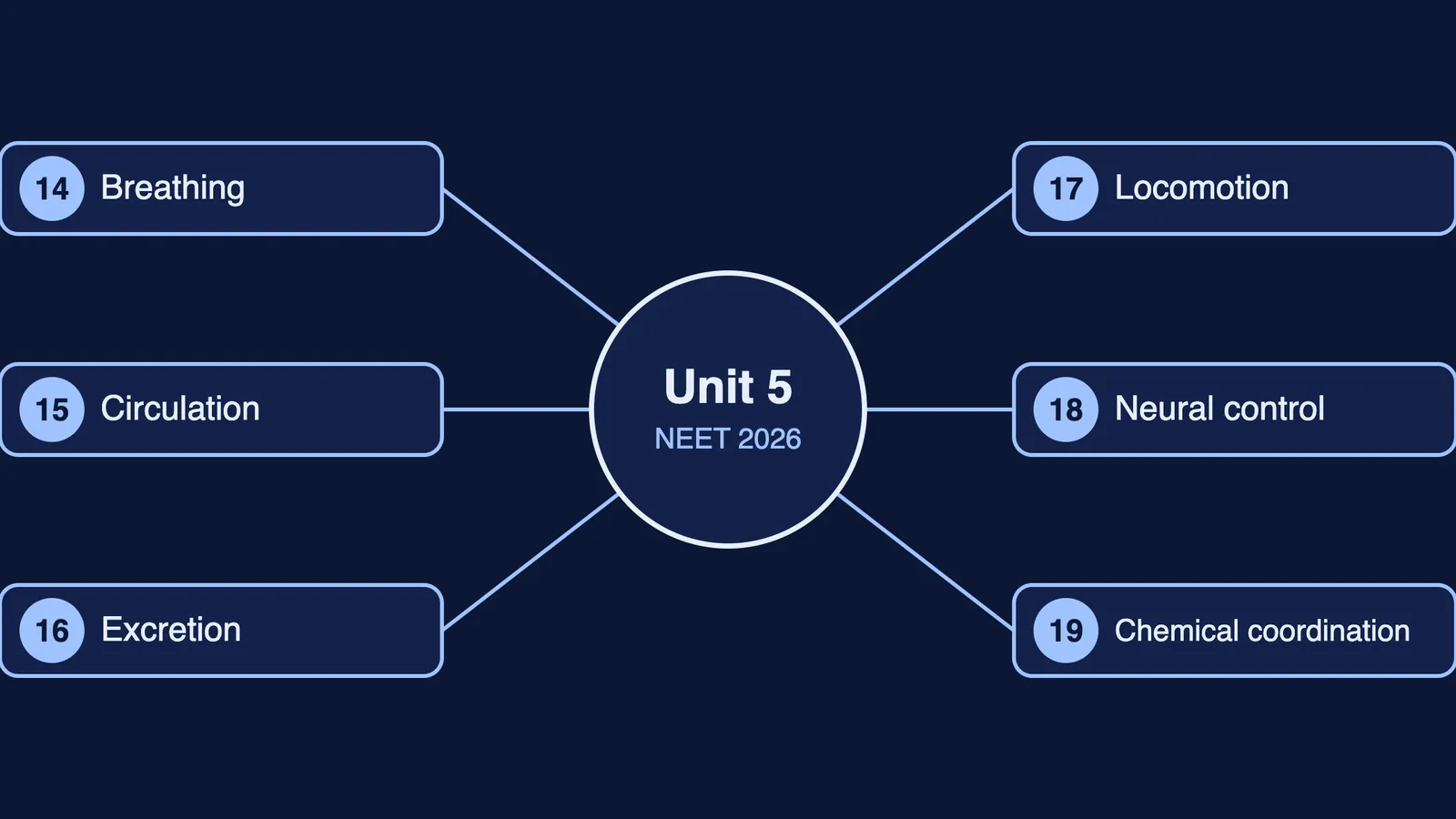
The National Medical Commission's updated syllabus for NEET (UG) 2026, dated 22 December 2025 and posted by NTA (NMC syllabus PDF), puts Human Physiology in Biology Unit 5 with six topics. Each matches a chapter of the current NCERT Class 11 Biology book (Reprint 2026-27), whose contents page lists Unit 5 as Chapters 14 to 19:
Breathing and Respiration: Chapter 14, Breathing and Exchange of Gases
Body fluids and circulation: Chapter 15, Body Fluids and Circulation
Excretory products and their elimination: Chapter 16
Locomotion and Movement: Chapter 17
Neural control and coordination: Chapter 18
Chemical coordination and regulation: Chapter 19, Chemical Coordination and Integration
Digestion and Absorption is not one of the Unit 5 topics, and the 2026-27 NCERT book has no chapter on it. The syllabus also says this unit's diseases and disorders are to be covered in brief. Keep each topic's syllabus line open while you read; it marks what is in scope.
How should you study each chapter from NCERT?
Each chapter has one mechanism to learn as a sequence you can draw from memory; attach the numbers after.
Chapter 14: how pressure changes drive breathing (section 14.2), and the volumes and capacities (14.2.1).
Chapter 15: the cardiac cycle (15.3.2) and the ECG (15.3.3) together, matching each wave to an event.
Chapter 16: the nephron (16.1), what each part of the tubule does (16.3) and the counter current mechanism (16.4).
Chapter 17: the contractile proteins (17.2.1), then the cross-bridge cycle (17.2.2).
Chapter 18: resting potential, then how an impulse is generated and conducted (18.3.1), as the syllabus words it.
Chapter 19: one gland at a time through 19.2: hormone, target, effect, disorder.
Our explainer on double circulation in humans follows blood one loop at a time. When a sequence like the cardiac cycle stays flat on the page, the Fermi Simulation Lab has interactive simulations for ideas that are easier to see than to read.
Which NCERT numbers should you be able to use?
Some questions here are short calculations on NCERT's own values (see our guide to numerical question types in NEET biology). Work these three by hand.
Vital capacity. NCERT Chapter 14 gives tidal volume as about 500 mL, inspiratory reserve volume as 2500 to 3000 mL and expiratory reserve volume as 1000 to 1100 mL. Vital capacity is ERV + TV + IRV, so about 4000 to 4600 mL. Residual volume (1100 to 1200 mL) is added only for total lung capacity.
Cardiac output. NCERT Chapter 15 gives an average heart rate of 72 beats a minute, so one cardiac cycle lasts 0.8 seconds. Each ventricle pumps about 70 mL per beat (the stroke volume), and 70 mL times 72 is roughly 5 litres a minute, NCERT's average cardiac output.
Reabsorption. In NCERT Chapter 16, a GFR of about 125 mL a minute means about 180 litres of filtrate a day, yet only about 1.5 litres of urine leaves, so nearly 99 per cent of the filtrate is reabsorbed.
Which traps cost marks in Human Physiology?
Most errors here are swapped pairs, all checkable in the NCERT chapters linked above.
Heart sounds: the first sound (lub) comes from the tricuspid and bicuspid valves closing; the second (dub) from the semilunar valves closing.
ECG: the QRS complex is ventricular depolarisation, and the end of the T-wave marks the end of systole.
Loop of Henle: the descending limb lets water through but almost no electrolytes; the ascending limb is the reverse.
ADH: released from the posterior pituitary but made in the hypothalamus. Too little gives diabetes insipidus, a water-loss condition.
Muscle: calcium binds a subunit of troponin, uncovering the sites on actin; the myosin head is the ATPase.
Nerve: the sodium-potassium pump moves 3 Na+ out for every 2 K+ in, leaving the inside of the resting axon negative.
How can you plan two weeks of Human Physiology practice?
Days 1 to 6: one chapter a day, 14 to 19. Read the sections above, draw the mechanism from memory, list its numbers on one card.
Day 7: redraw all six mechanisms on blank paper.
Days 8 to 10: previous year questions on this unit, chapter by chapter. For each miss, note the NCERT line that would have saved you. Our guide to using previous year questions for NEET sets up an error log for this.
Days 11 and 12: the traps list, then the disorders in brief.
Days 13 and 14: a mixed timed set, then re-read only the sections behind your errors.
If one idea keeps slipping, the Fermi Concept Library gives every biology concept its own lesson and its place in the map.
Tick the six topics on the syllabus PDF and start with Chapter 14 today.