On this page
Your heart is two pumps sitting side by side. The right half sends blood to the lungs; the left half sends it to the rest of the body. Because blood goes through the heart twice on one full trip, biologists call this double circulation. The reason behind it is more useful than the definition.
What is double circulation in humans?
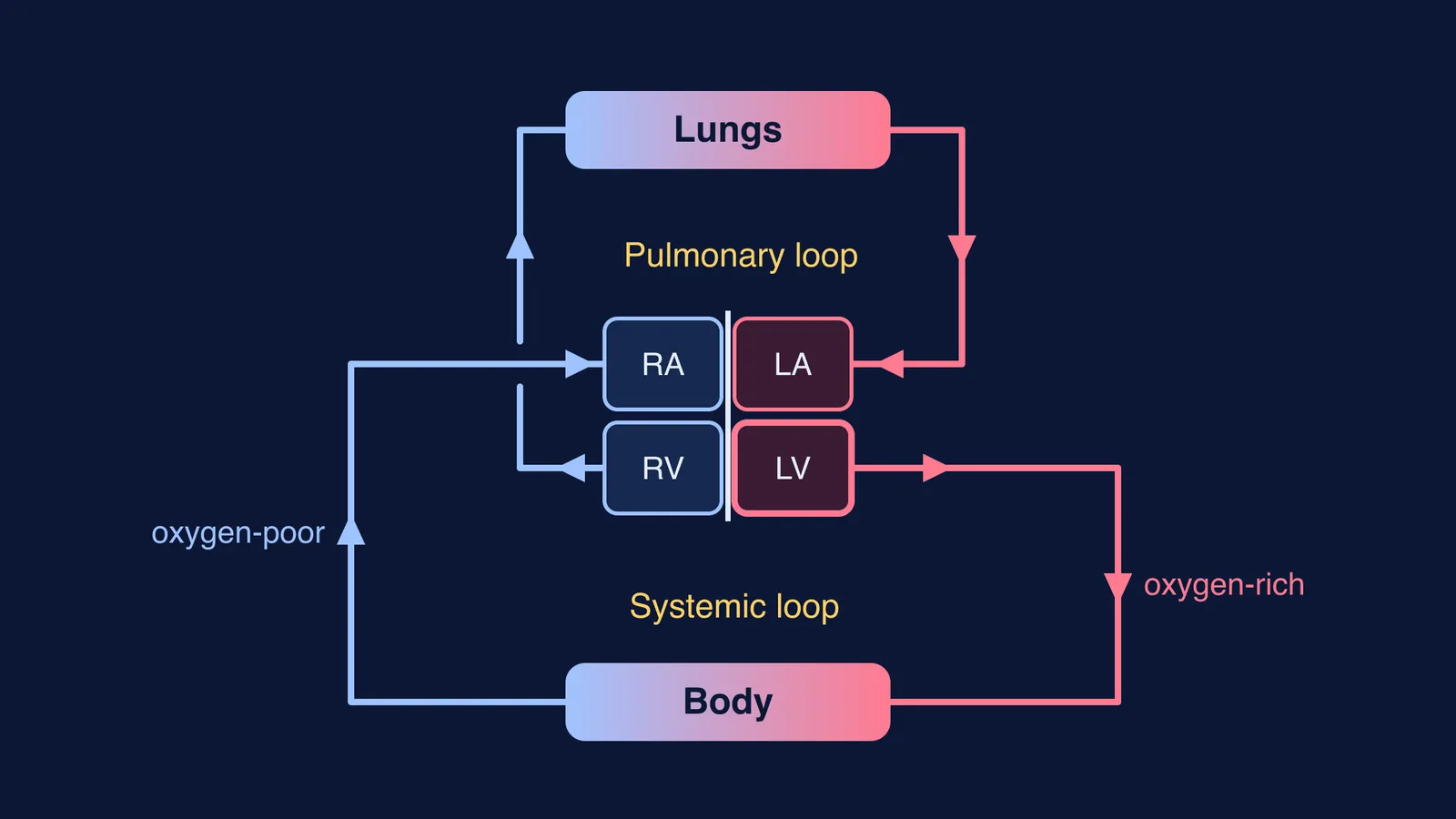
The pulmonary circuit carries blood to and from the lungs, where it picks up oxygen and gives up carbon dioxide (OpenStax Anatomy and Physiology 2e). The systemic circuit carries oxygenated blood to almost every tissue in the body and brings oxygen-poor blood back to the heart (same source).
Both sides of the heart pump the same amount of blood, yet the left ventricle's wall is much thicker, because it must generate enough pressure to push blood through the higher-resistance systemic circuit (same source).
Why do humans need double circulation?
Each of the three reasons depends on keeping the loops apart.
Undiluted oxygen. In a fully divided four-chambered heart, oxygen-rich blood from the lungs never mixes with oxygen-poor blood from the body. OpenStax Biology 2e notes that this separation improves efficiency and is "probably required for the warm-blooded lifestyle of mammals and birds" (OpenStax Biology 2e).
Two different pressures. The lungs need gentle pressure and the body needs strong pressure. Teach Me Physiology gives a mean arterial pressure of 5-15 mmHg in the pulmonary circulation against 93 mmHg in the systemic circulation (Teach Me Physiology). The barrier between lung air and blood is only about 0.3 micrometres thick, and low capillary pressure keeps fluid formation in the lungs to a minimum (same source). Two separate pumps let each loop run at its own pressure.
The energy cost of being warm-blooded. OpenStax Biology 2e gives a basal metabolic rate of 1600-1800 kcal a day for human males, against a standard metabolic rate of 60 kcal a day for an alligator, which is cold-blooded (OpenStax Biology 2e). The animals differ in size, but the point stands: burning that much fuel needs a steady supply of oxygen-rich blood.
How do fish, frogs and reptiles manage with less?
OpenStax Biology 2e lays out the comparison that exams like to test (OpenStax Biology 2e):
Fish: a single circuit and a two-chambered heart with one atrium and one ventricle. Blood goes from the heart to the gills, then on to the body, and the falling oxygen level along the way limits how much energy a fish can use.
Amphibians: a three-chambered heart with two atria and one ventricle. Some blood mixes in the ventricle, and frogs also take in oxygen through their skin.
Most reptiles: three chambers with a partial wall in the ventricle, so less mixing.
Birds and mammals: four chambers, completely separate, with full double circulation.
How do you trace the path of one red blood cell?
Say each stop and the oxygen state out loud. The route follows OpenStax Anatomy and Physiology 2e.
Superior and inferior venae cavae into the right atrium: oxygen-poor.
Right atrium to right ventricle, through the tricuspid valve.
Right ventricle into the pulmonary trunk and pulmonary arteries, towards the lungs: still oxygen-poor.
Lung capillaries: oxygen in, carbon dioxide out.
Pulmonary veins into the left atrium: now oxygen-rich.
Left atrium to left ventricle, through the bicuspid (mitral) valve.
Left ventricle into the aorta, out to the body.
Body capillaries: oxygen out, carbon dioxide in, then back to the venae cavae.
Steps 3 to 5 make up the pulmonary loop (right ventricle to left atrium), and steps 7, 8 and 1 the systemic loop (left ventricle to right atrium). To see why oxygen moves at step 4, read our table of partial pressures of oxygen and carbon dioxide in the alveoli and blood. For how the blood carries that oxygen, see haemoglobin vs myoglobin.
How should you write this in an exam answer?
For a three-mark question, use three sentences:
Definition: blood passes through the heart twice in one complete circuit.
The two loops, with start and end chambers: right ventricle to lungs to left atrium; left ventricle to body to right atrium.
The reason: separation stops mixing, so tissues get fully oxygenated blood to support the high metabolic rate of a warm-blooded animal.
Before you submit, check for these four slips:
Writing that all arteries carry oxygenated blood.
Calling the right ventricle the thicker one.
Giving a frog a four-chambered heart.
Forgetting to say that blood passes through the heart twice.
If a step won't stick, the Fermi Concept Library gives every biology concept its own lesson and its place in the map, so you can see how circulation connects to breathing. For practice, the Fermi Problem Library has worked problems with a step-by-step solver that explains the reasoning rather than printing an answer.
Once both loops feel solid, try matching ECG waves to events in the cardiac cycle.