
On this page
Most of NEET biology is reading. A few chapters turn into arithmetic, though, and those questions reward careful setup more than memory. Marks are often lost in the setup: counting one strand instead of two, or treating q² as if it were q.
For 2026, the National Medical Commission finalised the NEET-UG syllabus without removing any chapters (Careers360 report).
What kind of numerical questions come in NEET biology?
The calculations come from five types:
Base pairing and DNA length (molecular basis of inheritance)
Mendelian ratios and probabilities (principles of inheritance)
Hardy-Weinberg allele frequencies (evolution)
Chromosome and DNA counts through cell division (cell cycle)
Cardiac output (body fluids and circulation)
Each rests on one rule; write it down first.
How do you solve DNA, genetics and Hardy-Weinberg numericals?
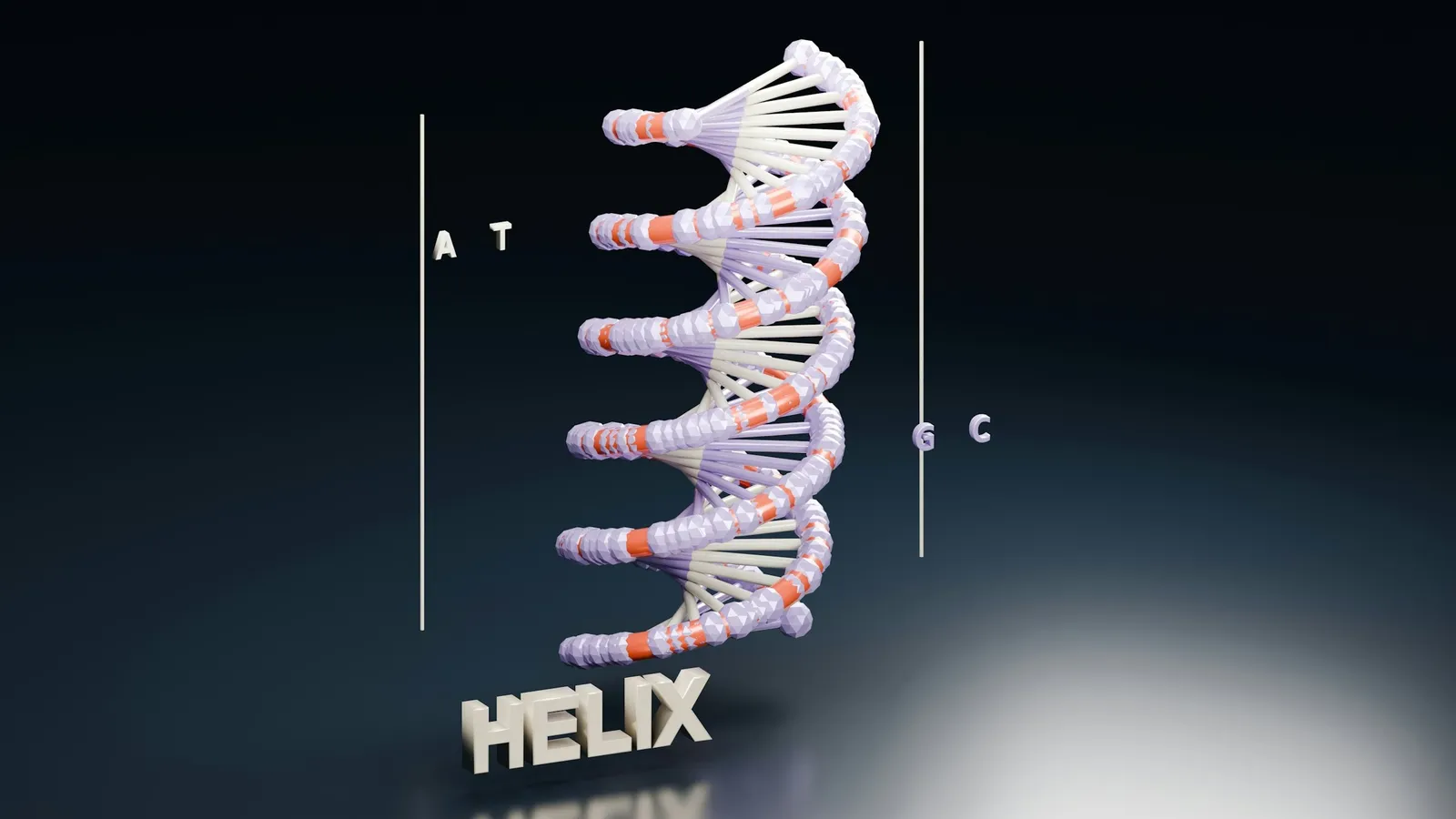
Type 1: base pairing and DNA length. In double-stranded DNA, A pairs with T and G pairs with C. A–T pairs form two hydrogen bonds and G–C pairs form three. Each base pair adds 0.34 nm, so one 3.4 nm turn holds 10 base pairs (OpenStax Biology 2e).
Example: a 500 bp double-stranded DNA molecule is 30% adenine. Then T = 30%, so G + C = 40% and G = 20%. There are 1,000 bases: 300 A–T pairs and 200 G–C pairs. Hydrogen bonds = 300 × 2 + 200 × 3 = 1,200. Length = 500 × 0.34 = 170 nm, which makes 50 turns.
Check: 30 + 30 + 20 + 20 = 100%, purines (A + G) are exactly 50%, and 300 + 200 = 500 pairs. Our Chargaff's rule numericals guide goes through the single-strand versions.
Type 2: Mendelian ratios and probabilities. A monohybrid F2 gives a 3:1 phenotypic ratio and a 1:2:1 genotypic ratio (OpenStax). A dihybrid cross gives 9:3:3:1, because independent probabilities multiply: (3/4) × (3/4) = 9/16 (OpenStax).
Example: AaBbCc is selfed and the three genes assort independently. P(aabbcc) = (1/4)³ = 1/64. P(all three dominant traits) = (3/4)³ = 27/64.
Check: the phenotype classes 27 + 9 + 9 + 9 + 3 + 3 + 3 + 1 add up to 64. For more on Punnett squares, see Mendelian genetics problems for NEET.
Type 3: Hardy-Weinberg frequencies. For a gene with two alleles at frequencies p and q, the genotype frequencies are p² + 2pq + q² = 1 (OpenStax).
Example: 1 person in 400 shows a recessive trait. Then q² = 0.0025, so q = 0.05 and p = 0.95. The carrier frequency is 2pq = 2 × 0.95 × 0.05 = 0.095, about 9.5%.
Check: p + q = 1, and 0.9025 + 0.095 + 0.0025 = 1. The usual trap is setting q = 1/400. The trait tells you q², not q.
How do you solve cell division and cardiac output numericals?
Type 4: chromosome and DNA counts in cell division. In S phase each chromosome is copied into two sister chromatids. Meiosis I halves the chromosome number, and meiosis II separates the chromatids. Humans have 23 pairs of chromosomes (OpenStax).
Example: call the DNA content of a human G1 cell 2C. That cell has 46 chromosomes. After S phase it still has 46 chromosomes, but now 92 chromatids and 4C of DNA. After meiosis I, each cell has 23 chromosomes, 46 chromatids and 2C. After meiosis II, each cell has 23 chromosomes and 1C.
Check: count centromeres to get chromosomes. DNA doubles only in S phase and halves at each division.
Type 5: cardiac output. Cardiac output is the volume of blood one ventricle pumps in a minute: CO = heart rate × stroke volume. A resting stroke volume is about 70 mL, heart rate about 75 beats per minute, and mean cardiac output 5.25 L/min, within a range of 4.0–8.0 L/min (OpenStax Anatomy and Physiology 2e).
Example: 70 mL/beat × 75 beats/min = 5,250 mL/min = 5.25 L/min. Run it backwards: a cardiac output of 6 L/min at 80 beats/min gives a stroke volume of 6,000 ÷ 80 = 75 mL.
Check: mL/beat × beats/min leaves mL/min. The answer should fall in the 4–8 L/min range, and stroke volume between 55 and 100 mL (OpenStax). Our notes on body fluids and circulation cover the cardiac cycle around it.
How should you practise biology numericals?
Each week, do five questions of each type, mixed so you must spot the type.
Write the rule (p² + 2pq + q² = 1, CO = HR × SV) before any numbers.
Do the check every time.
For every wrong answer, name the slip: wrong rule, wrong setup, or arithmetic.
If the gap is the idea underneath, such as why a replicated chromosome still counts as one, the Fermi Concept Library gives each biology concept its own lesson. If your slips keep coming from the method, you can bring a problem set to Fermi's AI tutor, which works through problems alongside you and notices where you are stuck.
Pick one type tonight, do five questions, and check every answer.