On this page
The last ten questions of a worksheet go faster than the first ten. That pull has a name, and you can use it.
What is the goal-gradient effect?
The goal-gradient effect is the tendency to work harder and faster the closer you are to a goal. The idea comes from the behaviourist Clark Hull, whose 1932 paper in Psychological Review predicted that animals in a maze "will move at a progressively more rapid pace as the goal is approached." In Hull's later runway experiments, rats ran faster as they neared the food, as the 2006 Journal of Marketing Research paper that tested the idea on people describes.
What did the coffee-card study find?
Ran Kivetz, Oleg Urminsky and Yuhuang Zheng ran their test at a real café on the Columbia University campus with a buy-ten-get-one-free stamp card (Journal of Marketing Research, 2006). Three findings matter:
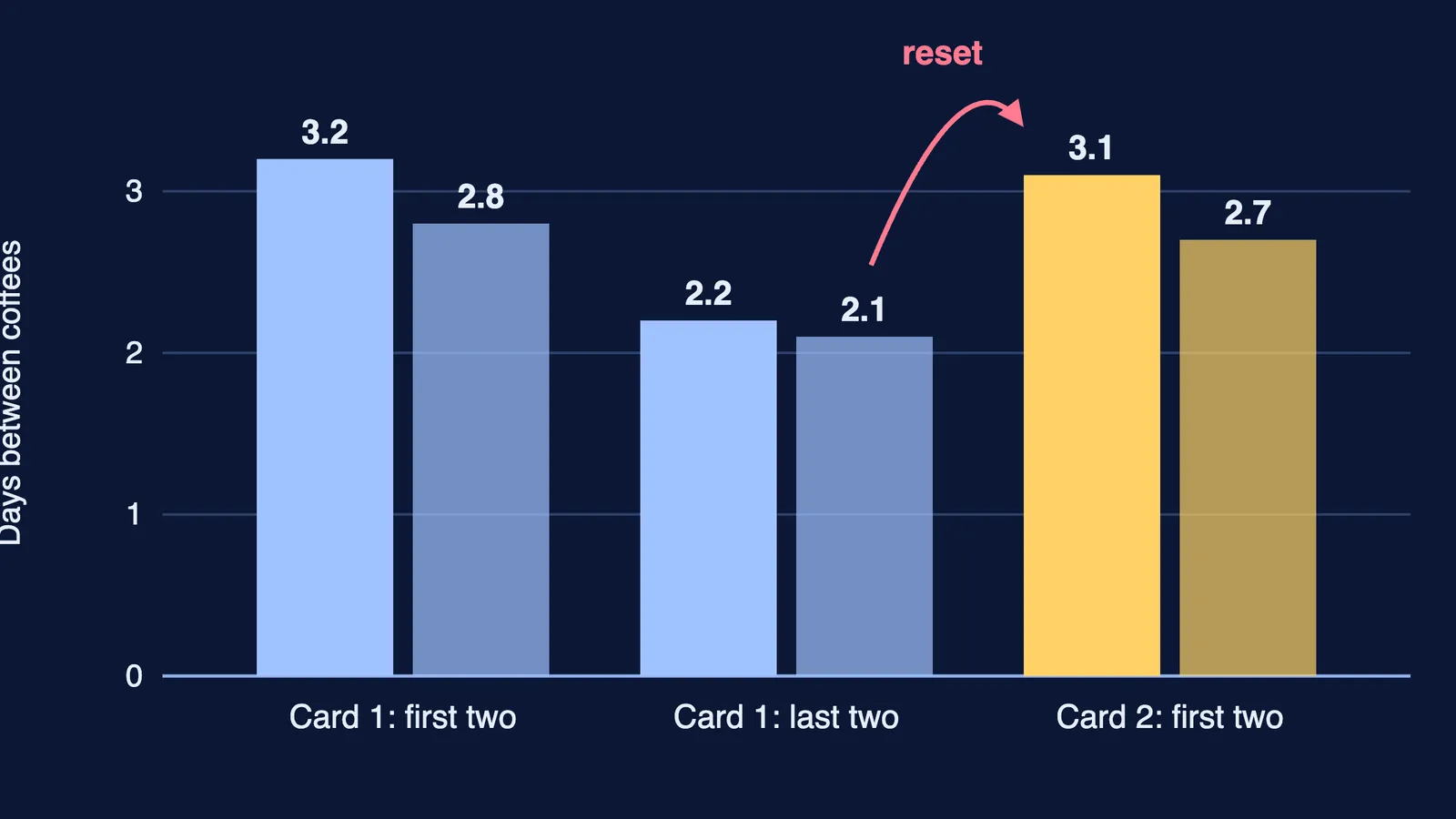
Across 949 completed cards, the gaps between coffees shrank as stamps piled up. The last gap was on average 0.7 days, or 20%, shorter than the first.
After the free coffee, people slowed down again. For 110 customers who started a second card, the first gaps on the new card (3.1 and 2.7 days) looked like the start of the first card (3.2 and 2.8 days), not its fast finish (2.2 and 2.1 days).
In a field experiment, some customers got a 10-stamp card and others a 12-stamp card with two "bonus" stamps already filled in. Both needed ten purchases. The head-start group finished in 12.7 days on average, against 15.6 days, about 20% faster.
The work left was identical. Only the feeling of progress changed.
How do you use the goal-gradient effect for JEE or NEET?
Your exam is one distant finish line. Build many near ones instead.
Cut each chapter into a checklist of 6 to 10 items. For rotational mechanics: moment of inertia, torque, rolling, angular momentum, collisions, a mixed problem set, one timed set, error log.
Make progress visible. Draw a bar on the first page of your notes, one segment per item, and shade it as you go. It is your stamp card.
Start with a few boxes already ticked, honestly. When you build a revision sheet, list the topics you have genuinely finished and tick them first. A sheet that opens at 3 of 10 is your 12-stamp card.
For a checklist item like "mixed problem set", the Fermi Problem Library has worked problems with a step-by-step solver that explains the reasoning rather than printing an answer.
Why does motivation dip in the middle?
Andrea Bonezzi, Miguel Brendl and Matteo De Angelis found that motivation can be higher near the start and near the end, and lower around halfway, a pattern they called "stuck in the middle" (Psychological Science, 2011). Their explanation: early on, people judge progress from the start; near the end, by what is left. In the middle, neither feels like much.
In one experiment, volunteers proofread nine essays. When progress was shown as work still to go, performance rose steadily towards the end (Kellogg Insight summary). Brendl's advice there: early in a goal, look back at what you have done; towards the end, look forward.
So in the first half of a checklist, count up ("4 done"). Past halfway, count down ("3 to go"). The same dip shows up across a whole drop year; our three-part reset for a drop-year slump covers that longer version.
Some honest limits. Each finding comes from one café or one set of lab studies, so treat them as useful nudges, not laws. They measured coffee purchases, donations and proofreading, not exam marks, and moving faster is not learning more, so make every box real work: problems solved, errors fixed. And expect the reset: a slow start on the next chapter is what the café data predicts, not proof you have lost your drive.
If you feel low for weeks, talk to a parent, teacher or school counsellor. Tele MANAS, the government's free mental health helpline, is on 14416.
What does a finish-line week look like?
Day 1: Write a 10-item checklist for one chapter and tick what you already know well. Two ticks is a normal start.
Day 2: Finish two items. Shade the bar and say it as "4 done."
Day 3: Finish one more and log it in a done list, as in our small wins method. You are at halfway, where the dip lives.
Day 4: Make today's finish line tiny: one 15-question set for the next item, then stop.
Day 5: Switch to counting down: "4 to go." Finish two.
Day 6: The last two: a timed mixed set and your error log.
Day 7: Review, then write the next chapter's checklist with its earned ticks, and open it with its easiest item.
Fallen behind? Do not stretch an old list; start a new one on a natural reset day, as in the fresh start effect for your study plan.