On this page
Eight new JEE Main-style circle questions, easy to hard. Every answer was checked with a computer algebra system, and each solution ends with the trap: the wrong option that looks most right.
What does JEE Main ask about circles?
The NTA's Syllabus for JEE (Main) 2027 puts circles in Unit 10, Co-ordinate Geometry: the standard and general forms, centre and radius, the circle on given diameter endpoints, and where a line meets a circle centred at the origin. For the theory first, read our guide on how to prepare circles for JEE Main.
How should you use this set?
Hide the solutions; allow 2 minutes per easy question, 4 per hard one.
Commit to an option before reading the answer.
For each miss, note the trap that caught you, and redo it in three days.
Easy: forms, centre and radius
Q1 (easy). The centre and radius of 2x² + 2y² − 8x + 12y − 6 = 0 are
(A) (−2, 3) and 4
(B) (2, −3) and 4
(C) (2, −3) and √19
(D) (4, −6) and √58
Answer: (B). Divide by 2: x² + y² − 4x + 6y − 3 = 0, so the centre is (2, −3) and the radius √(4 + 9 + 3) = 4. Trap: (C) halves the x and y terms but leaves the constant at −6.
Q2 (easy). The circle on the segment joining (−1, 4) and (5, −2) as diameter is
(A) x² + y² + 4x + 2y − 13 = 0
(B) x² + y² − 4x − 2y − 13 = 0
(C) x² + y² − 4x − 2y + 13 = 0
(D) x² + y² − 4x − 2y − 67 = 0
Answer: (B). (x + 1)(x − 5) + (y − 4)(y + 2) = 0 expands to x² + y² − 4x − 2y − 13 = 0: centre (2, 1), radius √18. Trap: (A) flips every sign in the diameter form, moving the centre to (−2, −1).
Q3 (easy). The line x − y = 1 meets x² + y² = 25 at P and Q. PQ equals
(A) 4√6
(B) 7
(C) 7√2
(D) 14
Answer: (C). Put x = y + 1: y² + y − 12 = 0, so P(4, 3), Q(−3, −4) and PQ = √(49 + 49) = 7√2. Trap: (A) takes the centre's distance from the line as 1; it is 1/√2. See the length of a chord cut off by a line.
Medium: when does a line meet a circle?
Q4 (medium). The line y = 2x + c meets x² + y² = 20 at two distinct points exactly when
(A) −10 < c < 10
(B) −2√5 < c < 2√5
(C) −10 ≤ c ≤ 10
(D) |c| > 10
Answer: (A). Substituting gives 5x² + 4cx + c² − 20 = 0. Two points need 16c² − 20(c² − 20) > 0, so c² < 100. Trap: (C) lets in c = ±10, where the line only touches.
Q5 (medium). The line 3x − 4y = k touches x² + y² − 2x + 4y − 4 = 0. Then k is
(A) −4 or 26
(B) 4 or −26
(C) 8 or 14
(D) 6 or 16
Answer: (A). Centre (1, −2), radius 3. Tangency: |3 + 8 − k| / 5 = 3, so |11 − k| = 15. Trap: (B) takes the centre as (−1, 2). More on the condition for a line to be tangent.
Q6 (medium, numerical value). Two circles touch both coordinate axes and pass through (9, 2). The sum of their radii is ____.
Answer: 22. Centre (a, a), radius a, so (9 − a)² + (2 − a)² = a², giving a² − 22a + 85 = 0 and a = 5 or 17. Trap: entering 17 means you kept only the larger root.
Hard: circles that join with straight lines
Q7 (hard). A circle through the origin O cuts the positive axes at A and B. Its radius is 5 and its centre lies on x + 2y = 10. The circle is
(A) x² + y² − 6x − 8y = 0
(B) x² + y² + 8x + 6y = 0
(C) x² + y² − 8x − 6y = 0
(D) x² + y² − 10y = 0
Answer: (C). Angle AOB is 90°, so AB is a diameter: with A(a, 0), B(0, b), centre (a/2, b/2), a² + b² = 100 and a = 20 − 2b. Then b² − 16b + 60 = 0, so b = 6 or 10. b = 10 gives a = 0, no point on the positive x-axis, so a = 8 and b = 6. Trap: (D) is the b = 10 root.
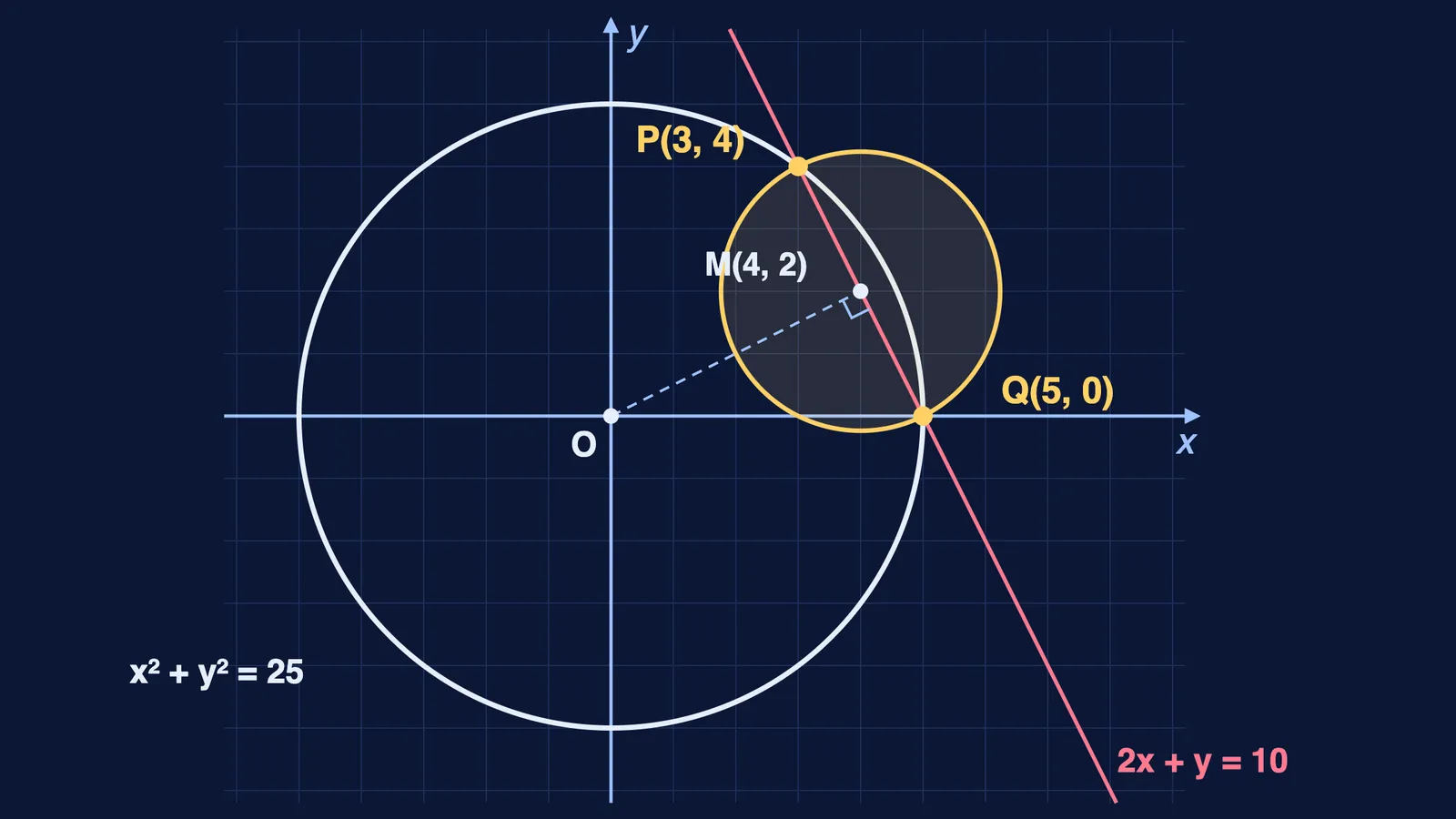
Q8 (hard). The line 2x + y = 10 meets x² + y² = 25 at P and Q. The circle with PQ as diameter is
(A) x² + y² − 8x − 4y = 0
(B) x² + y² + 8x + 4y + 15 = 0
(C) x² + y² − 8x − 4y + 15 = 0
(D) x² + y² − 8x − 4y − 1 = 0
Answer: (C). Put y = 10 − 2x: x² − 8x + 15 = 0, so P(3, 4) and Q(5, 0). Then (x − 3)(x − 5) + (y − 4)y = 0 gives centre (4, 2) and radius √5. Check: the half-chord is √(25 − 20) = √5. Trap: (A) uses the whole chord 2√5 as the radius. The diagram above draws it to scale.
What should you do after this set?
Sort misses by trap. For sign slips (Q1, Q2, Q5), make the x² and y² coefficients 1, then read off −g and −f. For lost roots (Q6, Q7), test both roots against every condition.
If one method keeps failing, the Fermi Problem Library has worked problems with a step-by-step solver that explains the reasoning rather than printing an answer.