On this page
This set has eight original electrochemistry questions in JEE Main style, ordered from easy to hard. Each one comes with a worked solution and a trap line: the wrong option that looks most tempting, and the slip that leads you to it. Q3 and Q7 are numerical-value questions.
How should you use this electrochemistry practice set?
Unit 7 of the JEE (Main) 2027 syllabus covers molar conductivity, Kohlrausch's law, electrode potentials, the Nernst equation and the link between cell potential and Gibbs energy. All eight questions stay inside that list. The JEE (Main) 2027 information bulletin gives +4 for a correct answer and −1 for a wrong one, in both the MCQ and numerical sections.
Take every standard potential and ionic conductivity from Table 2.1 and Table 2.4 of the NCERT Class 12 electrochemistry chapter, at 298 K. Use 2.303RT/F = 0.059 V and F = 96487 C mol⁻¹, as NCERT does.
Set a timer for 20 minutes and work on paper.
For each cell, write which electrode is the anode before you use any formula.
Read every trap line, including the ones for questions you got right.
New to the chapter? Read our guide on how to prepare electrochemistry for JEE Main first.
Easy: can you read the electrochemical series?
Q1 (easy). A clean metal strip is dipped in 1 M NiSO₄ solution (E°(Ni²⁺/Ni) = −0.25 V). Which strip gets a coating of nickel?
(A) Tin, E°(Sn²⁺/Sn) = −0.14 V
(B) Iron, E°(Fe²⁺/Fe) = −0.44 V
(C) Copper, E°(Cu²⁺/Cu) = 0.34 V
(D) Silver, E°(Ag⁺/Ag) = 0.80 V
Answer: (B). A metal can reduce Ni²⁺ only if its own couple has a lower E° than −0.25 V. Only iron (−0.44 V) does, so Fe + Ni²⁺ → Fe²⁺ + Ni has E° = +0.19 V. Trap: (A), from comparing sizes instead of signs. −0.14 V is higher than −0.25 V, so tin is the weaker reducing agent.
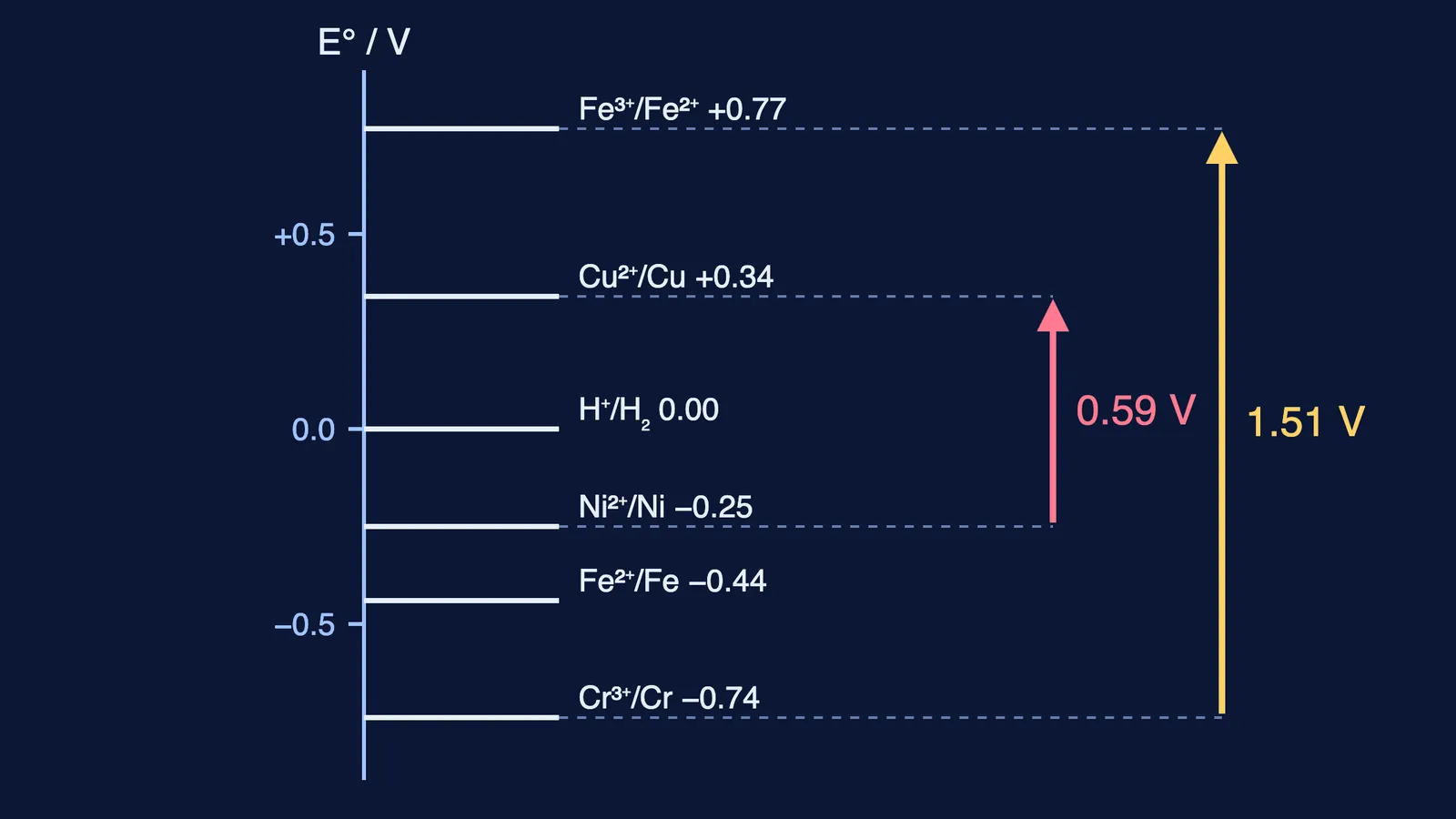
Q2 (easy). The standard emf of the cell Cr | Cr³⁺ || Fe³⁺, Fe²⁺ | Pt is (E°(Cr³⁺/Cr) = −0.74 V, E°(Fe³⁺/Fe²⁺) = 0.77 V):
(A) 0.03 V
(B) 3.05 V
(C) 1.51 V
(D) −1.51 V
Answer: (C). E°cell = E°cathode − E°anode = 0.77 − (−0.74) = 1.51 V. Trap: (B), from multiplying 0.77 V by 3 to balance electrons. E° is an intensive property, so it never scales with the coefficients.
Q3 (easy, numerical). Using λ°(K⁺) = 73.5 and λ°(SO₄²⁻) = 160.0 S cm² mol⁻¹, find Λ°m of K₂SO₄ in S cm² mol⁻¹.
Answer: 307. By Kohlrausch's law, Λ°m = 2λ°(K⁺) + λ°(SO₄²⁻) = 147.0 + 160.0 = 307.0. Trap: 233.5, which forgets that one formula unit gives two K⁺ ions.
Medium: where do conductivity and the Nernst equation trip you up?
Q4 (medium). A 0.040 M solution of a salt shows a resistance of 400 Ω in a cell of cell constant 1.20 cm⁻¹. Its molar conductivity, in S cm² mol⁻¹, is:
(A) 0.075
(B) 75
(C) 0.12
(D) 3.0
Answer: (B). κ = G*/R = 1.20/400 = 0.0030 S cm⁻¹. Then Λm = κ × 1000/c = 0.0030 × 1000/0.040 = 75. Trap: (A), which drops the 1000 cm³ L⁻¹ that turns mol L⁻¹ into mol cm⁻³.
Q5 (medium). For Sn | Sn²⁺ (0.0010 M) || Cu²⁺ (0.10 M) | Cu at 298 K, the cell potential is closest to:
(A) 0.60 V
(B) 0.42 V
(C) 0.48 V
(D) 0.54 V
Answer: (D). E°cell = 0.34 − (−0.14) = 0.48 V, and n = 2. E = 0.48 − (0.059/2) log(0.0010/0.10) = 0.48 + 0.0295 × 2 = 0.539 V. Trap: (A), which uses n = 1 and doubles the correction.
Q6 (medium). For Ni(s) + 2Fe³⁺(aq) → Ni²⁺(aq) + 2Fe²⁺(aq), ΔG° is closest to:
(A) −197 kJ mol⁻¹
(B) +197 kJ mol⁻¹
(C) −98 kJ mol⁻¹
(D) −100 kJ mol⁻¹
Answer: (A). E° = 0.77 − (−0.25) = 1.02 V. Two electrons move (one to each Fe³⁺), so ΔG° = −nFE° = −2 × 96487 × 1.02 J = −196.8 kJ mol⁻¹. Trap: (C), from taking n = 1 because each Fe³⁺ gains one electron.
Hard: what happens when a cell runs down to equilibrium?
Q7 (hard, numerical). Excess nickel powder is stirred into 0.10 M CuSO₄ until equilibrium. Given E°(Cu²⁺/Cu) = 0.34 V and E°(Ni²⁺/Ni) = −0.25 V, [Cu²⁺] at equilibrium is 10⁻ʸ M. Find y.
Answer: 21. E° = 0.59 V and n = 2, so log K = 2 × 0.59/0.059 = 20 and K = [Ni²⁺]/[Cu²⁺] = 10²⁰. The reaction goes almost to completion, so [Ni²⁺] ≈ 0.10 M and [Cu²⁺] = 0.10/10²⁰ = 10⁻²¹ M. Trap: 20, which sets [Cu²⁺] = 1/K and forgets that [Ni²⁺] is 0.10 M, not 1 M.
Q8 (hard). The cell Pt | H₂ (1 bar) | HA (0.10 M) || Cu²⁺ (1 M) | Cu reads 0.517 V at 298 K. If HA is a weak monobasic acid, its Ka is closest to:
(A) 1.0 × 10⁻¹¹
(B) 1.0 × 10⁻³
(C) 1.0 × 10⁻⁵
(D) 1.0 × 10⁻²
Answer: (C). The hydrogen electrode is the anode, with E(H⁺/H₂) = −0.059 pH. So 0.517 = 0.34 + 0.059 pH, giving pH = 3.0 and [H⁺] = 10⁻³ M. Then Ka = (10⁻³)²/(0.10 − 0.001) ≈ 1.0 × 10⁻⁵. Trap: (A), from writing 0.059/2 without squaring [H⁺], which gives pH 6.
What should you do after checking your answers?
Put each miss in one of three bins: sign or anode choice (Q1, Q2, Q8), the value of n (Q5, Q6, Q7) or units and stoichiometry (Q3, Q4). The fullest bin is what you practise this week. Our post on four common electrochemistry numerical mistakes works through each slip with its fix.
When a whole method fails rather than one step, the Fermi Problem Library has worked problems with a step-by-step solver that explains the reasoning rather than printing an answer.
Redo your misses in two days, without the solutions.