On this page
Rotational motion punishes small slips: a missing square, the wrong axis, a torque assumed to be zero. Here are 8 new JEE Main-style questions, easy to hard, each with a worked solution and its trap. Take g = 9.8 m/s².
Unit 5 of the NTA syllabus for JEE (Main) 2027 covers torque, conservation of angular momentum, moments of inertia with the axes theorems, equilibrium of rigid bodies and the equations of rotational motion. New to the chapter? Read our guide on how to prepare rotational motion for JEE Main first.
How should you use this practice set?
According to the JEE (Main) 2027 information bulletin, Physics has 20 multiple-choice questions in Section A and 5 numerical-value questions in Section B. Both sections give +4 for a correct answer and −1 for a wrong one.
Allow 20 minutes for all eight; Q5 and Q6 have integer answers.
Write down the axis before you solve.
Answer before reading the solution.
Log each trap you fell for.
Easy: moment of inertia and angular kinematics
Q1 (easy). A light rod carries point masses of 1 kg, 2 kg and 3 kg at 0.2 m, 0.5 m and 0.6 m from one end. Its moment of inertia about an axis through that end, perpendicular to the rod, is
(A) 3.00 kg m² (B) 1.50 kg m² (C) 1.62 kg m² (D) 0.81 kg m²
Answer: (C). I = Σmr² = 0.04 + 0.50 + 1.08 = 1.62 kg m². Trap: (B) puts all 6 kg at the centre of mass (0.5 m). Because r is squared, that undercounts the far mass.
Q2 (easy). A ceiling fan turning at 900 rpm is switched off and slows uniformly to rest in 40 s. How many revolutions does it make while stopping?
(A) 600 (B) 300 (C) 150 (D) 1885
Answer: (B). ω₀ = 15 rev/s, and with uniform deceleration θ = (ω₀/2)t = 7.5 × 40 = 300. Trap: (A) is ω₀t, as if full speed lasted 40 s.
Q3 (easy). A uniform rod of mass 3 kg and length 1.2 m rotates about an axis perpendicular to it through a point 0.2 m from one end. Its moment of inertia is
(A) 1.44 kg m² (B) 0.48 kg m² (C) 1.32 kg m² (D) 0.84 kg m²
Answer: (D). I_cm = ML²/12 = 0.36 kg m², and the axis is 0.4 m from the centre, so I = 0.36 + 3(0.4)² = 0.84 kg m². Trap: (C) applies the parallel axis theorem from the end axis (1.44 − 3 × 0.2²). The theorem starts from the centre of mass.
Medium: which equation does each body need?
Q4 (medium). A 2 kg block hangs from a light string wound round a uniform 4 kg disc pulley of radius 0.1 m on a frictionless axle. The block's acceleration is
(A) 4.9 m/s² (B) 9.8 m/s² (C) 3.3 m/s² (D) 6.5 m/s²
Answer: (A). Block: mg − T = ma. Disc: TR = (½MR²)(a/R), so T = 2a. Adding, 19.6 = 4a and a = 4.9 m/s². Trap: (C) treats the pulley as a ring (I = MR²), which gives a = mg/(m + M).
Q5 (medium, numerical). A uniform 4 kg horizontal disc of radius 0.5 m spins freely at 6 rad/s about its axis. A 1 kg lump of clay is placed gently on its rim and sticks. How many joules of kinetic energy are lost?
Answer: 3. No torque acts about the axis, so angular momentum is conserved. I₁ = ½(4)(0.5)² = 0.5 kg m² and I₂ = 0.5 + 1(0.5)² = 0.75 kg m², so ω₂ = 0.5 × 6/0.75 = 4 rad/s. KE falls from ½(0.5)(36) = 9 J to ½(0.75)(16) = 6 J. Trap: treating the disc as a ring (I = MR²) gives 3.6 J, which rounds to 4.
Q6 (medium, numerical). A uniform 5 m, 30 kg plank rests on supports 1.0 m and 3.5 m from its left end. A 25 kg child walks from the middle towards the right end. How far beyond the right support, in cm, can the child go before the plank starts to tip?
Answer: 120. At tipping the left support's force is zero, so take moments about the right support. The plank's weight acts 1.0 m to its left: 30g × 1.0 = 25g × d, so d = 1.2 m = 120 cm. Trap: 180 comes from using the 1.5 m overhang as the plank's lever arm.
Hard: energy, angular momentum and rolling
Q7 (hard). A uniform 1.2 kg rod, 0.9 m long, pivoted at one end, carries a 0.3 kg point mass at its free end. Released from rest horizontal, what is its angular speed at the vertical?
(A) 7.0 rad/s (B) 6.8 rad/s (C) 5.7 rad/s (D) 5.3 rad/s
Answer: (D). Potential energy lost = g(1.2 × 0.45 + 0.3 × 0.9) = 7.94 J. About the pivot, I = ML²/3 + mL² = 0.324 + 0.243 = 0.567 kg m². Then ½Iω² = 7.94 gives ω² = 28, so ω ≈ 5.3 rad/s. Trap: (A) uses ML²/12, the rod's inertia about its centre, though it swings about its end.
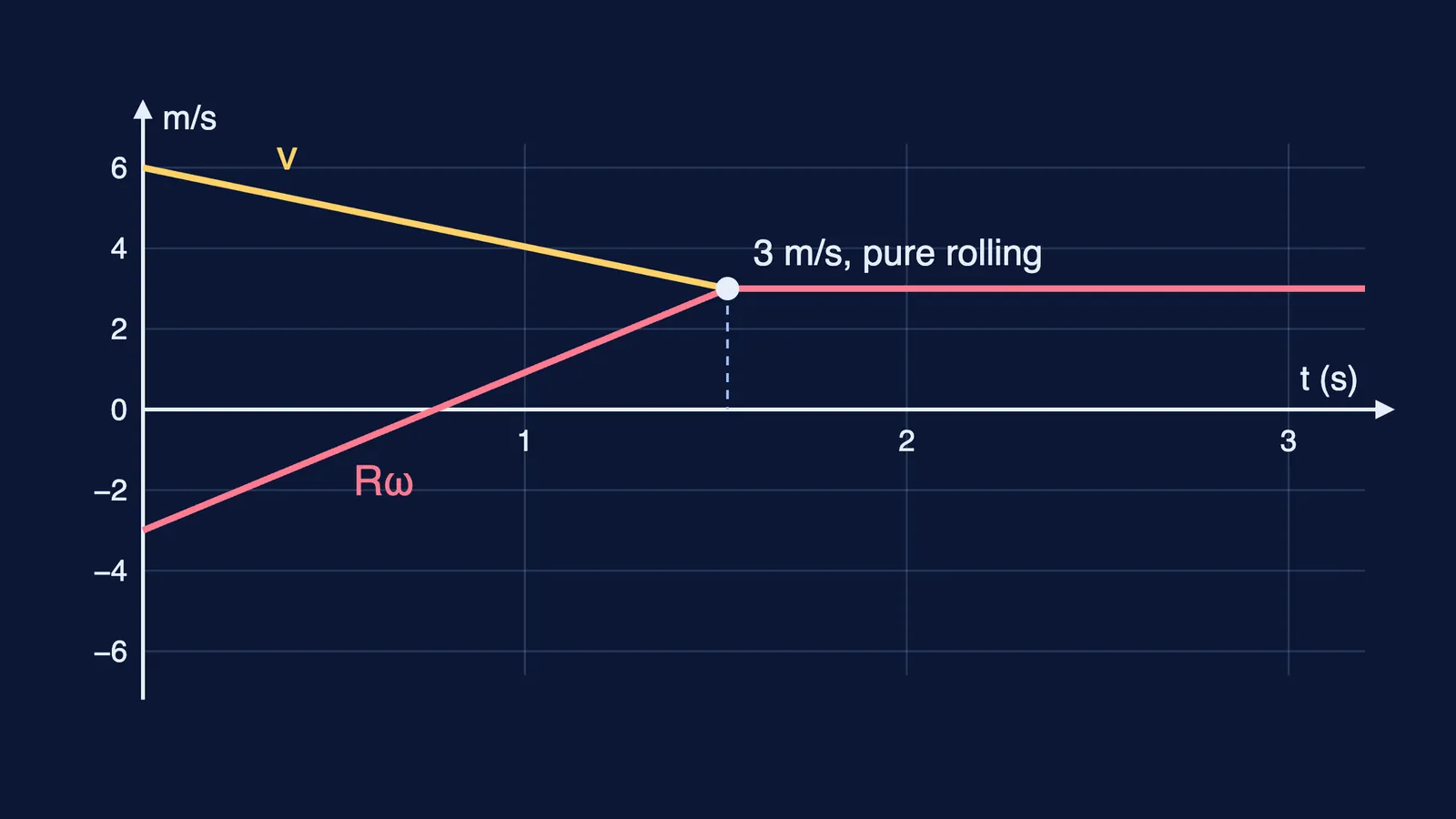
Q8 (hard). A uniform disc moving forward at 6 m/s, with backspin of rim speed 3 m/s, lands on a rough floor. What is its speed once it rolls without slipping?
(A) 1.5 m/s (B) 2 m/s (C) 3 m/s (D) 5.2 m/s
Answer: (C). Friction passes through the contact point, so angular momentum about it is conserved. Initially L = MR(6) − ½MR(3) = 4.5MR. When rolling, L = MvR + ½MvR = (3/2)MvR. Equating, v = 3 m/s. Trap: (D) conserves kinetic energy, but friction does work during slipping. (B) is the memorised v₀/3, valid only for backspin rim speed v₀. (A) is a ring's answer. Unsure of friction's direction? See which way friction acts when a rolling body slips.
What should you do after this set?
Sort your misses: axis errors (Q1, Q3), a missing equation for one body (Q4), or conserving the wrong quantity (Q5, Q7, Q8). Our post on five common rotational motion mistakes in JEE has fixes for each.
For further practice, the Fermi Problem Library has worked problems with a step-by-step solver that explains the reasoning rather than printing an answer. Redo your misses in two days.