On this page
Rotational Motion is where JEE Main mechanics stops treating bodies as points. Here is what the official syllabus lists, where your NCERT chapter falls short, four worked numericals and a two-week plan.
What does the JEE Main syllabus include in Rotational Motion?
NTA's Syllabus for JEE (Main) - 2027 lists Unit 5, Rotational Motion, as: centre of mass of a two-particle system and of a rigid body; moment of a force, torque, angular momentum and its conservation; moment of inertia, radius of gyration, values for simple geometrical objects; parallel and perpendicular axes theorems; equilibrium of rigid bodies; equations of rotational motion; and the comparison of linear and rotational motion.
The NCERT Class 11 chapter Systems of Particles and Rotational Motion (reprint 2026-27) runs from section 6.1 to 6.12. Two points matter:
It does not derive or state the parallel and perpendicular axes theorems, though NTA lists them. Learn them from OpenStax University Physics, section 10.5 and HyperPhysics.
It has no section on rolling motion, and NTA's Unit 5 does not name rolling either, so this plan skips it. If your material includes it, see how a rolling body splits its kinetic energy.
How do you solve centre of mass and torque questions?
Centre of mass. For two particles on a line, x_cm = (m1x1 + m2x2)/(m1 + m2), as in section 6.2 of the NCERT chapter. Put 2 kg at x = 0 and 3 kg at x = 1.5 m. Then x_cm = (0 + 4.5)/5 = 0.9 m. Check: it sits nearer the heavier mass.
Torque. Torque is τ = r × F, with magnitude rF sin θ, where θ is the angle between r and F (NCERT section 6.7). You push a door with 20 N at 0.8 m from the hinge, at 60° to the door. τ = 0.8 × 20 × sin 60° = 16 × 0.866 ≈ 13.9 N m. A push along the door (θ = 0) gives zero torque.
Torque links to motion through τ = Iα. If forces still feel shaky, warm up with free-body diagrams and friction for JEE Main.
How do the parallel and perpendicular axes theorems work?
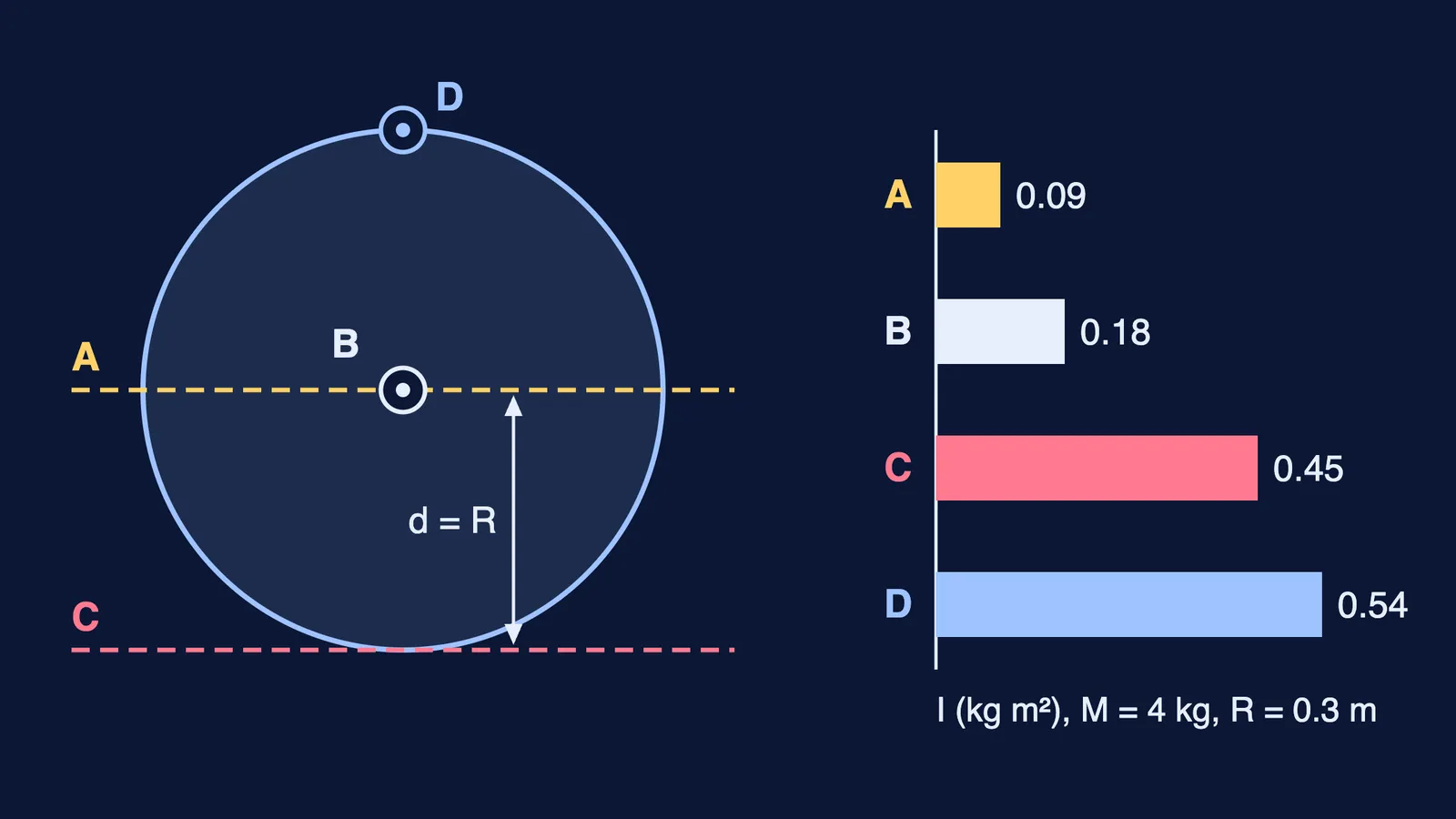
The parallel axis theorem says I = I_cm + Md², where d is the distance from an axis through the centre of mass to a parallel axis (OpenStax 10.5). The perpendicular axis theorem says that for a flat body, I_z = I_x + I_y, with x and y in the plane and z perpendicular, all through one point (HyperPhysics).
Worked example: a uniform disc, M = 4 kg, R = 0.3 m (the diagram above shows all four axes).
About a diameter (A), NCERT Table 6.1 gives MR²/4 = 4 × 0.09/4 = 0.09 kg m².
About the central axis perpendicular to the disc (B), the perpendicular theorem adds two diameters: 0.09 + 0.09 = 0.18 kg m². That matches Table 6.1's MR²/2.
About a tangent in the plane (C), parallel to A at d = R: 0.09 + 4 × 0.3² = 0.09 + 0.36 = 0.45 kg m².
About a perpendicular axis through the rim (D), parallel to B: 0.18 + 0.36 = 0.54 kg m².
Now pull a string wound round this disc, mounted on axis B, with 6 N. τ = 6 × 0.3 = 1.8 N m, so α = 1.8/0.18 = 10 rad/s².
How do you use conservation of angular momentum?
If the net external torque about an axis is zero, Iω stays constant (NCERT section 6.12.1).
Worked example: a skater spins at 2 rev/s with I = 3.0 kg m², then pulls her arms in to I = 1.2 kg m². Then 3.0 × 2 = 1.2 × f, so f = 5 rev/s.
The trap: kinetic energy is not conserved. KE = L²/2I, so with L fixed, KE rises by 3.0/1.2 = 2.5 times, from about 237 J to about 592 J. The extra energy comes from the work her muscles do pulling her arms in.
Then test yourself against five common rotational motion mistakes and their fixes.
A two-week practice plan
Days 1-2: centre of mass (NCERT 6.1-6.4).
Days 3-4: vector product and torque, including equilibrium of a rigid body (NCERT 6.5-6.8). Write a sign convention first.
Days 5-7: Table 6.1, radius of gyration, and both axis theorems. Rebuild table values with them.
Days 8-9: τ = Iα and the rotational kinematics equations (NCERT 6.10-6.11).
Days 10-11: angular momentum conservation: first ask whether external torque about the axis is zero.
Days 12-14: mixed timed sets, then redo every wrong answer from a blank page.
When a numerical goes wrong and you cannot see where, the Fermi Problem Library has worked problems with a step-by-step solver that explains the reasoning rather than printing an answer.