On this page
These eight questions run from easy to hard, and each has a worked solution and a trap note: a tempting wrong option and the slip that leads to it. Two are numerical-value questions.
How should you use this probability practice set?
In the JEE (Main) 2027 information bulletin, Paper 1 mathematics has 20 multiple-choice questions and 5 numerical-value questions. The same bulletin marks a correct answer +4 and a wrong one −1 in both sections, so a trap option costs you five marks against a correct answer.
Give yourself 20 minutes for all eight, on paper.
Write the sample space or the formula before you touch the numbers.
Read every solution and trap line, even for questions you got right.
Every question sits inside Unit 13 of the JEE (Main) 2027 mathematics syllabus, which lists probability of an event, the addition and multiplication theorems, and Bayes' theorem. If the ideas feel shaky, start with our guide on how to prepare probability for JEE Main.
Easy: can you count the sample space correctly?
Q1 (easy). A bag holds 5 red, 4 green and 3 blue balls. Two balls are drawn together. The probability that both are the same colour is:
(A) 19/66
(B) 25/72
(C) 19/132
(D) 47/66
Answer: (A). Total pairs = 12C2 = 66. Same colour = 5C2 + 4C2 + 3C2 = 10 + 6 + 3 = 19. So the probability is 19/66. Trap: (B) treats the draw as with replacement, (5² + 4² + 3²)/12².
Q2 (easy, numerical). A whole number is picked at random from 1 to 60. If p is the probability that it is divisible by 4 or by 6, find 60p.
Answer: 20. Multiples of 4: 15. Multiples of 6: 10. Multiples of both, that is of 12: 5. So 15 + 10 − 5 = 20 numbers, and 60p = 20. Trap: 25, which counts 12, 24, 36, 48 and 60 twice.
Q3 (easy). For events A and B, P(A) = 0.5, P(B) = 0.4 and P(A ∪ B) = 0.7. Then P(A | B) is:
(A) 0.4
(B) 0.5
(C) 0.2
(D) 0.8
Answer: (B). P(A ∩ B) = 0.5 + 0.4 − 0.7 = 0.2, so P(A | B) = 0.2/0.4 = 0.5. Trap: (A) divides by P(A), which gives P(B | A).
Medium: how does a condition shrink the sample space?
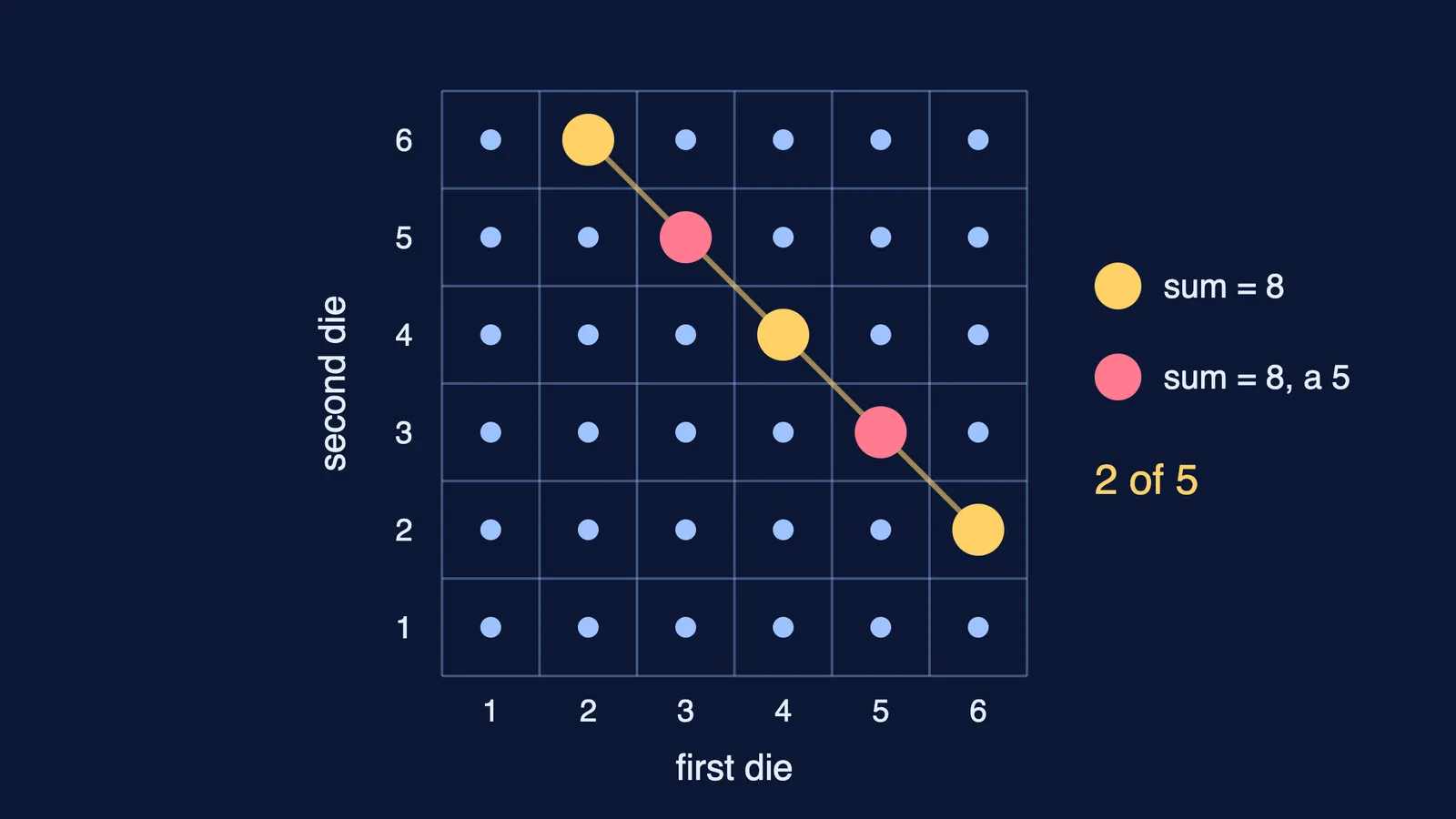
Q4 (medium). Two fair dice are thrown. Given that the sum is 8, the probability that at least one die shows 5 is:
(A) 11/36
(B) 1/3
(C) 2/5
(D) 1/18
Answer: (C). The condition leaves five ordered outcomes: (2, 6), (3, 5), (4, 4), (5, 3), (6, 2). Two of them contain a 5, so the answer is 2/5. Trap: (B) lists unordered pairs {2, 6}, {3, 5}, {4, 4}, which are not equally likely.
Q5 (medium). Three students try a problem independently. Their chances of solving it are 1/3, 2/5 and 1/4. The probability that exactly one of them solves it is:
(A) 7/10
(B) 9/20
(C) 59/60
(D) 1/30
Answer: (B). Add three cases, each with one success and two failures: (1/3)(3/5)(3/4) + (2/3)(2/5)(3/4) + (2/3)(3/5)(1/4) = 9/60 + 12/60 + 6/60 = 27/60 = 9/20. Trap: (A) is "at least one", 1 − (2/3)(3/5)(3/4).
Hard: when should you reach for Bayes' theorem?
Q6 (hard). A courier hub gets 45% of its parcels from Pune, 35% from Nagpur and 20% from Nashik. Of these, 2%, 4% and 6% respectively arrive damaged. A parcel picked at random is damaged. The probability that it came from Nashik is:
(A) 1/2
(B) 1/5
(C) 2/5
(D) 12/35
Answer: (D). P(damaged) = 0.45 × 0.02 + 0.35 × 0.04 + 0.20 × 0.06 = 0.009 + 0.014 + 0.012 = 0.035. By Bayes' theorem, P(Nashik | damaged) = 0.012/0.035 = 12/35. Trap: (A) compares only the damage rates, 6/(2 + 4 + 6), and forgets that Nashik sends the fewest parcels.
Q7 (hard). Urn I has 4 white and 2 black balls. Urn II has 3 white and 5 black balls. Two balls are moved together at random from Urn I to Urn II, and then one ball is drawn from Urn II. It is white. The probability that both moved balls were white is:
(A) 2/5
(B) 6/13
(C) 13/30
(D) 1/2
Answer: (B). Moving two white balls has probability 6/15, and then Urn II holds 5 white in 10, so this case gives (6/15)(5/10) = 30/150. One white and one black: (8/15)(4/10) = 32/150. Two black: (1/15)(3/10) = 3/150. Total = 65/150. So P(both white | white drawn) = 30/65 = 6/13. Trap: (A) is 6/15, the chance before you learned the drawn ball was white.
Q8 (hard, numerical). A and B take turns throwing a pair of dice, A first. A wins by throwing a sum of 9; B wins by throwing a doublet. They continue until someone wins. If P(A wins) = m/n in lowest terms, find m + n.
Answer: 10. P(sum 9) = 4/36 = 1/9 and P(doublet) = 6/36 = 1/6. A round with no winner has probability (8/9)(5/6) = 20/27. A wins on round 1, 2, 3 and so on, giving a geometric series: (1/9)/(1 − 20/27) = (1/9)(27/7) = 3/7. So m + n = 10. Trap: 7, from 2/5 = (1/9)/(1/9 + 1/6), which only compares the two success chances and ignores the turn order.
What should you do after checking your answers?
Sort each miss into one bin: wrong sample space (Q1, Q4), wrong rule (Q3, Q6, Q7) or misread wording (Q2, Q5, Q8). The bin tells you what to practise. Our list of common reasoning mistakes in JEE probability covers the usual causes, and the Bayes' theorem walk-through with a 10,000-person count shows the counting method behind Q6.
If a whole method went wrong, not just one step, the Fermi Problem Library has worked problems with a step-by-step solver that explains the reasoning rather than printing an answer.
Redo your misses in two days, without the solutions.