On this page
Probability questions can look easy and still go wrong, because the mistakes happen in the reasoning before any calculation. Psychologists Amos Tversky and Daniel Kahneman described how the mental shortcuts people use to judge chance "lead to systematic and predictable errors" (Tversky and Kahneman, 1974, Science). Exam questions often turn on the same kinds of errors. Here are five, with fixes. Definitions follow NCERT's Class 12 chapter on probability.
Mistake 1: Treating independent and mutually exclusive as the same
NCERT addresses this confusion directly: "mutually exclusive events never have an outcome common, but independent events, may have common outcome." It adds that two independent events with nonzero probabilities cannot be mutually exclusive, and the reverse.
Worked example. Draw one card from a standard deck.
A = heart, B = king. P(A) = 1/4, P(B) = 1/13, and P(A and B) = 1/52 (the king of hearts). Since 1/4 × 1/13 = 1/52, A and B are independent, but not mutually exclusive.
A = heart, C = spade. P(A and C) = 0, but P(A) × P(C) = 1/16. They are mutually exclusive and therefore dependent: knowing a heart was drawn tells you it is not a spade.
The fix: test independence with numbers, P(A ∩ B) = P(A)P(B), never with intuition.
Mistake 2: Reversing a conditional probability
P(A | B) and P(B | A) are different numbers, and Bayes' theorem is what connects them. Writing one when the question asks for the other is a classic Bayes error.
Gerd Gigerenzer and Ulrich Hoffrage found that people handle Bayesian problems much better when the information is given as frequencies rather than probabilities; with frequency formats, statistically naive participants reached Bayesian answers for up to 50% of inferences (Gigerenzer and Hoffrage, 1995, ERIC record). You can use that yourself by converting to counts.
Worked example. Machine A makes 60% of a factory's bulbs, 2% of them defective. Machine B makes 40%, 5% defective. A bulb is defective. What is the chance it came from B?
Think of 1000 bulbs: 600 from A, of which 12 are defective, and 400 from B, of which 20 are defective. Out of 32 defective bulbs, 20 are from B. The answer is 20/32 = 0.625. The reversed answer, 0.05, is P(defective | B).
Mistake 3: Assuming outcomes are equally likely
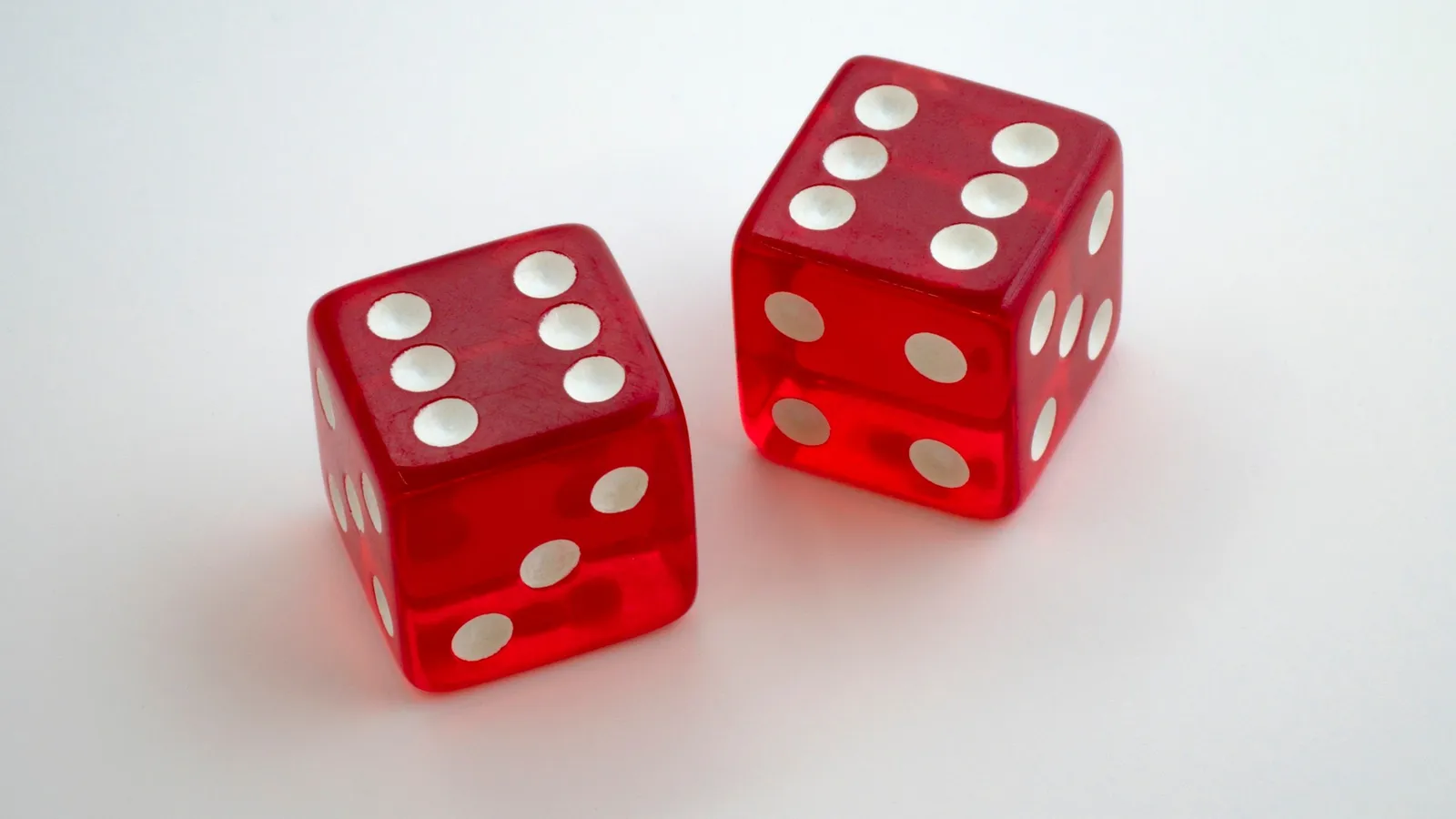
The formula favourable/total only works when every outcome is equally likely. When you roll two dice, the sums 2 to 12 are eleven outcomes, but they are not equally likely. The 36 ordered pairs are.
Worked example. P(sum = 7) = 6/36 = 1/6, because (1,6), (2,5), (3,4), (4,3), (5,2) and (6,1) all give 7. Writing 1/11 is the trap.
The fix: before counting, write down the sample space and ask whether each element is equally likely. Ordered pairs usually are; sums and unordered groups often are not.
Mistake 4: Adding probabilities for 'at least one'
Worked example. What is the chance of at least one six in four rolls of a die? Adding 1/6 four times gives 2/3, and the same logic would give more than 1 for seven rolls. The correct route uses the complement: P(no six) = (5/6)⁴ = 625/1296, so P(at least one six) = 1 − 625/1296 = 671/1296 ≈ 0.518.
Addition works only for mutually exclusive events. "Six on roll 1" and "six on roll 2" can both happen.
A related slip is ignoring replacement. Two cards drawn without replacement are both aces with probability (4/52)(3/51) = 1/221; with replacement it is (1/13)² = 1/169. Read the question for that word.
Mistake 5: Expecting chance to balance out
After five heads in a row, a fair coin is still 1/2 for heads on the next toss, because the tosses are independent. The feeling that tails is "due" is the kind of judgement Tversky and Kahneman's work on representativeness describes. The same feeling shows up when a sequence that "looks random" is judged more likely than one that looks patterned, though every specific sequence of fair tosses has the same probability.
A five-question check before you answer
What exactly is the sample space, and are its elements equally likely?
With or without replacement?
Are the events mutually exclusive, independent, both or neither? Check with numbers.
Is the question asking for P(A | B) or P(B | A)?
Does "at least one" call for the complement?
Careless errors under time pressure are a topic of their own; see Kahneman's fast and slow thinking and careless errors in exams. Probability also decides whether a guess is worth it in an exam with negative marking; see negative marking in JEE and NEET: when is guessing worth it?
To practise these with explanations, the Fermi Problem Library has worked problems with a step-by-step solver that explains the reasoning rather than printing an answer.