On this page
These eight questions are written for JEE Main and graded from easy to hard. Each one comes with a short worked solution and the trap: the wrong option a hurried student is most likely to pick. All eight are new.
The official JEE (Main) 2027 syllabus from NTA lists "the fundamental theorem of calculus, properties of definite integrals", evaluation of definite integrals and areas of regions bounded by simple curves in standard forms. If you have not studied the chapter yet, start with our guide on how to prepare definite integrals and area for JEE Main.
How should you use this practice set?
In the JEE (Main) 2027 information bulletin, Mathematics has 20 multiple-choice questions in Section A and 5 numerical-value questions in Section B, and both carry +4 for a correct answer and −1 for a wrong one. So a guess costs you, even on numerical questions.
Give yourself 16 minutes for all eight, about two minutes each.
Cover the solutions. Write your answer and one line on why before you look.
For every miss, name the trap in your own words. That line is what you revise later.
Questions 5 and 8 are numerical: the answer is an integer, with no options.
Easy: can you apply the fundamental theorem cleanly?
Q1 (easy). The value of ∫ from 1 to e of (2x + 1/x) dx is
(A) e² − 1 (B) e² (C) e² + 1 (D) e² − 2
Answer: (B). An antiderivative is x² + ln x. At e it is e² + 1; at 1 it is 1 + 0 = 1. The difference is e². Trap: (C) comes from forgetting to subtract the lower limit's x² = 1.
Q2 (easy). The area bounded by y = x² − 4x, the x-axis and the lines x = 0 and x = 6 is
(A) 0 (B) 32/3 (C) 64/3 (D) 16
Answer: (C). The curve is below the axis on (0, 4) and above it on (4, 6). Area = ∫ from 0 to 4 of (4x − x²) dx + ∫ from 4 to 6 of (x² − 4x) dx = 32/3 + 32/3 = 64/3. Trap: (A) is the signed integral from 0 to 6, where the two parts cancel. Split at the roots first.
Q3 (easy). ∫ from −2 to 2 of (x³e^(x²) + |x|) dx equals
(A) 0 (B) 2 (C) 4 (D) 8
Answer: (C). x³e^(x²) is odd, so it contributes 0. |x| is even, so it gives 2 × ∫ from 0 to 2 of x dx = 4. Trap: (A) treats |x| as odd too.
Medium: which property of definite integrals does the question want?
Q4 (medium). ∫ from 0 to π of x sin x cos⁴x dx equals
(A) 2/5 (B) π/10 (C) π/5 (D) 2π/5
Answer: (C). Replace x by π − x: the integrand becomes (π − x) sin x cos⁴x. Adding the two forms, 2I = π ∫ from 0 to π of sin x cos⁴x dx = π × 2/5, so I = π/5. Trap: (D) forgets to divide by 2 after adding.
Q5 (medium, numerical). Find ∫ from 0 to 10 of [√x] dx, where [·] is the greatest integer function.
Answer: 16. [√x] is 0 on [0, 1), 1 on [1, 4), 2 on [4, 9) and 3 on [9, 10]. The integral is 0 + 1×3 + 2×5 + 3×1 = 16. Trap: stopping the steps at x = 9 gives 13, and integrating √x instead gives about 21.
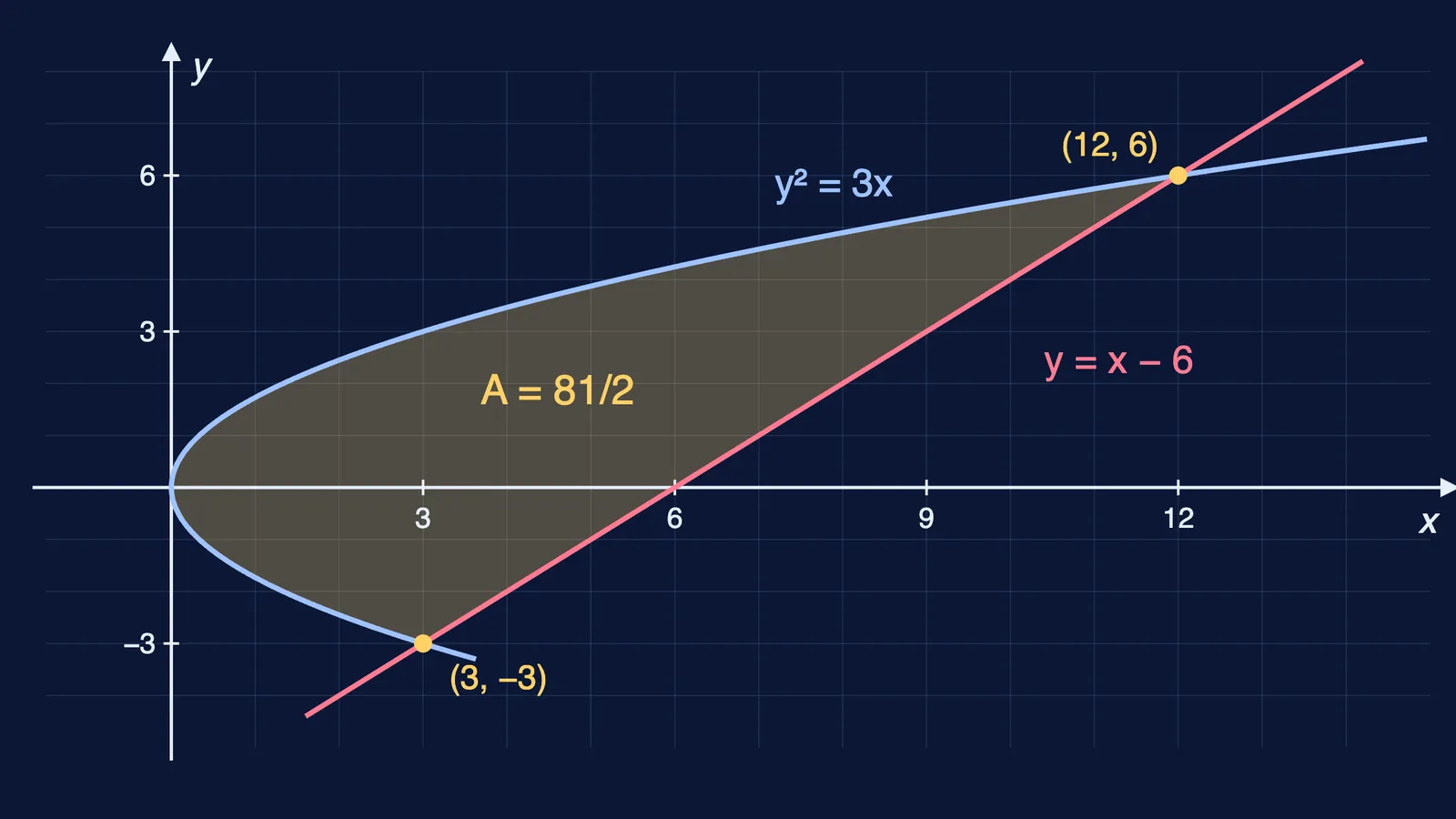
Q6 (medium). The area of the region bounded by the parabola y² = 3x and the line y = x − 6 is
(A) 48 (B) 81/2 (C) 27 (D) 81/4
Answer: (B). The curves meet where y² = 3(y + 6), so y = −3 or y = 6, at the points (3, −3) and (12, 6). Integrate along y, with the line on the right: Area = ∫ from −3 to 6 of (y + 6 − y²/3) dy = 81/2. Trap: (A) integrates √(3x) − (x − 6) from 0 to 12, but for x < 3 the lower boundary is the parabola's lower arm, not the line. The picture above shows why.
Hard: can you handle the fundamental theorem and modulus areas?
Q7 (hard). f is continuous on [0, ∞) and ∫ from 0 to x² of f(t) dt = x⁴ + 2x³ for all x ≥ 0. Then f(4) is
(A) 56 (B) 44 (C) 28 (D) 14
Answer: (D). Differentiate both sides: by the fundamental theorem and the chain rule, 2x f(x²) = 4x³ + 6x², so f(x²) = 2x² + 3x. For f(4), put x = 2: f(4) = 8 + 6 = 14. Trap: (A) drops the chain-rule factor 2x.
Q8 (hard, numerical). If A is the area of the region bounded by y = |x² − 4| and y = 5, find 3A.
Answer: 44. The curves meet at x = ±3. Using symmetry, A = 2[∫ from 0 to 2 of (1 + x²) dx + ∫ from 2 to 3 of (9 − x²) dx] = 2[14/3 + 8/3] = 44/3, so 3A = 44. Trap: ignoring the modulus and integrating 5 − (x² − 4) from −3 to 3 gives A = 36 and 3A = 108.
What should you do after checking your answers?
Score yourself with the +4/−1 rule from the bulletin and note which traps caught you. If Q2, Q6 or Q8 went wrong, the issue is usually the sketch, so work through our step-by-step area between y = x² and y = x example. If Q4 slowed you down, revise the f(a − x) property, worked through on 1/(1 + tan x) from 0 to π/2.
For more practice after this set, the Fermi Problem Library has worked problems with a step-by-step solver that explains the reasoning rather than printing an answer. Then come back to these eight in a week and try them again in 12 minutes.