

On this page
Find the area enclosed by y = x² and y = x. The answer is a tidy 1/6, but the marks are in the method: where the curves meet, which one is on top, and how you set up the integral. Here is the full working, a second route, and a check with no calculus at all.
Where do y = x² and y = x intersect?
The curves meet where their y-values are equal, so set x² = x.
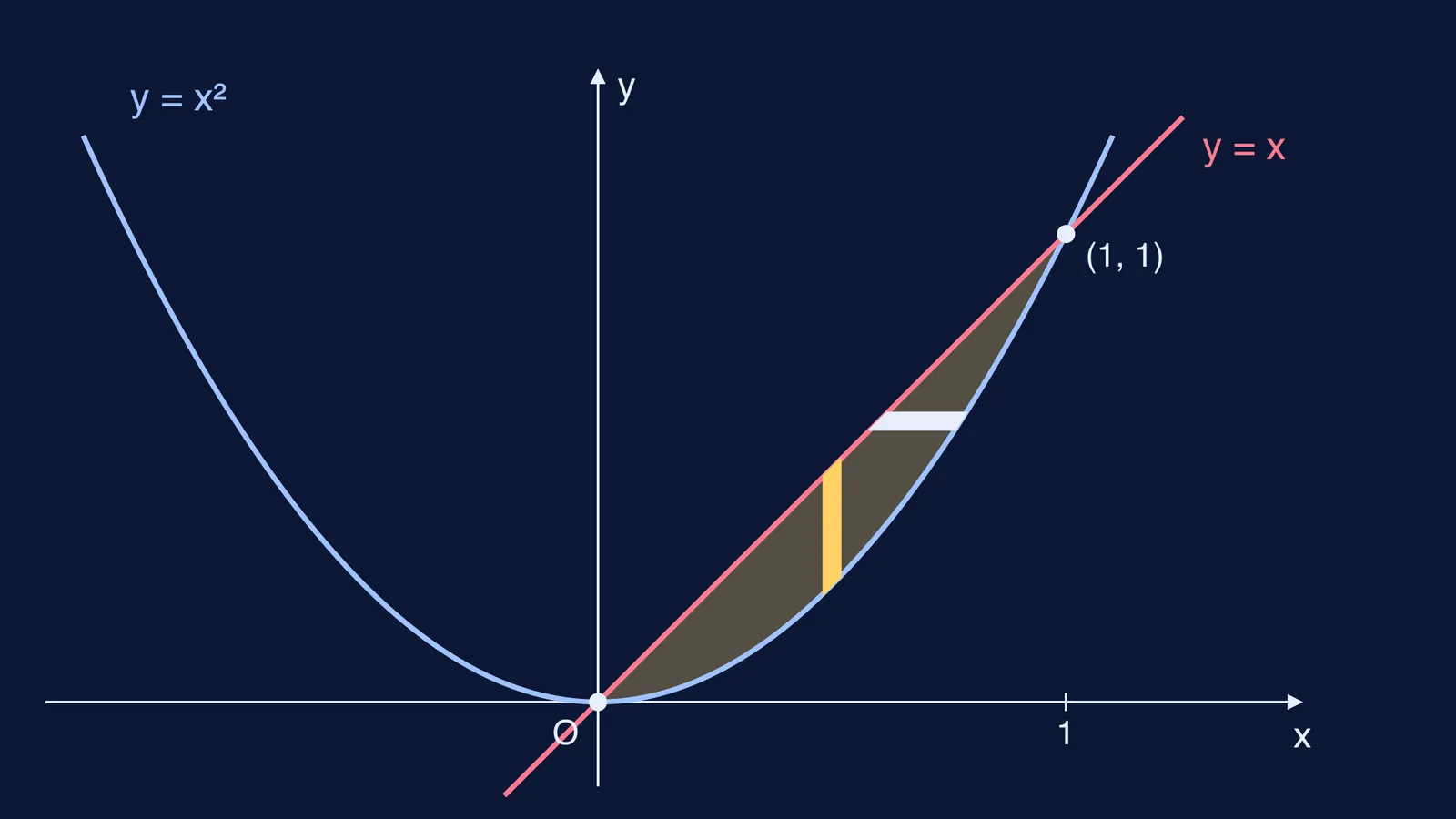
Rearrange to x² − x = 0 and factor to x(x − 1) = 0, so x = 0 or x = 1. The curves meet at (0, 0) and (1, 1), and these x-values are your limits of integration.
Which curve is on top between 0 and 1?
Test any x between the limits. At x = 1/2, the line gives 1/2 and the parabola gives 1/4, so the line is the upper curve: squaring a number between 0 and 1 makes it smaller.
If f(x) ≥ g(x) on [a, b], the area between them is the integral of f(x) − g(x) from a to b (Theorem 6.1 in OpenStax Calculus Volume 1, section 6.1). Each vertical strip has height (upper − lower) and width dx.
How do you integrate to get 1/6?
Write the area: A = ∫₀¹ (x − x²) dx.
Integrate term by term: the antiderivative is x²/2 − x³/3.
Put in x = 1: 1/2 − 1/3 = 1/6.
Put in x = 0: 0 − 0 = 0.
Subtract: A = 1/6 − 0 = 1/6 square units.
In pictures: the triangle under the line has area 1/2, the region under the parabola has area 1/3, and you want the gap, 1/2 − 1/3 = 1/6.
Can you get the same area with horizontal strips?
Yes, and it checks your first answer by a different route. The NCERT Class 12 chapter Application of Integrals sets up horizontal strips for a curve written as x = g(y), with area given by the integral of x dy between y = c and y = d. For two curves, Theorem 6.3 in OpenStax section 6.1 gives the area as the integral of (right curve − left curve) dy.
Rewrite each curve as x in terms of y:
The line y = x becomes x = y.
The parabola y = x² becomes x = √y (take the positive root, since the region is in the first quadrant).
Now compare at y = 1/4. The line gives x = 1/4 and the parabola gives x = 1/2. So the parabola is on the right and the line on the left. The y-limits are still 0 and 1.
Write the area: A = ∫₀¹ (√y − y) dy.
Integrate: the antiderivative is (2/3)y^(3/2) − y²/2.
Put in y = 1: 2/3 − 1/2 = 1/6.
Put in y = 0 and subtract: A = 1/6.
Same region, same 1/6. If the two methods disagree, one setup is wrong.
How can you check the answer without integrating?
Archimedes proved in the 3rd century BC that the area of a parabolic segment is 4/3 the area of a particular inscribed triangle, as summarised in The Quadrature of the Parabola. The triangle's base is the chord, and its third vertex is the point on the parabola where the tangent runs parallel to that chord.
Here the chord from (0, 0) to (1, 1) has slope 1, and the tangent slope 2x equals 1 at x = 1/2, so the third vertex is (1/2, 1/4). By the shoelace formula, the triangle with corners (0, 0), (1, 1) and (1/2, 1/4) has area 1/8. Then 4/3 × 1/8 = 1/6. Same answer, no integral.
What mistakes cost marks on this question?
Dividing x² = x by x, which loses the intersection at x = 0.
Assuming the parabola is on top. Always test a point between the limits.
With horizontal strips, writing x = y² instead of x = √y.
Keeping x-limits after switching to dy. Here both are 0 to 1, which hides the slip; for y = x² and y = 2x the y-limits are 0 to 4.
Skipping the sketch, which shows the region, the order of the curves and the limits at a glance.
If you keep picking the wrong upper curve or the wrong limits, work through similar questions in the Fermi Problem Library, where the step-by-step solver explains the reasoning rather than printing an answer. If the idea of a definite integral as a sum of thin strips is still hazy, the lesson on it in the Fermi Concept Library is a good place to start.
Next time you see a two-curve area question, run the same four steps: intersect, compare, integrate, and check with the other strip direction.


