On this page
One mock says 162, the next says 141, and it feels like you went backwards. Often you didn't. Single scores bounce because papers differ in difficulty, in the chapters they test, and in how well you slept. The fix is a simple log and one number that moves more slowly than your mood: the average of your last three mocks.
Why do mock test scores go up and down so much?
Regression to the mean is "a statistical phenomenon that can make natural variation in repeated data look like real change", according to a 2005 paper by Barnett and colleagues in the International Journal of Epidemiology. The same paper explains that unusually large or small measurements tend to be followed by measurements closer to the mean.
For mocks, an unusually high score is likely to be followed by a lower one, and a terrible one by a better one, even if your preparation has not changed. Our post on why mock test scores fluctuate so much goes through the usual causes.
How do you log mock test scores?
Use one line per mock and the same columns every time, in a notebook or a spreadsheet:
Date, and which test series the mock came from
Total score and maximum marks
Questions attempted, correct and wrong
Score in each subject
A note on conditions (short sleep, late start, new pattern)
Three-mock average, filled in from the third mock onward
Where you can, compare mocks from the same series; a harder or easier series creates jumps that have nothing to do with you.
How do you calculate a three-test moving average?
A single moving average is the mean of the most recent N values, recalculated each time a new value arrives, as defined in the NIST/SEMATECH e-Handbook of Statistical Methods. The handbook calls it a smoothing process and works its own example with N = 3.
In practice: add your three latest scores and divide by 3. With each new mock, drop the oldest and add the newest. In a spreadsheet with scores in column C from row 2, type =AVERAGE(C2:C4) next to your third mock and drag it down.
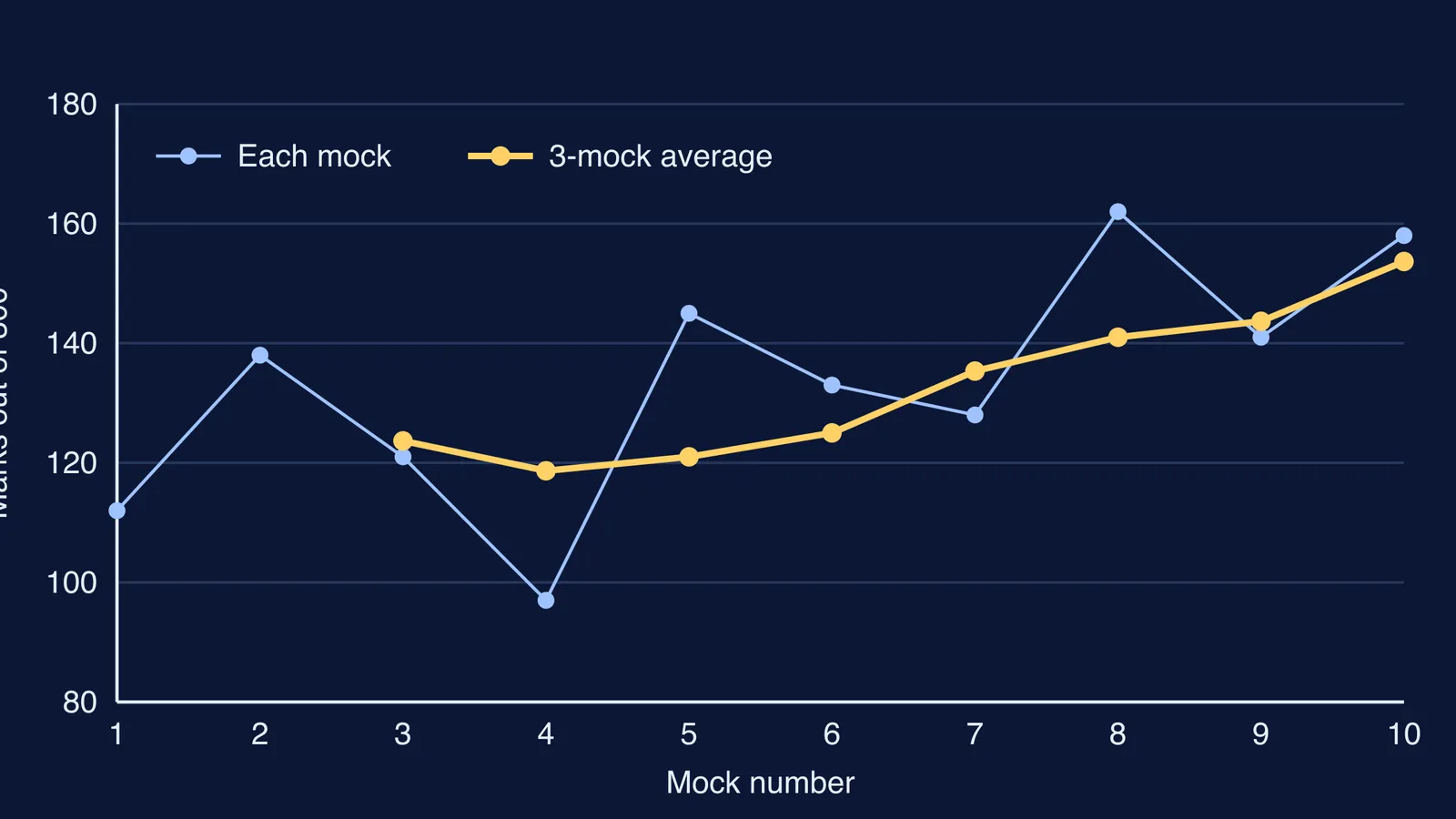
A worked example: these ten scores out of 300 are made up. The number after each score is the three-mock average.
Mock 1: 112
Mock 2: 138
Mock 3: 121, average 123.7
Mock 4: 97, average 118.7
Mock 5: 145, average 121.0
Mock 6: 133, average 125.0
Mock 7: 128, average 135.3
Mock 8: 162, average 141.0
Mock 9: 141, average 143.7
Mock 10: 158, average 153.7
What the average shows that raw scores hide:
Mock 4 looks like a collapse, 24 marks below Mock 3. The average dipped only 5 marks.
Mock 5 jumped 48 marks. The average moved just 2.3. One good day is not yet a new level.
Mock 9 felt like a 21-mark fall after Mock 8. The average still rose, to 143.7.
From Mock 5 to Mock 10 the average rose every single time.
Across the ten mocks, single scores swung between 97 and 162, but the average climbed 30 marks overall, from 123.7 to 153.7, with only one small dip along the way. That rise, not any single score, is the progress to watch.
How do you know if you are really improving?
Read the average after every mock and use these four rules of thumb:
The average rose on two mocks in a row: the progress is probably real. Keep the plan.
The average stayed within about 5 marks for three mocks: you have likely plateaued. Change how you practise a weak chapter rather than only taking more mocks.
The average fell on two mocks in a row: find the subject pulling it down, then read your conditions notes.
One score fell far below the average: analyse that paper with a 60-minute mock review routine, but don't rewrite your plan over one mock.
When the same chapter keeps costing you marks, work through its problems in the Fermi Problem Library, where a step-by-step solver explains the reasoning rather than printing an answer. If the gap is a missing idea rather than a slip, the Fermi Concept Library has a lesson for each concept in physics, chemistry, biology and mathematics.
What should parents look at in mock results?
Ask about the average, not the latest score: "What's your three-mock average now, and which way has it moved?" That turns a tense talk about one number into a calmer one about direction. If the average is falling close to the exam, see our guide to JEE mock scores that drop in the last two months.
If mock results are affecting sleep, appetite or mood for more than a few days, talk to someone you trust. Tele MANAS, the free 24x7 national mental-health helpline, answers on 14416, as listed on IIT Kanpur's counselling page.
Start tonight: write down your last three mock scores, divide their sum by 3, and that is the number to beat.