

On this page
You have three formulas for the same energy, and the exam question only tells you that a battery was "disconnected" or "kept connected". If you pick the right form, the problem takes one line of algebra.
What is the formula for energy stored in a capacitor?
The energy stored in a capacitor is U = ½CV² = Q²/2C = ½QV, as given in OpenStax University Physics Volume 2, section 8.3. The three are the same quantity: put Q = CV into any one of them and you get the other two.
Suppose the capacitor already holds charge q, so the voltage across it is q/C. Moving a further small charge dq from one plate to the other takes work dW = (q/C) dq. Add up these steps from q = 0 to q = Q and you get W = Q²/2C, which is the energy stored.
The same OpenStax section says the energy is stored in the electric field between the plates, with energy density u = ½ε₀E². You need that form when a question asks for energy per unit volume rather than for the whole capacitor.
Why is it half QV and not QV?
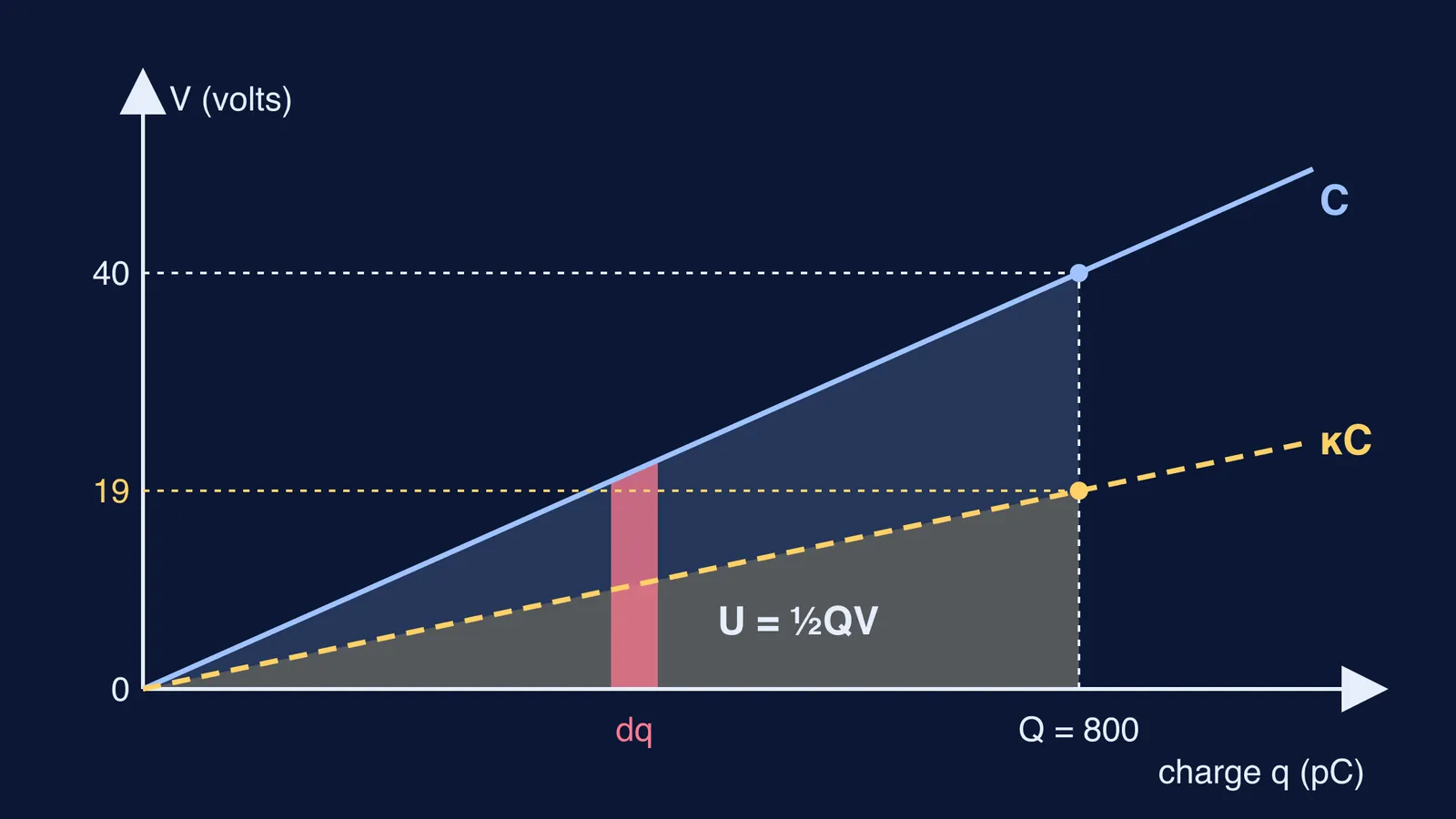
The voltage is not V for the whole time you are charging. Because V = q/C (OpenStax section 8.3), it starts at zero and rises in a straight line to V, so on average each bit of charge is moved through V/2. On a graph of V against q, the stored energy is the area of the triangle under the line: ½ × Q × V.
The battery is a different story. It pushes all the charge Q through its full voltage V, so it does work QV. Only half of that ends up in the capacitor; the other half becomes heat in the wires, whatever their resistance. We explain that in why half the energy is lost when charging a capacitor.
Which form should you use when charge or voltage is fixed?
Pick the form that contains the quantity that stays fixed, plus C. Then only C changes, and you never need to work out the new V or Q first.
Battery disconnected (isolated capacitor): the charge has nowhere to go, so Q is fixed. Use U = Q²/2C. Energy goes as 1/C.
Battery still connected: the battery holds the voltage at V. Use U = ½CV². Energy goes as C.
Q and V both given, or read off a graph: use U = ½QV and skip C entirely.
Worked example: a dielectric slid into a charged capacitor
OpenStax section 8.4 works through this case: a 20.0 pF capacitor charged to 40.0 V, then a Teflon slab with κ = 2.1 slid between the plates. The starting energy is ½ × 20.0 pF × (40.0 V)² = 16.0 nJ, and the charge is Q = CV = 800 pC. The new capacitance is 2.1 × 20.0 = 42 pF.
Case 1: battery disconnected first. Q stays at 800 pC.
Use U = Q²/2C = (800 pC)² / (2 × 42 pF).
U ≈ 7.6 nJ, down by a factor of 2.1, which matches the OpenStax answer.
OpenStax explains the drop: the work done polarising the dielectric is taken from the stored energy. If you had used ½CV² with the old 40 V, you would get 33.6 nJ, more than four times too large.
Case 2: battery kept connected. V stays at 40.0 V.
Use U = ½CV² = ½ × 42 pF × (40.0 V)².
U = 33.6 nJ, up by a factor of 2.1.
The charge rises to 42 pF × 40 V = 1680 pC, so the battery pushes an extra 880 pC through 40 V and does 35.2 nJ of work. Only 17.6 nJ of that is stored; the rest is the work done on the slab as the field pulls it in.
Same slab, same capacitor, opposite answers. For more on this pair of cases, read inserting a dielectric slab with the battery connected or disconnected; the same logic for pulling the plates apart is in energy of a capacitor when plate separation is doubled.
A 30-second check before you write the formula
Read the question for "disconnected", "isolated" or "kept connected". Mark Q or V as fixed.
Find the factor by which C changes: κ for a gap filled with dielectric, ½ when the gap of a parallel-plate capacitor is doubled.
Write the energy formula that contains only C and the fixed quantity.
Scale: U goes as 1/C at fixed Q and as C at fixed V.
To practise the choice on more questions, the Fermi Problem Library has worked problems with a step-by-step solver that explains the reasoning rather than printing an answer, so you can see the step where the fixed quantity is chosen. If capacitance itself still feels shaky, the Fermi Concept Library gives every concept in physics its own lesson and its place in the map, so you can go back a step before trying these again.


