

On this page
Students studying electromagnetism for the JEE Main or NEET-UG exams often trip over this exact question: what happens to the energy of a capacitor when the plate separation is doubled? The answer is not a single number, because the physical result flips depending on what you do with the battery.
First, we must look at the geometry of the device. For any parallel-plate capacitor in a vacuum, the capacitance C is determined by the area A of the plates and the distance d between them, using the formula C = ε₀A/d. Because the separation d is in the denominator, pulling the plates twice as far apart cuts the capacitance exactly in half (C/2).
How this drop in capacitance affects the stored electrostatic energy depends entirely on whether the system is isolated or connected to a power source.
What if the battery is disconnected?
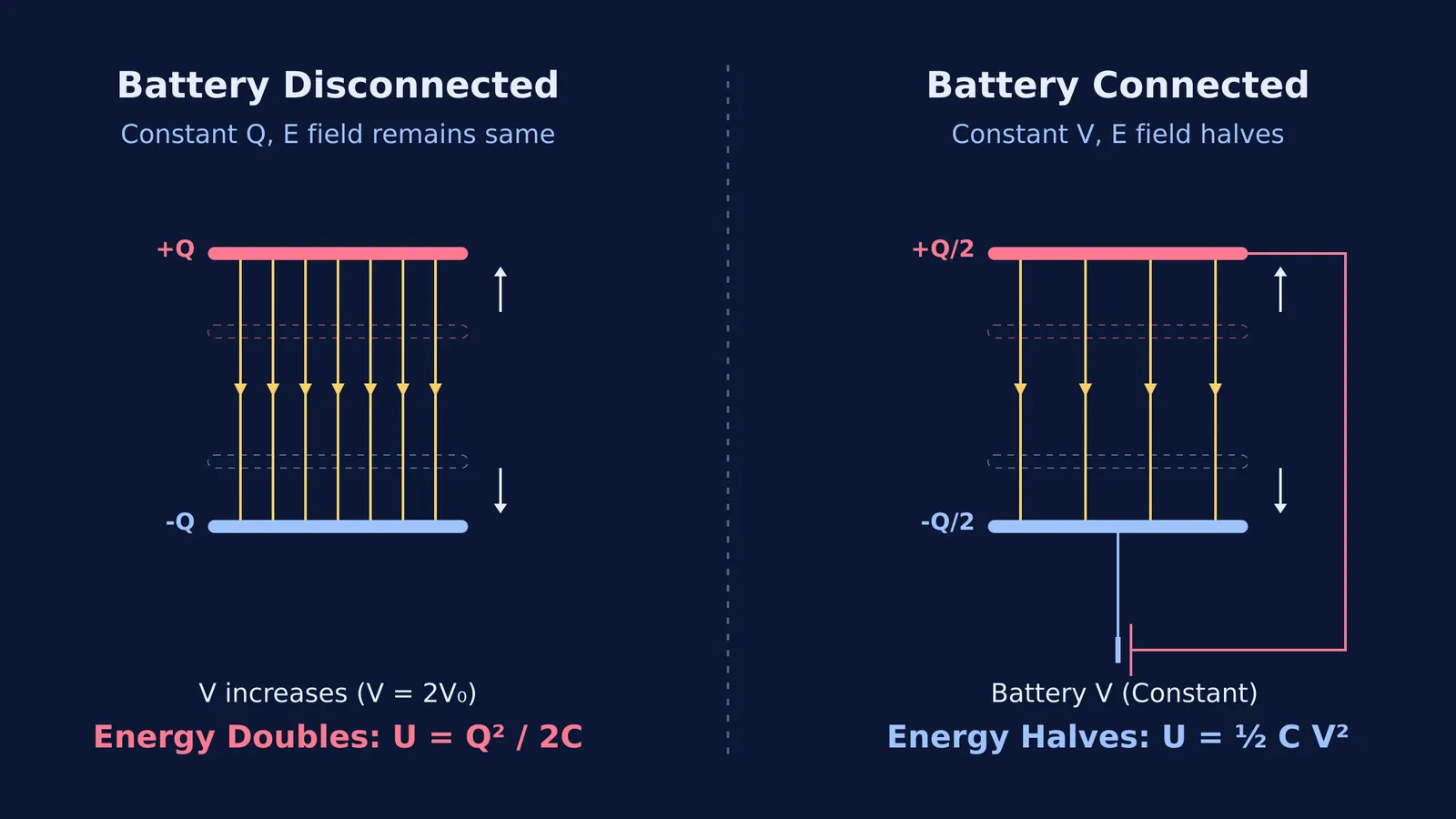
If you charge a capacitor and then remove the battery before moving the plates, the charge Q has nowhere to go. It remains trapped on the plates, making Q a constant value.
The energy stored in this state is calculated using the formula U = Q² / 2C.
Because the capacitance C is halved and Q is unchanged, the new energy becomes U' = Q² / (2(C/2)) = 2(Q² / 2C). The stored energy doubles.
Where does this extra energy come from? The oppositely charged plates naturally attract each other. You must do mechanical work to pull them apart against this electrostatic force. This mechanical work is stored as additional electrical potential energy in the uniform electric field between the plates.
What if the battery remains connected?
If the battery stays connected to the circuit while you pull the plates apart, it acts as a reservoir that forces the potential difference V across the plates to remain constant.
Because the voltage is fixed, the energy is best calculated using the formula U = ½ C V².
With V constant and C halved, the new energy is U' = ½ (C/2) V², which is exactly half of the original energy. The stored energy is halved.
As the plates separate and the capacitance drops, the capacitor can hold less charge for the same voltage (Q = CV). This excess charge flows back into the battery, transferring energy out of the capacitor and doing negative work on the power source.
A framework for capacitor problems
Here is a simple plan for solving any capacitor change problem, which also applies to scenarios like inserting a dielectric slab: battery connected vs disconnected:
Find out what is constant. A disconnected battery means constant Q. A connected battery means constant V.
Find how capacitance C changes. For doubling d, C halves. (This same logic is used when deriving the capacitance of spherical and cylindrical capacitors).
Pick the energy formula that uses the constant variable. Use U = Q² / 2C for constant charge; use U = ½ C V² for constant voltage.
It is easy to mix up these cases on a test if you rely on memory alone. The Fermi Problem Library breaks down physics problems by identifying the constant constraints first. If you are struggling to picture why the electric field stays constant in one case but weakens in the other, Fermi's AI tutor can draw the field lines and walk you through the logic step by step, so you are ready for your next exam.


