On this page
Principles of Inheritance and Variation is the chapter where NEET biology turns into arithmetic. Most questions are a cross in disguise: you get the parents or a ratio and must find the missing piece.
What does the NEET syllabus include from this chapter?
The Syllabus for NEET (UG)-2026, issued by the National Medical Commission's Undergraduate Medical Education Board on 22 December 2025, lists heredity and variation under Unit 7, Genetics and Evolution. It names Mendelian inheritance, incomplete dominance, co-dominance, multiple alleles and blood groups, pleiotropy, polygenic inheritance, the chromosome theory, sex determination in humans, birds and honey bee, linkage and crossing over, haemophilia, colour blindness, thalassemia, and Down's, Turner's and Klinefelter's syndromes. The NTA NEET website still links this 2026 document; recheck it for a newer version.
In the NCERT Class 12 Biology textbook (reprint 2026-27), all of this sits in Chapter 4, Principles of Inheritance and Variation. Pedigree analysis is not named in the syllabus line, but it is in the chapter and is the usual way disorders are tested, so learn its symbols too.
Which crosses should you be able to work out?
Every cross below builds on the examples in NCERT Chapter 4. Work each on paper until it is automatic:
Monohybrid: Tt × Tt gives 1 TT : 2 Tt : 1 tt, so 3 tall : 1 dwarf.
Test cross: cross an unknown tall plant with tt. All tall offspring means TT; half tall and half dwarf means Tt.
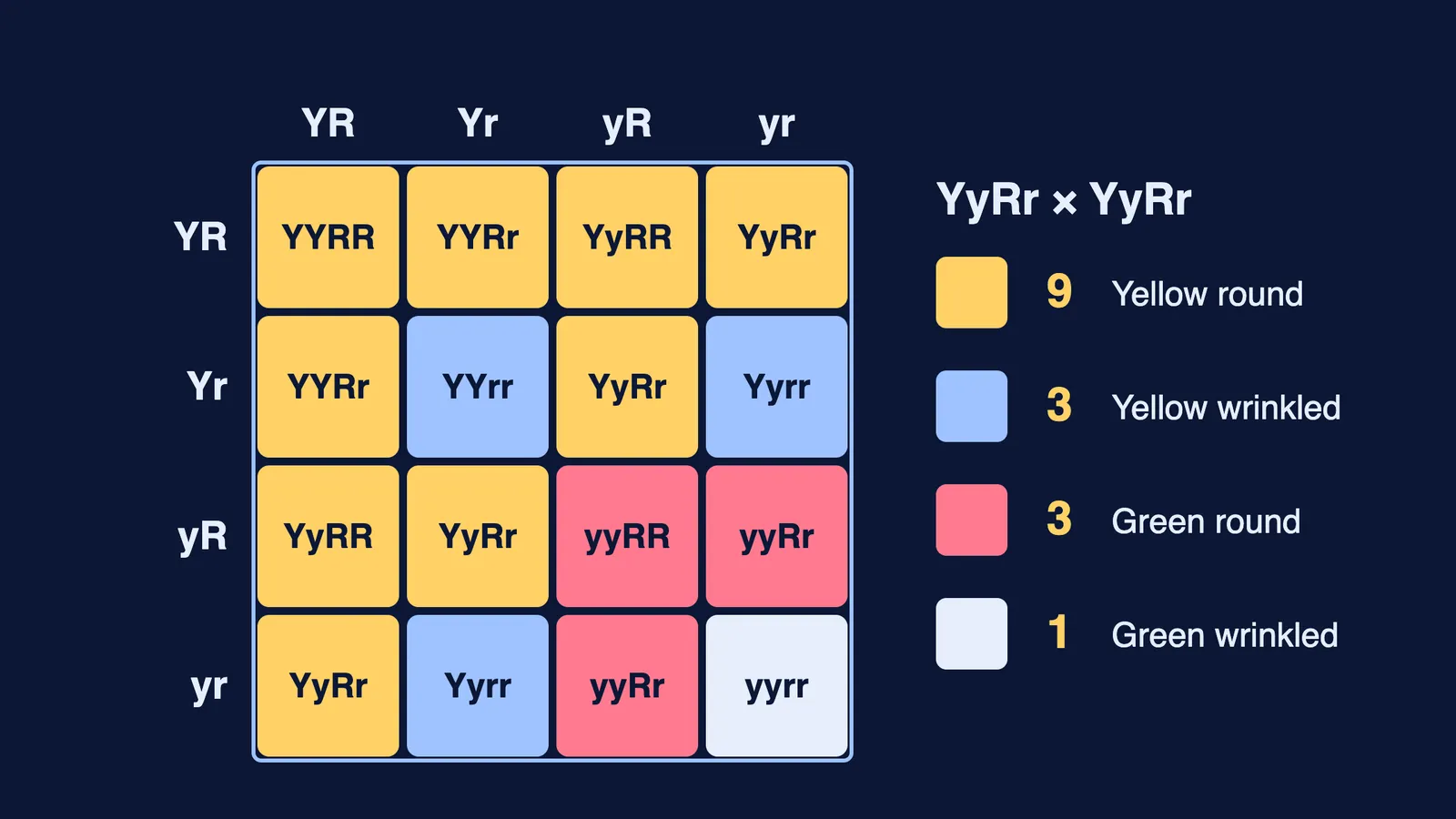
Dihybrid: YyRr × YyRr gives 9 yellow round : 3 yellow wrinkled : 3 green round : 1 green wrinkled, as in the square above. Its test cross, YyRr × yyrr, gives 1 : 1 : 1 : 1.
Incomplete dominance: in snapdragon, Rr × Rr gives 1 red : 2 pink : 1 white. Here the phenotype ratio equals the genotype ratio.
Co-dominance and multiple alleles: a group A parent (Iᴬi) and a group B parent (Iᴮi) can have children of all four groups, AB, A, B and O, each with a chance of 1 in 4.
Sex-linked: a carrier mother (XᴴXʰ) and an unaffected father (XᴴY) have unaffected daughters, half of them carriers, and sons who are affected half the time.
How do linkage and sex determination change the answers?
Linkage breaks the 9:3:3:1 ratio because genes on the same chromosome tend to travel together. The NCERT chapter records that Morgan found only 1.3 per cent recombination between the white and yellow genes in Drosophila, but 37.2 per cent between white and miniature wing. The rule to carry into the exam: parental combinations outnumber recombinants, and recombination frequency is the share of recombinants. So a test cross of AB/ab × ab/ab with 10 per cent recombination gives 45 AB : 45 ab : 5 Ab : 5 aB per 100 offspring.
For sex determination, the trap is who decides. In the same chapter, humans and Drosophila are XY, so the sperm decides; grasshoppers are XO, with males carrying a single X, so again the sperm decides; birds are ZW in females and ZZ in males, so the egg decides; and honey bees are haplodiploid, with diploid females of 32 chromosomes and haploid drones of 16 that grow from unfertilised eggs.
What are the common traps?
Calling a 1:2:1 phenotype ratio a failure of Mendel's laws. The alleles still segregate; only dominance is incomplete. Our list of exceptions to Mendel's laws with their ratios covers six NCERT cases.
Assuming group A and group B parents cannot have a group O child. They can, if both carry i.
Forgetting that a son gets his X from his mother, so a father cannot pass an X-linked trait to his son.
In a pedigree, unaffected parents with an affected child means the trait is recessive. If that child is a daughter and her father is unaffected, it cannot be X-linked recessive, so it is autosomal recessive.
Mixing up which disorders are X-linked. If you revise from an AI-made table, check X-linked versus autosomal against NCERT.
How should you plan your practice?
Spread these steps over a fortnight:
Monohybrid, test cross and dihybrid squares. Then get 9:3:3:1 by multiplying (3:1) by (3:1), so you can skip the full square in the exam.
Incomplete dominance, blood groups, pleiotropy and polygenic traits.
Linkage, recombination frequency and sex determination.
Sex-linked crosses and pedigrees. Draw three family trees of your own and name the inheritance pattern in each.
Previous-year questions, timed. Our guide to using previous year questions for NEET shows how to log each mistake by type.
If most of your mistakes are a wrong method rather than a slip, the Fermi Problem Library has worked problems with a step-by-step solver that explains the reasoning rather than printing an answer.