On this page
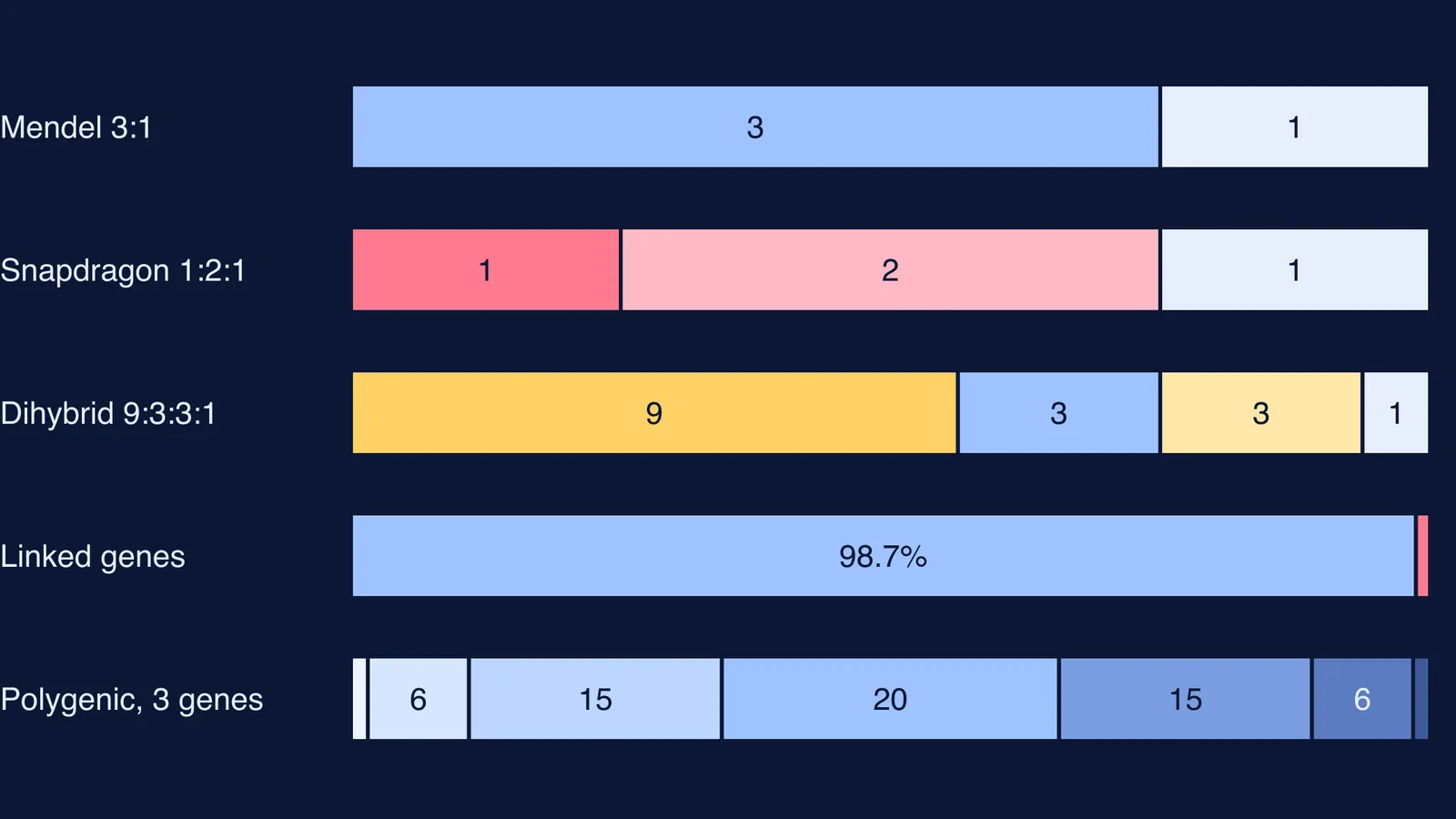
Mendel's pea crosses gave two clean ratios: 3:1 in the F2 of a monohybrid cross and 9:3:3:1 in a dihybrid cross, as the NCERT Class 12 Biology chapter Principles of Inheritance and Variation explains. The same chapter then describes cases where real organisms do not give those numbers.
What are the exceptions to Mendel's laws?
In every case alleles still separate into gametes, so segregation survives. Each case breaks one of Mendel's assumptions: that one allele fully dominates, that a gene has only two alleles, that genes assort independently, or that one gene controls one trait. The six examples below are the ones in the NCERT chapter.
Which exceptions change how dominance works?
Incomplete dominance: snapdragon, 1:2:1. In the snapdragon (Antirrhinum), a cross between true-breeding red (RR) and white (rr) plants gives pink F1 plants (Rr). Selfing the F1 gives 1 red : 2 pink : 1 white, so the phenotype ratio equals the genotype ratio. NCERT adds that in pea, Bb seeds are round like BB seeds but have intermediate-sized starch grains: dominance depends on the phenotype you measure.
Codominance: ABO blood groups, 1:2:1. In codominance the F1 resembles both parents. A person with alleles IA and IB makes both A and B sugars on their red blood cells and has blood group AB. Cross two AB parents (IAIB x IAIB) and you expect 1 A : 2 AB : 1 B.
Multiple alleles: ABO blood groups again, 1:1:1:1. The gene I has three alleles, IA, IB and i, and IA and IB are both dominant over i. Three alleles give six genotypes and four blood groups: A, B, AB and O. A cross of IAi x IBi gives all four groups in a 1:1:1:1 ratio.
Which exception breaks independent assortment?
Linkage: Morgan's fruit flies, no fixed ratio. Thomas Hunt Morgan crossed Drosophila for two genes on the X chromosome and found the F2 ratio deviated very significantly from 9:3:3:1, according to NCERT. Parental combinations far outnumbered new ones: genes on one chromosome tend to travel together. White eye and yellow body showed only 1.3 per cent recombination; white eye and miniature wing showed 37.2 per cent. So linkage breaks independent assortment, and the answer is a percentage, not a fixed ratio. Our guide to linkage and calculating recombination frequency has worked numbers.
What if many genes shape one trait, or one gene shapes many?
Polygenic inheritance: skin colour, 1:6:15:20:15:6:1. Height and skin colour vary along a range, not in two classes. NCERT's model uses three genes, A, B and C, whose dominant alleles each add to skin darkness, with environment also playing a part. If you cross two AaBbCc parents and sort the 64 boxes by the number of dominant alleles (0 to 6), you get seven classes in the ratio 1:6:15:20:15:6:1.
Pleiotropy: phenylketonuria, ratio unchanged. Here one gene affects several traits. In phenylketonuria (PKU), a mutation in the gene for the enzyme phenylalanine hydroxylase harms brain development and also reduces hair and skin pigmentation. NCERT lists PKU as autosomal recessive, so two carrier parents still give 3 unaffected : 1 affected. For both cases, see polygenic inheritance and pleiotropy for NEET genetics.
How can you tell which exception a question is about?
When a question hands you an odd result, ask in order:
Does the F1 look in between the two parents? Incomplete dominance, F2 1:2:1.
Does the F1 show both parental traits at once? Codominance, F2 1:2:1.
Are more than two forms of one gene named, like IA, IB and i? Multiple alleles.
Is a dihybrid result far from 9:3:3:1, with too many parental types? Linkage; find the recombination frequency.
Is the trait a continuous range, like height? Polygenic.
Does one gene cause several unrelated effects? Pleiotropy; the ratio stays Mendelian.
For more crosses on the first three cases, read incomplete dominance, codominance and multiple alleles, worked out.
How do you solve an exam question on these?
Worked example: a woman with blood group A, whose father was group O, marries a man with blood group B, whose mother was group O. Which blood groups can their children have?
Her father was ii, so she must carry i: she is IAi.
His mother was ii, so he is IBi.
Her gametes are IA or i; his are IB or i.
The four boxes are IAIB (AB), IAi (A), IBi (B) and ii (O).
Answer: all four groups, each with a chance of 1 in 4.
That one question uses three ideas from the list: multiple alleles, codominance in the AB child, and full dominance of IA and IB over i. Write the parents' genotypes before drawing any square.
If you keep getting the method wrong, the Fermi Problem Library has worked problems with a step-by-step solver that explains the reasoning rather than printing an answer. If the gap is the idea itself, the Fermi Concept Library gives every concept in biology its own lesson and its place in the map.
Next step: cover the ratios above and say each example with its ratio from memory.