On this page
Ask a chatbot for a table of Mendelian disorders and you get one in seconds. The risk is one wrong word in the inheritance column, such as sex-linked for autosomal, which costs marks in boards or NEET-UG. Treat the AI table as a first draft and check every row against the textbook.
First, a note on chapter numbers. In the current NCERT Class 12 Biology chapter, Principles of Inheritance and Variation (Reprint 2026-27), this topic is Chapter 4, and Chapter 5 is Molecular Basis of Inheritance. If your guide or the AI says "Chapter 5", check the chapter title, not the number.
Which Mendelian disorders are X-linked and which are autosomal?
NCERT defines Mendelian disorders as those "mainly determined by alteration or mutation in the single gene" (NCERT Class 12 Biology, section 4.8.2). Here is what the chapter says about each one, on pages 73 to 75 of the current reprint:
Colour blindness: sex-linked recessive. A defect in the red or green cone, caused by genes on the X chromosome.
Haemophilia: sex-linked recessive. One protein in the blood-clotting cascade is affected.
Sickle-cell anaemia: autosome-linked recessive. Only HbSHbS individuals are affected; valine replaces glutamic acid at the sixth position of the beta globin chain.
Thalassemia: autosome-linked recessive. Too little alpha or beta globin chain is made.
Phenylketonuria: autosomal recessive. The enzyme that converts phenylalanine into tyrosine is missing.
Myotonic dystrophy: the chapter's Figure 4.14 uses it as its example of an autosomal dominant trait.
Cystic fibrosis: named in the list of common Mendelian disorders, but the chapter does not describe how it is inherited.
Down's, Turner's and Klinefelter's syndromes belong in the next section, 4.8.3, as chromosomal disorders. If the AI puts them in your Mendelian table, it has mixed two categories. Our explainer on sickle-cell anaemia, thalassemia and PKU goes deeper on the autosomal rows.
What should you ask the AI?
Before you open the chatbot, write the inheritance column yourself from memory. Then paste this prompt:
"Make a table of the Mendelian disorders in NCERT Class 12 Biology, Principles of Inheritance and Variation. Columns: disorder, autosomal or X-linked, dominant or recessive, what is affected, one key fact. Use only that chapter. If the chapter does not say something, write 'not in NCERT'."
The last line makes gaps visible instead of letting the AI fill them.
Where do AI tables muddle colour blindness, haemophilia and thalassemia?
These three rows hide the most detail, so check them line by line against the NCERT chapter.
In the colour blindness row, check that:
-Inheritance says sex-linked (X-linked) recessive.
Numbers match NCERT: about 8 per cent of males and about 0.4 per cent of females. If the AI quotes different figures, use the textbook's for exams.
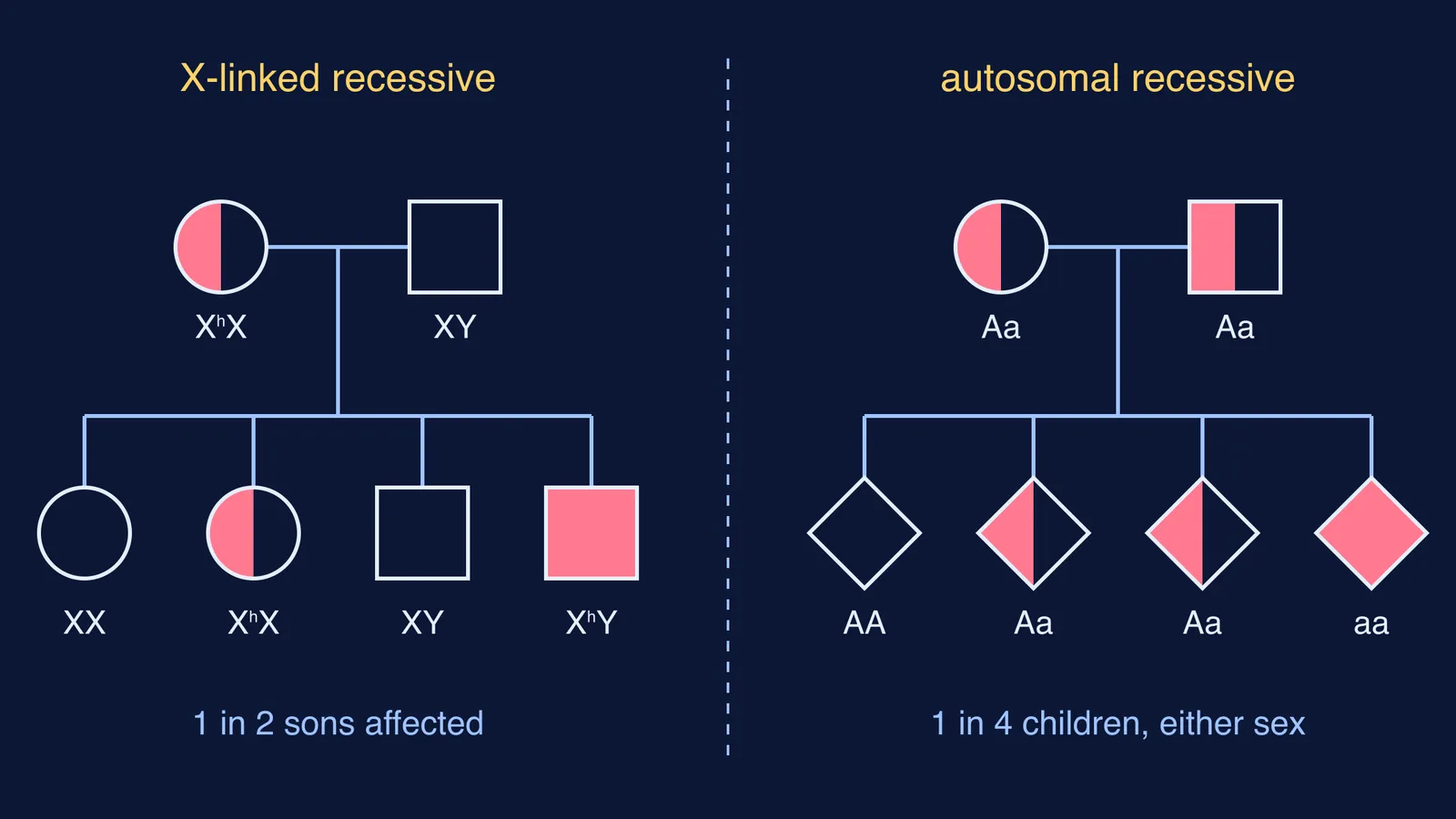
The son of a woman who carries the gene has a 50 per cent chance of being colour blind.
A daughter is not normally colour blind unless her mother is a carrier and her father is colour blind.
In the haemophilia row, check that:
-Inheritance says sex-linked recessive, never autosomal.
Watch for "only males get it". NCERT says a haemophilic female is extremely rare, because her mother must be at least a carrier and her father haemophilic. Rare is not impossible.
It passes from an unaffected carrier female to some of her sons. The chapter's example is the family pedigree of Queen Victoria, who was a carrier.
In the thalassemia row, check that:
-Inheritance says autosome-linked recessive, passed on when both parents are unaffected carriers. If the AI files it under X-linked, the row is wrong.
Alpha thalassemia is controlled by two closely linked genes, HBA1 and HBA2, on chromosome 16. Beta thalassemia is controlled by a single gene, HBB, on chromosome 11, not the other way round.
Thalassemia is a quantitative problem (too few globin molecules); sickle-cell anaemia is a qualitative one (a globin that works incorrectly), not the reverse.
To practise the crosses behind these rows, work through X-linked crosses for colour blindness and haemophilia. Then read the family trees using what pedigree squares, circles and lines mean.
How do you check the whole table in ten minutes?
Cover the AI's inheritance column and compare it with the one you wrote from memory.
Open the chapter and tick each row for four things: autosomal or X-linked, dominant or recessive, what is affected, and any number.
Mark anything the chapter does not say as "extra". It may be true, but it is not what your exam is set from.
Move any chromosomal disorders into a separate table.
For each row the AI got wrong, ask it to explain its mistake, then draw one cross yourself.
If one row keeps tripping you up, the gap is probably the concept, not the table. The Fermi Concept Library covers every concept in biology, each with its own lesson. If a cross keeps going wrong, the Fermi Problem Library has worked problems with a step-by-step solver that explains the reasoning rather than just printing an answer.
Build the table tonight, check the three tricky rows, and keep the corrected version as your revision sheet.