

On this page
Ask a class what “equilibrium” means and someone will say “equal amounts on both sides”. It is a natural reading, and it is wrong. Science educators have recorded it for decades: a Royal Society of Chemistry review of students' ideas by Vanessa Kind lists students who think reactant and product concentrations are equal at equilibrium, citing work including Hackling and Garnett (1985).
What does equilibrium actually mean?
Chemical equilibrium is the state in which the forward and reverse reactions run at the same rate, so the concentrations of reactants and products stay constant (NCERT Class 11 Chemistry, Unit 6). Both reactions keep going. NCERT's evidence is ammonia synthesis repeated with deuterium: when two equilibrium mixtures were combined, deuterium spread into the ammonia, which could only happen if the forward and reverse reactions were still running.
So the equals sign belongs to the rates, not the amounts. A hall where as many people walk in as walk out each minute has a steady head count, whether it is a quarter full or packed.
Does equilibrium mean equal amounts of reactants and products?
No, and NCERT's own data show it. In its H₂ + I₂ ⇌ 2HI experiments at 731 K, one run started with only HI at 3.04 × 10⁻² mol L⁻¹ and settled at 0.345 × 10⁻² mol L⁻¹ each of H₂ and I₂, with 2.35 × 10⁻² mol L⁻¹ of HI (NCERT Unit 6, Table 6.2). HI ended up about seven times as concentrated as each reactant. Six runs with different starting mixtures all gave [HI]²/[H₂][I₂] between 46.4 and 47.6 (Table 6.3): different amounts, same K.
How does K decide the mix?
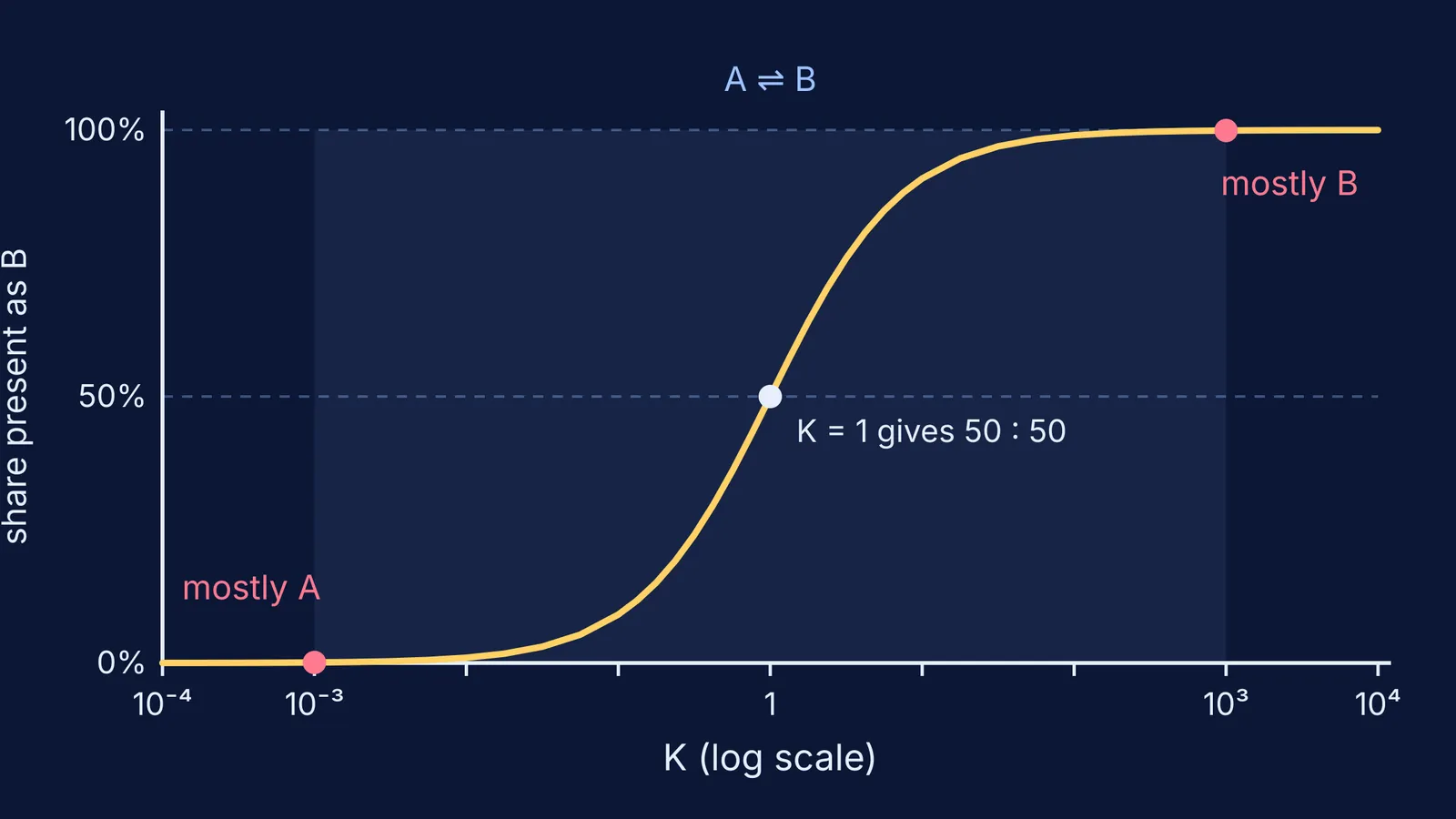
NCERT's rule of thumb is that products predominate when Kc is greater than 10³, reactants predominate when Kc is less than 10⁻³, and appreciable amounts of both are present in between (NCERT Unit 6, section 6.6.1). Its examples run from H₂(g) + Cl₂(g) ⇌ 2HCl(g) at 300 K, with Kc = 4.0 × 10³¹, to N₂(g) + O₂(g) ⇌ 2NO(g) at 298 K, with Kc = 4.8 × 10⁻³¹. Some sources draw the middle band more narrowly: a LibreTexts general chemistry page on interpreting equilibrium constants/15%3A_Chemical_Equilibrium/15.03%3A_Interpreting_and_Working_with_Equilibrium_Constants) uses roughly 0.01 to 100.
To see why, take the simplest reaction, A ⇌ B. Then K = [B]/[A], so the share present as B is K/(1 + K). That one line, plotted in the diagram above, gives:
K = 0.001: about 0.1% B, almost all A
K = 1: 50% B, the only case with equal amounts
K = 4: 80% B
K = 1000: about 99.9% B
One thing K does not tell you, NCERT notes, is how fast equilibrium is reached. For more on the size of K, read our explainer on what a large or small equilibrium constant means, and see the dynamic part in action in dynamic equilibrium shown with two beakers of water.
A worked example: CO and steam at 800 K
This is Problem 6.4 in NCERT's equilibrium unit. For CO(g) + H₂O(g) ⇌ CO₂(g) + H₂(g), Kc = 4.24 at 800 K. Start with 0.10 M each of CO and H₂O.
Let x mol L⁻¹ of CO₂ and of H₂ form. At equilibrium, CO = H₂O = 0.10 − x and CO₂ = H₂ = x.
Write K: x² / (0.10 − x)² = 4.24.
Both sides are perfect squares, so take the square root: x / (0.10 − x) = 2.06, which gives x ≈ 0.067.
At equilibrium, CO₂ = H₂ = 0.067 M and CO = H₂O = 0.033 M.
Products end up at about twice the reactants. A K of about 4 gave a two-to-one split, not one-to-one. For more practice setting up these tables, try our ICE tables walk-through for equilibrium constant problems. If step 3 is where you lose the thread, the Fermi Problem Library has worked problems with a step-by-step solver that explains the reasoning rather than printing an answer.
How do you avoid the “equal amounts” trap in exams?
Run this check whenever a question says “at equilibrium”, using NCERT's thresholds:
Underline what is equal: the rates. Never write “concentrations are equal” unless the numbers prove it.
Read K. Above 10³, expect mostly products; below 10⁻³, mostly reactants; in between, solve for the mix.
Remember that pure HI or H₂ plus I₂ reach the same mixture if the H and I atom totals per volume match.
After solving, put your numbers back into K. If they do not reproduce it, recheck the algebra.
Watch for “constant” versus “equal” in assertion–reason and true/false questions; that is where this mistake costs marks.
If dynamic equilibrium, K and Q still feel like three separate topics, the Fermi Concept Library gives every chemistry concept its own lesson and its place in the map, so you can see how they connect.


