On this page
Laws of Motion is where NEET physics moves from describing motion to explaining it, and the free-body diagram you learn here returns in almost every later mechanics unit.
What does the NEET syllabus include in Laws of Motion?
The NMC's updated syllabus for NEET (UG)-2026, dated 22 December 2025, lists Unit 3: Laws of Motion as: force and inertia, Newton's three laws, momentum and impulses; conservation of linear momentum and its applications; equilibrium of concurrent forces; static and kinetic friction, laws of friction, rolling friction; and uniform circular motion, with centripetal force for a vehicle on a level circular road and on a banked road. It is the latest version we could find on nmc.org.in, so watch the site for a 2027 update.
In the current textbook this is NCERT Class 11 Physics Part I, Chapter 4, marked Reprint 2026-27. Impulse sits in section 4.5, momentum conservation in 4.7, equilibrium in 4.8, friction (including rolling friction) in 4.9, and level and banked roads in 4.10. Nothing on the NMC list has been cut. For board-exam framing, see our Laws of Motion Class 11 guide to FBDs, friction and banked roads.
How are Laws of Motion questions asked in NEET?
In NEET-UG 2026, Physics had 45 of the 180 compulsory single-correct MCQs, and the whole paper ran for 180 minutes, according to the NTA Information Bulletin for NEET (UG)-2026. A correct answer earned +4, a wrong one -1 and a blank 0. That is about a minute per question with no numerical-value section, the main difference from our Laws of Motion guide for JEE Main. NEET 2027 has not been notified yet, so treat this as the 2026 pattern.
Expect three styles:
Short numericals: one diagram, one equation, a number.
NCERT statements, such as static friction taking any value up to μs N, or a car on a banked road staying parked only if tan θ ≤ μs.
Assertion-reason: a true fact with a wrong reason, such as action and reaction "cancelling" (they act on different bodies).
Three worked examples in NEET style
All use g = 10 m/s².
Example 1, does the block even move? A 4 kg block rests on a floor with μs = 0.5 and μk = 0.4. Find the friction for pushes of 15 N and 30 N.
Limiting static friction = μs mg = 0.5 × 4 × 10 = 20 N.
15 N is below 20 N, so the block stays still and friction is 15 N, not 20 N.
30 N exceeds 20 N, so it slides: kinetic friction = μk mg = 16 N, and a = (30 - 16)/4 = 3.5 m/s².
Example 2, impulse from a bat: a 0.15 kg ball meets a bat at 20 m/s and leaves along the same line at 30 m/s. Contact lasts 0.01 s.
Outgoing is positive, so u = -20 m/s.
Impulse = m(v - u) = 0.15 × (30 + 20) = 7.5 N s.
Average force = 7.5/0.01 = 750 N. An option of 1.5 N s is the sign trap.
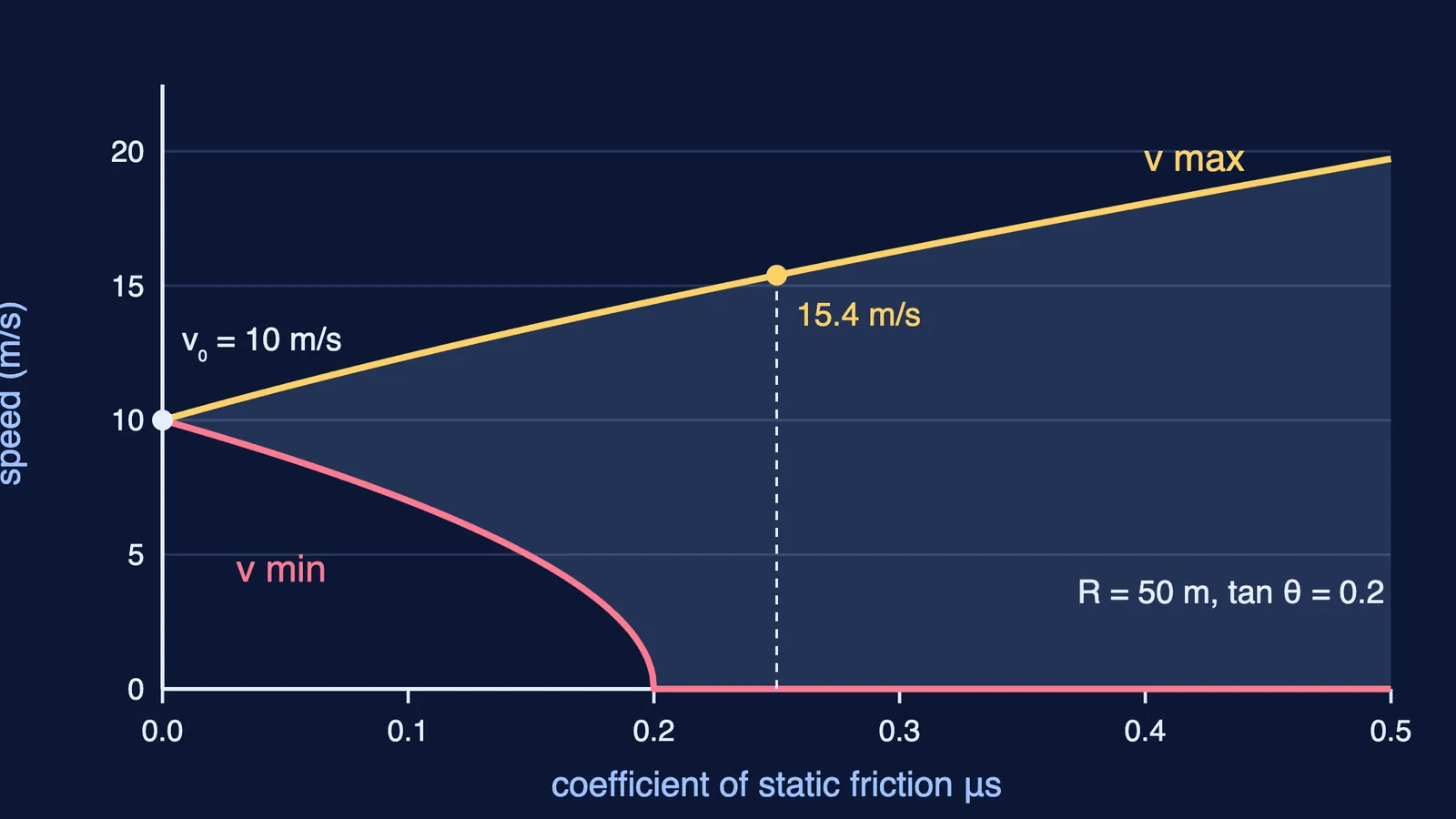
Example 3, speed limits on a banked curve: a curve of radius 50 m is banked so that tan θ = 0.2, and μs = 0.25.
Optimum speed: v₀ = √(Rg tan θ) = √(50 × 10 × 0.2) = 10 m/s, or 36 km/h.
Maximum speed: v max = √[Rg (μs + tan θ)/(1 - μs tan θ)] = √(500 × 0.45/0.95) ≈ 15.4 m/s, about 55 km/h.
Checks: μs = 0 gives v₀ back, and the bracket is dimensionless. Since μs ≥ tan θ, a parked car will not slide.
Which traps cost marks in Laws of Motion?
Writing μs N as the friction when the body is not about to slip.
Dropping the sign change in impulse when a ball bounces back.
Taking normal reaction as mg in a lift, on an incline or on a banked road.
Drawing centripetal force as an extra arrow; it is the net inward force.
Stuck on a step? The Fermi Problem Library has worked problems with a step-by-step solver that explains the reasoning rather than printing an answer.
How should you practise Laws of Motion for NEET?
Days 1-2: read Chapter 4 closely, marking statements that could become options; our note on how to study NCERT for NEET explains the method.
Days 3-4: draw a free-body diagram for every solved NCERT example before reading its solution.
Days 5-6: timed sets of 15 MCQs in 15 minutes; log each error by type.
Day 7: redo logged errors, then try these.
Practice questions:
Blocks of 1.5 kg and 4.5 kg touch on a smooth floor; 24 N pushes the 1.5 kg block. Find the contact force.
A 50 kg student stands on a scale in a lift accelerating upward at 1.5 m/s². What does the scale read?
What is the maximum safe speed on a level curve of radius 20 m with μs = 0.5?
Answers: 1. 18 N. 2. 575 N. 3. 10 m/s.