On this page
Drop a magnifying glass into a bucket of water and it magnifies far less. The glass hasn't changed. What changed is how much light bends at its surfaces, and the lens maker's formula tells you exactly how much.
What does the lens maker's formula say about the surrounding medium?
OpenStax University Physics writes the lens maker's equation as 1/f = (n2/n1 − 1)(1/R1 − 1/R2), where n2 is the refractive index of the lens and n1 is the index of the medium around it (OpenStax University Physics, Thin Lenses/University_Physics_III_-_Optics_and_Modern_Physics_(OpenStax)/02:_Geometric_Optics_and_Image_Formation/2.05:_Thin_Lenses)). The same chapter states that the focal length of a thin lens depends only on its radii of curvature, its refractive index and the refractive index of the surrounding medium. In air, n1 = 1.0, so the formula shortens to the familiar 1/f = (n − 1)(1/R1 − 1/R2).
That shortcut is where most mistakes start. The (n − 1) you memorised is really (n_lens/n_medium − 1). Light bends at a surface because the two media on either side have different indices. If the liquid's index is close to the glass's, the lens barely bends light at all.
Moving the lens doesn't change its radii, so divide the formula in the liquid by the formula in air. The radii cancel:
f_medium / f_air = (n_g − 1) / (n_g/n_m − 1)
Here n_g is the glass and n_m is the medium. If you need a refresher on which radius is positive, see our guide to assigning signs in the lens maker's formula.
What happens to the focal length of a convex lens in water?
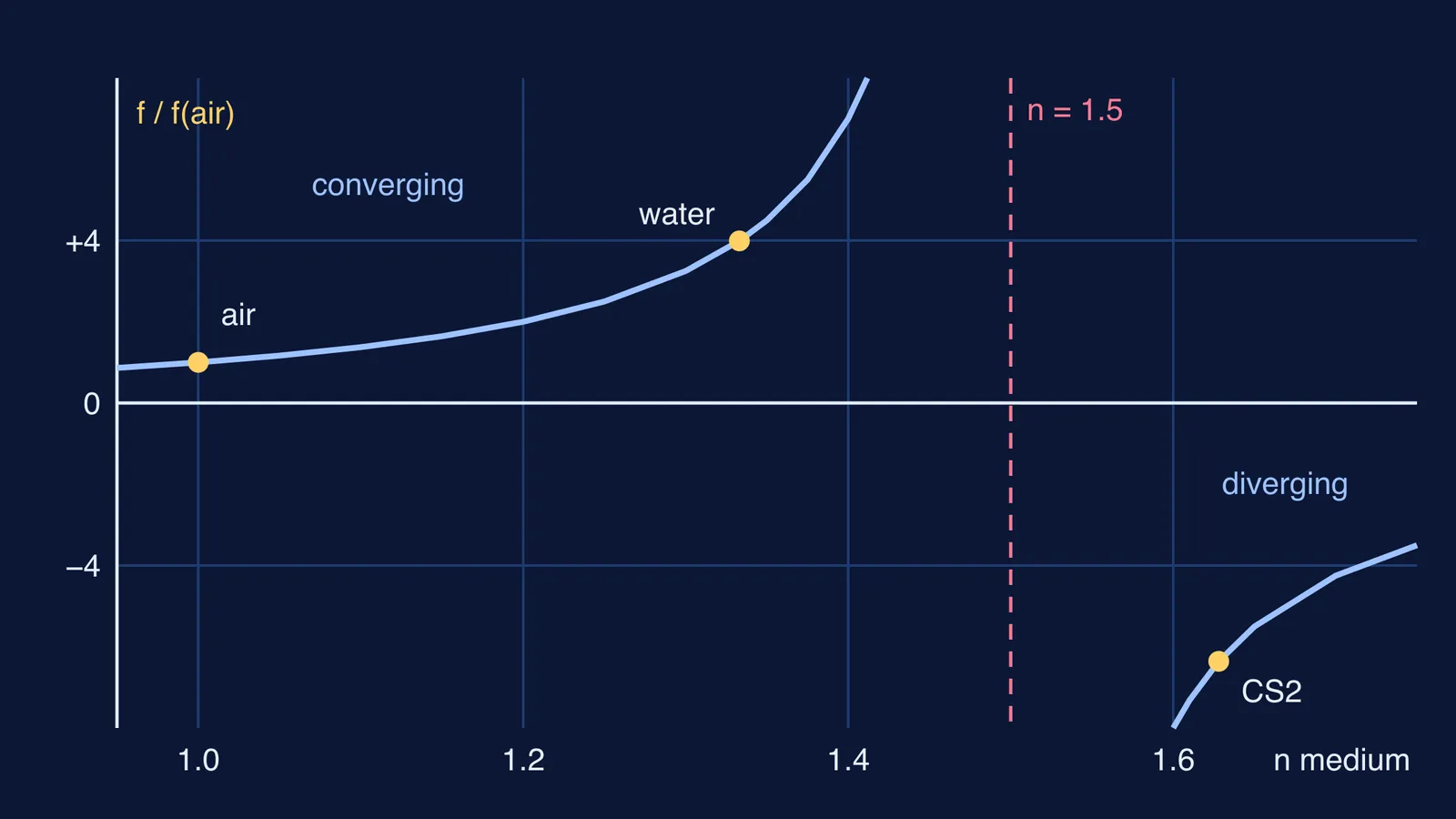
Take an equiconvex glass lens with n_g = 1.5 and f = 20 cm in air, so R1 = +20 cm and R2 = −20 cm. The liquid indices below come from the OpenStax table of refractive indices, for liquids at 20 °C (OpenStax College Physics 2e, Table 25.1). Each step uses f_m = 20 × 0.5 / (1.5/n_m − 1) cm.
Air, n = 1.000293 (take 1): the ratio is 1, so f = 20 cm and the power is +5 D.
Water, n = 1.333: 1.5/1.333 ≈ 1.125, so f ≈ 10/0.125 ≈ 80 cm. The lens still converges but is four times weaker, about +1.25 D.
Ethanol, n = 1.361: 1.5/1.361 ≈ 1.102, so f ≈ 98 cm.
Glycerine, n = 1.473: 1.5/1.473 ≈ 1.018, so f ≈ 5.5 m. Optically, the lens is now close to a flat sheet of glass.
Carbon disulfide, n = 1.628: 1.5/1.628 ≈ 0.921, so the bracket turns negative and f ≈ −127 cm. The same convex lens now diverges light.
The sign flip catches people out, so we have a separate post on when a convex lens acts like a concave lens. The same logic works in reverse: an air bubble has a lower index than the water around it, which is why an air bubble in water acts as a diverging lens.
Why is the n = 1.5 shortcut a trap?
"f becomes 4f in water" is not a law. It only works out exactly for n = 1.5 and n_water = 4/3. Crown glass in the same OpenStax table has n = 1.52. In water (1.333), that gives 0.52/(1.52/1.333 − 1) ≈ 3.7, not 4. If a question gives a different n, it expects you to work the ratio out, not recall 4.
Plugging 1.5 into (n − 1) inside water. This gives back the air answer, 20 cm, which is a tempting wrong option. Write n_g/n_m first, every time.
Near-matched liquids. Benzene is listed at 1.501, almost exactly 1.5. The formula gives f ≈ −150 m, but the third decimal of the glass's index decides the sign. The real lesson is that the lens has almost no effect on light.
How do you solve any lens-in-a-liquid question?
Get f in air, or the two radii with their signs.
Write the relative index n_rel = n_lens/n_medium.
Compute f_m = f_air × (n_g − 1)/(n_rel − 1), or put n_rel straight into 1/f = (n_rel − 1)(1/R1 − 1/R2).
Read the sign (positive means converging, negative means diverging), then sanity-check. If n_m is between 1 and n_g, the answer must be longer than f_air and keep the same sign.
This method only works when the same liquid touches both faces of the lens. If the lens forms the bottom of a water tank, with air on one side and water on the other, use refraction at each surface instead of this ratio.
If you keep getting the air answer back, the Fermi Problem Library has worked problems with a step-by-step solver that explains the reasoning rather than printing an answer, so you can see exactly where the relative index belongs. For the idea underneath, refraction at a boundary between two media, the Fermi Concept Library gives each concept in physics its own lesson.
Next time a question moves a lens into a liquid, write n_g/n_m before anything else.